
UCI BioSci D170, Williams Nervous Tissue
Reading: Chapter 12
What are the functions of the nervous system? Use the
terms sensory input, integration, and motor output in your
description.
1. It uses sensory receptors to receive stimulus and
transfer it into sensory input.
2. Integration. It interprets the sensory input and
makes decisions about what to do in that moment.
3. Motor output. It dictates a response by activating
the effector organs.
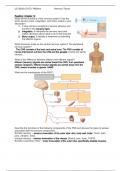
What structures make up the central nervous system? The peripheral
nervous system?
The CNS consists of the brain and spinal cord. The PNS consists of
nerves that branch out from the CNS and the ganglia (cranial and spinal
nerves).
What is the difference between afferent and efferent signals?
Afferent (sensory) signals are carried toward the CNS, from peripheral
sensory receptors. Efferent (motor) signals are carried away from the
CNS, toward muscles or glands. SAME
What are the subdivisions of the PNS?.
Describe the functions of the following components of the PNS and discuss the types of senses
associated with the sensory components.
Somatic sensory -- sensory innervation of the outer tube: skin, body wall, limbs. Touch, pain,
pres, vibration, temp.
Visceral sensory – sensory innervation of the viscera. Stretch, pain, temp, TASTE.
Somatic (voluntary) motor – motor innervation of the outer tube, specifically skeletal muscles.
, Visceral motor (autonomic) – involuntary motor innervation of the inner tube, specifically the
smooth and cardiac muscle, and glands.
What are the two types of cells that make up the nervous system?
Neurons and neuroglia, supporting cells that wrap the neurons, are the main NS cells.
What are the functional characteristics of neurons?
Neurons conduct electrical signals b/w body parts, have extreme longevity, do NOT divide, and
have a high metabolic rate.
Describe the characteristics of neurons, noting the following structures.
Cell body – consists of a single nucleus surrounded by cytoplasm.
Chromatophilic substance – large cluster of rough ER and free ribosomes. Renews cell
membranes and protein components of the cytosol.
Neurofibrils – bundles of intermediate filaments that run in b/w the chromatophilic substance.
Resist against tension.
Ganglia (ganglion) – clusters of cell bodies that lie along the PNS.
Neural process – armlike processes that extend from the neuron’s cell body.
Dendrite – neuron processes that contain organelles and chromatophilic substance. Receptive
sites that receive signals from other neurons, towards the cell bodies.
Axon – neuron process that arises from the axon hillock of the cell body. Chromatophilic
substance and other organelles are absent, yet neurofilaments are present to provide structure
and transport. Impulse generators and conductors that transmit impulses away from their cell
body.
Axon hillock – cone-shaped region that attaches the axon to the cell body.
Nerve fiber – a relatively long axon.
Axon collateral – branches that extend from the axon at more or less right angles.
Terminal bouton (axon terminal) – the end of each axonal branch. FUN FACT: contain
mitochondria to help secrete neurotransmitters.
Synapse – site at which neurons communicate. Determine the direction of informational flow
thru the nervous system (signals are unidirectional).
Presynaptic neuron – neurons that conduct signals toward the synapse.
Reading: Chapter 12
What are the functions of the nervous system? Use the
terms sensory input, integration, and motor output in your
description.
1. It uses sensory receptors to receive stimulus and
transfer it into sensory input.
2. Integration. It interprets the sensory input and
makes decisions about what to do in that moment.
3. Motor output. It dictates a response by activating
the effector organs.
What structures make up the central nervous system? The peripheral
nervous system?
The CNS consists of the brain and spinal cord. The PNS consists of
nerves that branch out from the CNS and the ganglia (cranial and spinal
nerves).
What is the difference between afferent and efferent signals?
Afferent (sensory) signals are carried toward the CNS, from peripheral
sensory receptors. Efferent (motor) signals are carried away from the
CNS, toward muscles or glands. SAME
What are the subdivisions of the PNS?.
Describe the functions of the following components of the PNS and discuss the types of senses
associated with the sensory components.
Somatic sensory -- sensory innervation of the outer tube: skin, body wall, limbs. Touch, pain,
pres, vibration, temp.
Visceral sensory – sensory innervation of the viscera. Stretch, pain, temp, TASTE.
Somatic (voluntary) motor – motor innervation of the outer tube, specifically skeletal muscles.
, Visceral motor (autonomic) – involuntary motor innervation of the inner tube, specifically the
smooth and cardiac muscle, and glands.
What are the two types of cells that make up the nervous system?
Neurons and neuroglia, supporting cells that wrap the neurons, are the main NS cells.
What are the functional characteristics of neurons?
Neurons conduct electrical signals b/w body parts, have extreme longevity, do NOT divide, and
have a high metabolic rate.
Describe the characteristics of neurons, noting the following structures.
Cell body – consists of a single nucleus surrounded by cytoplasm.
Chromatophilic substance – large cluster of rough ER and free ribosomes. Renews cell
membranes and protein components of the cytosol.
Neurofibrils – bundles of intermediate filaments that run in b/w the chromatophilic substance.
Resist against tension.
Ganglia (ganglion) – clusters of cell bodies that lie along the PNS.
Neural process – armlike processes that extend from the neuron’s cell body.
Dendrite – neuron processes that contain organelles and chromatophilic substance. Receptive
sites that receive signals from other neurons, towards the cell bodies.
Axon – neuron process that arises from the axon hillock of the cell body. Chromatophilic
substance and other organelles are absent, yet neurofilaments are present to provide structure
and transport. Impulse generators and conductors that transmit impulses away from their cell
body.
Axon hillock – cone-shaped region that attaches the axon to the cell body.
Nerve fiber – a relatively long axon.
Axon collateral – branches that extend from the axon at more or less right angles.
Terminal bouton (axon terminal) – the end of each axonal branch. FUN FACT: contain
mitochondria to help secrete neurotransmitters.
Synapse – site at which neurons communicate. Determine the direction of informational flow
thru the nervous system (signals are unidirectional).
Presynaptic neuron – neurons that conduct signals toward the synapse.


