
D170 The Skull Williams
Read: Chapter 7
What are the four components of the human skeleton?
The skull, vertebral column, thoracic cage, and the limbs.
What are the differences between the axial and appendicular skeletons? What regions do they
consist of?
The axial skeleton supports the head, neck and trunk; also protects
the brain, spinal, and visceral organs. The appendicular skeleton
attaches to the axial skeleton and allows the body to carry out
various movements.
What are the functions of the cranial bones?
Enclose and protect the brain; provide attachment sites for head
and neck muscles.
Of the facial bones?
1) Form the framework of the face, 2) form the cavities for sense organs, 3) provide openings
for passage of air/food, 4) hold the teeth, and 5) anchor the muscles of the face.
How are the bones of the skull held together?
Skull (flat) bones are held together by sutures (interlocking immovable joints).
What are the major cavities of the skull? What do they hold?
Cranial cavity holds the brain, inner/middle ear cavities, nasal cavity holds the nose, and the
orbits hold the eyeballs.
What is a suture? Describe the orientation of and the bones that the following sutures connect:
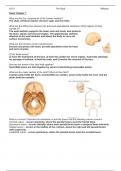
Coronal suture – occurs anteriorly, where the parietal bones meet the frontal bone.
Squamous suture – occurs laterally, where each parietal bone meets a temporal bone inferiorly.
Sagittal suture – occurs in the midline of the cranium, where the right and left parietal bones
meet superiorly.
Lambdoid suture – occurs posteriorly, where the parietal bones meet the occipital bone.
, Alycia Edquilang
4/10/20
Give a description of and the relative location of the following cranial bones and their landmarks. As
you are doing this, refer to the figures in the book to visualize the location of these structures and
their relationship to other structures. See Table 7.1 for a summary.
Read: Chapter 7
What are the four components of the human skeleton?
The skull, vertebral column, thoracic cage, and the limbs.
What are the differences between the axial and appendicular skeletons? What regions do they
consist of?
The axial skeleton supports the head, neck and trunk; also protects
the brain, spinal, and visceral organs. The appendicular skeleton
attaches to the axial skeleton and allows the body to carry out
various movements.
What are the functions of the cranial bones?
Enclose and protect the brain; provide attachment sites for head
and neck muscles.
Of the facial bones?
1) Form the framework of the face, 2) form the cavities for sense organs, 3) provide openings
for passage of air/food, 4) hold the teeth, and 5) anchor the muscles of the face.
How are the bones of the skull held together?
Skull (flat) bones are held together by sutures (interlocking immovable joints).
What are the major cavities of the skull? What do they hold?
Cranial cavity holds the brain, inner/middle ear cavities, nasal cavity holds the nose, and the
orbits hold the eyeballs.
What is a suture? Describe the orientation of and the bones that the following sutures connect:
Coronal suture – occurs anteriorly, where the parietal bones meet the frontal bone.
Squamous suture – occurs laterally, where each parietal bone meets a temporal bone inferiorly.
Sagittal suture – occurs in the midline of the cranium, where the right and left parietal bones
meet superiorly.
Lambdoid suture – occurs posteriorly, where the parietal bones meet the occipital bone.
, Alycia Edquilang
4/10/20
Give a description of and the relative location of the following cranial bones and their landmarks. As
you are doing this, refer to the figures in the book to visualize the location of these structures and
their relationship to other structures. See Table 7.1 for a summary.


