
CHem 104 final exam | Questions & Answers (100 %Score) Latest Updated 2024/2025
Comprehensive Questions A+ Graded Answers | With Expert Solutions
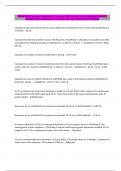
Calculate the percent yield of only 57.2 g of CaSiO3 were collected from the reaction that yielded 69.7 g
of CaSiO3. - 82.1%
Calculate the theoretical yield of casio3, if 58.45 grams of Ca3(Po4)2 is allowed to react with excess SiO2
according to the following reaction.2 Ca3(Po4)2 (s) + 6 SiO2 (s) + 10 C(s) ---> 6 CaSiO3 (s) +10 CO + P4(s) -
65.67 g
Calculate the number of moles of Ca3(Po4)2 in 58.45 g. - 0.19 moles
Calculate the number of moles of CaSiO3 product from the reaction below if 61.85 g of Ca3(PO4)2 were
used to start the reaction.2 Ca3(PO4)2 (s) + 6 SiO2 (s) + 10 C (s) --> 6CaSiO3 (s) + 10 CO + P4 (s) - 0.598
moles
Calculate the mass of CaSiO3 if 60.64 g of Ca3(PO4)2 were used in the reaction below:2 Ca3(PO4)2 (s) +
6 SiO2 (s)+ 10 C(s)---> 6CaSiO3 (s) + 10 CO + P4 (s) - 68.13 g
A 0.21 g sample of an antacid was dissolved in 20.00 mL of 0.131 M HCl. After reaction, the solution was
titrated with 0.121 M NaOh requiring 9.43 mL. How many moles of HCl were neutralized per gram of
antacid tablet? - 0.00148 moles
How many mL of .1100 M HCl are required to neutralize 32.50 mL of .1010 M NaOH? - 29.84 mL
How many mL of .1100 M HCl are required to neutralize 43.75 mL of .0951 Ba(OH)2? - 75.6 mL
A solution made from .875 g of a substance dissolved in 25 g of camphor froze at 170.80 deg C. The
freezing point of pure camphor is 178.40 deg C and the molal freezing point depression constant, Kf, for
camphor is 37.7 C/m. Calculate the molar mass of the solute. - 174 g/mol
12 g of a nonelectrolyte were dissolved in 120 g of water. The solution froze at -0.94 deg C. Calculate the
molar mass of the substance. Kf for water is 1.86 C/m. - 198 g/mol
Comprehensive Questions A+ Graded Answers | With Expert Solutions
Calculate the percent yield of only 57.2 g of CaSiO3 were collected from the reaction that yielded 69.7 g
of CaSiO3. - 82.1%
Calculate the theoretical yield of casio3, if 58.45 grams of Ca3(Po4)2 is allowed to react with excess SiO2
according to the following reaction.2 Ca3(Po4)2 (s) + 6 SiO2 (s) + 10 C(s) ---> 6 CaSiO3 (s) +10 CO + P4(s) -
65.67 g
Calculate the number of moles of Ca3(Po4)2 in 58.45 g. - 0.19 moles
Calculate the number of moles of CaSiO3 product from the reaction below if 61.85 g of Ca3(PO4)2 were
used to start the reaction.2 Ca3(PO4)2 (s) + 6 SiO2 (s) + 10 C (s) --> 6CaSiO3 (s) + 10 CO + P4 (s) - 0.598
moles
Calculate the mass of CaSiO3 if 60.64 g of Ca3(PO4)2 were used in the reaction below:2 Ca3(PO4)2 (s) +
6 SiO2 (s)+ 10 C(s)---> 6CaSiO3 (s) + 10 CO + P4 (s) - 68.13 g
A 0.21 g sample of an antacid was dissolved in 20.00 mL of 0.131 M HCl. After reaction, the solution was
titrated with 0.121 M NaOh requiring 9.43 mL. How many moles of HCl were neutralized per gram of
antacid tablet? - 0.00148 moles
How many mL of .1100 M HCl are required to neutralize 32.50 mL of .1010 M NaOH? - 29.84 mL
How many mL of .1100 M HCl are required to neutralize 43.75 mL of .0951 Ba(OH)2? - 75.6 mL
A solution made from .875 g of a substance dissolved in 25 g of camphor froze at 170.80 deg C. The
freezing point of pure camphor is 178.40 deg C and the molal freezing point depression constant, Kf, for
camphor is 37.7 C/m. Calculate the molar mass of the solute. - 174 g/mol
12 g of a nonelectrolyte were dissolved in 120 g of water. The solution froze at -0.94 deg C. Calculate the
molar mass of the substance. Kf for water is 1.86 C/m. - 198 g/mol


