
Regulation of Bacterial Processes (skip Lac Operon
section) (Ch. 10, Lec. 14)
Saturday, November 7, 2020 6:51 PM ACTIVE LEARNING (11/9/2020)
• Cells have to be ready to give environmental responses (osmotic stress, temp change).
• Transcriptional, translational, post-translational control.
• Extracellular signal is relayed intracellularly once sensor kinase is phosphorylated (uses
• Gene regulation occurs at multiple levels: alteration of DNA sequence, control of transcription, mRNA ATP). Phosphorylation --> turns signal on.
stability, translational control, postranslational control. ○ Dephosphorylation is just as important --> turns signal off.
• Biofilms: microbes found in plaque on our teeth. Bacteria attached to surfaces exposed to
water.
○ Slow growing, but grow together to survive harsh environments. Stick together and
communicate.
•
• 16S rRNA: widely-used markers. Sequencing these will give us bacterial genomes.
○ Build primers at bacterial conserved regions. -> can build amplicons from there.
○ Need ribosomes -> cannot sequence viral genome.
• Taxonomic ranks: microbes are placed in a hierarchy where each level share a common
set of features. Domain -> phylum -> class -> order -> …
○ Genus name, species epithet. Ex. E. coli
• Control at the DNA level is the most drastic and least reversible. While at the protein level it is the most ○ The type strain can tell whether the bug is benign or ever growing.
rapid and most reversible. • Species: Collection of strains (fine-level differences b/w microbes in the same species).
10.1: Transcription Repressors and Activators • Phylogenetic trees:
• Key aspects of transcription control: (1) DNA-binding regulatory proteins that control initiation of ○ Rooted: all species has a common ancestor. Organized w/ an outgroup.
transcription at gene promoters, (2) environmental changes within/outside the cell that affect regulatory ○ Unrooted: species are not particularly related.
protein activity. ○ Distance of lines are approximates of time.
• Regulatory proteins: control initiation of bacterial transcription. Bind DNA at/near gene promoters, • The # of sequence differences b/w 2 species should be proportional to the time of
stimulate/prevent binding of RNA polymerase to promoter, contain a DNA-binding domain that interacts divergence b/w them. TRUE-- mutations accumulate over time.
w/ major groove of DNA.
○ Bind at sites that usually exhibit a sequence symmetry that involves an inverted repeat.
(palindromes?)
○ Each subunit of the regulatory protein dimer binds to half the symmetrical DNA sequence.
○ *Sequence of DNA affects the binding affinity of the regulatory proteins.
• Cells use different mechanisms to sense and respond to changes in intercellular and extracellular
conditions.
• Once ligands are bound to regulatory proteins, ligands alter the DNA-binding affinities of the regulatory
proteins, and thus their ability to stimulate/prevent transcription initiation at gene promoters.
• (plasma) Membrane-embedded signaling molecules detect extracellular conditions and inform the cell.
○ Extracellular conditions: osmotic stress, temp, sugars, amino acids, chemicals.
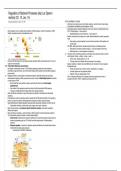
• Most microbes possess a 2-component signal transduction systems; each system regulates a
different set of genes.
• Many microbes are unicellular-- each cell needs an efficient system to detect extracellular conditions.
• The 2-component systems are based on protein phosphorylation:
○ Sensor kinase: membrane-bound enzyme; binding (to) an environmental signal causes kinase to
transfer a phosphate group from ATP to itself (or another target protein). Phosphorylated =
activated.
○ Response regulator: a cytosolic (in cytoplasm) protein stimulated by an activated sensor kinase;
binds to DNA and alters gene expression.
• Controlled by COVALENT modifications.
○
section) (Ch. 10, Lec. 14)
Saturday, November 7, 2020 6:51 PM ACTIVE LEARNING (11/9/2020)
• Cells have to be ready to give environmental responses (osmotic stress, temp change).
• Transcriptional, translational, post-translational control.
• Extracellular signal is relayed intracellularly once sensor kinase is phosphorylated (uses
• Gene regulation occurs at multiple levels: alteration of DNA sequence, control of transcription, mRNA ATP). Phosphorylation --> turns signal on.
stability, translational control, postranslational control. ○ Dephosphorylation is just as important --> turns signal off.
• Biofilms: microbes found in plaque on our teeth. Bacteria attached to surfaces exposed to
water.
○ Slow growing, but grow together to survive harsh environments. Stick together and
communicate.
•
• 16S rRNA: widely-used markers. Sequencing these will give us bacterial genomes.
○ Build primers at bacterial conserved regions. -> can build amplicons from there.
○ Need ribosomes -> cannot sequence viral genome.
• Taxonomic ranks: microbes are placed in a hierarchy where each level share a common
set of features. Domain -> phylum -> class -> order -> …
○ Genus name, species epithet. Ex. E. coli
• Control at the DNA level is the most drastic and least reversible. While at the protein level it is the most ○ The type strain can tell whether the bug is benign or ever growing.
rapid and most reversible. • Species: Collection of strains (fine-level differences b/w microbes in the same species).
10.1: Transcription Repressors and Activators • Phylogenetic trees:
• Key aspects of transcription control: (1) DNA-binding regulatory proteins that control initiation of ○ Rooted: all species has a common ancestor. Organized w/ an outgroup.
transcription at gene promoters, (2) environmental changes within/outside the cell that affect regulatory ○ Unrooted: species are not particularly related.
protein activity. ○ Distance of lines are approximates of time.
• Regulatory proteins: control initiation of bacterial transcription. Bind DNA at/near gene promoters, • The # of sequence differences b/w 2 species should be proportional to the time of
stimulate/prevent binding of RNA polymerase to promoter, contain a DNA-binding domain that interacts divergence b/w them. TRUE-- mutations accumulate over time.
w/ major groove of DNA.
○ Bind at sites that usually exhibit a sequence symmetry that involves an inverted repeat.
(palindromes?)
○ Each subunit of the regulatory protein dimer binds to half the symmetrical DNA sequence.
○ *Sequence of DNA affects the binding affinity of the regulatory proteins.
• Cells use different mechanisms to sense and respond to changes in intercellular and extracellular
conditions.
• Once ligands are bound to regulatory proteins, ligands alter the DNA-binding affinities of the regulatory
proteins, and thus their ability to stimulate/prevent transcription initiation at gene promoters.
• (plasma) Membrane-embedded signaling molecules detect extracellular conditions and inform the cell.
○ Extracellular conditions: osmotic stress, temp, sugars, amino acids, chemicals.
• Most microbes possess a 2-component signal transduction systems; each system regulates a
different set of genes.
• Many microbes are unicellular-- each cell needs an efficient system to detect extracellular conditions.
• The 2-component systems are based on protein phosphorylation:
○ Sensor kinase: membrane-bound enzyme; binding (to) an environmental signal causes kinase to
transfer a phosphate group from ATP to itself (or another target protein). Phosphorylated =
activated.
○ Response regulator: a cytosolic (in cytoplasm) protein stimulated by an activated sensor kinase;
binds to DNA and alters gene expression.
• Controlled by COVALENT modifications.
○


