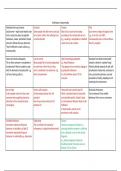
Definitions of abnormality
Deviation from social norms Eccentric Context Time
Social norms – explicit and implicit rules Some people that defy norms could just Most of our social norms change Social norms change throughout time
that a society has about acceptable be eccentric rather than suffering from according to the context that we’re in E.g., In the UK, until 1967,
behaviours, values, and beliefs. People a mental disorder E.g., swearing is acceptable at a football homosexuality was a criminal offence.
who don’t follow them are abnormal. match but not at a theatre Now it’s accepted.
They’re different to each culture e.g.,
homosexuality
Failure to function adequately Can be normal High functioning psychopaths Deviation from ideal mental health
This is when someone is considered to Most people fail to function adequately E.g. Harold Shipman Jahoda’s criteria for ‘optimal living’:
be abnormal if they’re unable to cope at some time in their life, but they They appear to be normal but engage in Positive attitude towards the self, self-
with the demands of everyday life. E.g. aren’t considered to be abnormal. E.g. psychopathic behaviour actualisation of potential, resistance to
self-care, having a job etc… after a bereavement So, this definition doesn’t fit for stress, personal autonomy, accurate
everyone perception of reality, adapting to and
mastering the environment.
Bar too high Hard to self-actualise Historically and culturally specific Statistical infrequency
So few people meet the criteria and So few people achieve their full What’s considered ideal is historically You’re abnormal if you exhibit
everyone ends up getting classed as potential and culturally specific. Jahoda’s ideas behaviour that’s rare or uncommon.
abnormal so the concept becomes How do you know what your full are only based on Western ideas of self-
meaningless potential is? fulfilment.
In Saudi Arabia, women aren’t
permitted to self-actualise.
Desirable behaviour Subjectivity Doctors
Sometimes statistical infrequent The cut-off point for statistical Doctors use aspects of statistics in
behaviour is desirable e.g. high IQ infrequency is subjectively determined. assessing whether someone is suffering
Sometimes statistically frequent from a disorder or not in their clinical
behaviour is undesirable e.g. depression diagnosis
E.g. doctors diagnose intellectual
disability disorder if anyone scores in
bottom 2.5% on IQ test
, Behavioural approach of phobias
Key words Behaviourist approach 2 Process Model Acquisition of phobias
Classical conditioning – learning All behaviour is learned Mowrer proposed that classical A neutral stimulus becomes associated
through association Learning is understood in terms of conditioning happens first, the with an unpleasant/traumatic
Operant conditioning – when a phobia conditioning individual learns fear through experience. So, it becomes a fear-
is maintained through reward and What is learned can be unlearned using association. This phobia then continues eliciting conditioned stimulus.
punishment the same principles. You can use because of operant conditioning and Only a single pairing of the neutral
conditioning in the treatment of the rewarding feelings they experience stimulus and the frightening event
phobias. (no fear) when they avoid the thing needs to occur for the association to be
Only their action and behaviour is of that they’re scared of. made and the phobia to form.
concern, not their thoughts etc…
Little Albert Munjack Maintaining phobias Mowrer
Watson et al worked with 11 month old little He investigated people with a driving Behaviours that are acquired through When an individual has developed a fear
Albert. He showed no fear when exposed to response, they then avoid or escape the
phobia. He found that only half of classical conditioning tend to decline
white fluffy object (neutral stimulus). But he feared object which then reduces their fear
showed fear when an iron bar was struck participants had experienced a car over time. This doesn’t happen with
and anxiety. The avoidance acts as a
loudly behind his head. So the unconditioned accident. In the control group, half of phobias. Operant conditioning is the
negative reinforcer as it removes the
stimulus caused the unconditioned response. them had experienced a serious car second step. unpleasant feeling of fear. The individual
Albert showed fear when the fluffy objects accident and didn’t have a driving then repeats the behaviour of avoidance,
were presented alone. The conditioned phobia. maintaining the phobia
stimuli now causes conditioned response.
Alternative explanation Incomplete explanation Diathesis stress model
In complex phobias like agoraphobia, Doesn’t explain how all phobias develop Idea that we’re born with a biological
there’s evidence that some avoidance Some phobias like fear of snakes develops predisposition to make us more
behaviour is motivated more by without a traumatic experience occurring. susceptible to developing a phobia. E.g.
So, there hasn’t been an association.
positive feelings of safety rather than a faulty gene. But, it depends on
So, biological preparedness theory could be
just avoiding the feeling of fear. better. This is the idea that we have innate whether experiences in our
fear of a creature that would have been of environment bring it out. This is an
danger in our evolutionary past interactionist approach as both nature
and nurture contribute to our
psychology.
Deviation from social norms Eccentric Context Time
Social norms – explicit and implicit rules Some people that defy norms could just Most of our social norms change Social norms change throughout time
that a society has about acceptable be eccentric rather than suffering from according to the context that we’re in E.g., In the UK, until 1967,
behaviours, values, and beliefs. People a mental disorder E.g., swearing is acceptable at a football homosexuality was a criminal offence.
who don’t follow them are abnormal. match but not at a theatre Now it’s accepted.
They’re different to each culture e.g.,
homosexuality
Failure to function adequately Can be normal High functioning psychopaths Deviation from ideal mental health
This is when someone is considered to Most people fail to function adequately E.g. Harold Shipman Jahoda’s criteria for ‘optimal living’:
be abnormal if they’re unable to cope at some time in their life, but they They appear to be normal but engage in Positive attitude towards the self, self-
with the demands of everyday life. E.g. aren’t considered to be abnormal. E.g. psychopathic behaviour actualisation of potential, resistance to
self-care, having a job etc… after a bereavement So, this definition doesn’t fit for stress, personal autonomy, accurate
everyone perception of reality, adapting to and
mastering the environment.
Bar too high Hard to self-actualise Historically and culturally specific Statistical infrequency
So few people meet the criteria and So few people achieve their full What’s considered ideal is historically You’re abnormal if you exhibit
everyone ends up getting classed as potential and culturally specific. Jahoda’s ideas behaviour that’s rare or uncommon.
abnormal so the concept becomes How do you know what your full are only based on Western ideas of self-
meaningless potential is? fulfilment.
In Saudi Arabia, women aren’t
permitted to self-actualise.
Desirable behaviour Subjectivity Doctors
Sometimes statistical infrequent The cut-off point for statistical Doctors use aspects of statistics in
behaviour is desirable e.g. high IQ infrequency is subjectively determined. assessing whether someone is suffering
Sometimes statistically frequent from a disorder or not in their clinical
behaviour is undesirable e.g. depression diagnosis
E.g. doctors diagnose intellectual
disability disorder if anyone scores in
bottom 2.5% on IQ test
, Behavioural approach of phobias
Key words Behaviourist approach 2 Process Model Acquisition of phobias
Classical conditioning – learning All behaviour is learned Mowrer proposed that classical A neutral stimulus becomes associated
through association Learning is understood in terms of conditioning happens first, the with an unpleasant/traumatic
Operant conditioning – when a phobia conditioning individual learns fear through experience. So, it becomes a fear-
is maintained through reward and What is learned can be unlearned using association. This phobia then continues eliciting conditioned stimulus.
punishment the same principles. You can use because of operant conditioning and Only a single pairing of the neutral
conditioning in the treatment of the rewarding feelings they experience stimulus and the frightening event
phobias. (no fear) when they avoid the thing needs to occur for the association to be
Only their action and behaviour is of that they’re scared of. made and the phobia to form.
concern, not their thoughts etc…
Little Albert Munjack Maintaining phobias Mowrer
Watson et al worked with 11 month old little He investigated people with a driving Behaviours that are acquired through When an individual has developed a fear
Albert. He showed no fear when exposed to response, they then avoid or escape the
phobia. He found that only half of classical conditioning tend to decline
white fluffy object (neutral stimulus). But he feared object which then reduces their fear
showed fear when an iron bar was struck participants had experienced a car over time. This doesn’t happen with
and anxiety. The avoidance acts as a
loudly behind his head. So the unconditioned accident. In the control group, half of phobias. Operant conditioning is the
negative reinforcer as it removes the
stimulus caused the unconditioned response. them had experienced a serious car second step. unpleasant feeling of fear. The individual
Albert showed fear when the fluffy objects accident and didn’t have a driving then repeats the behaviour of avoidance,
were presented alone. The conditioned phobia. maintaining the phobia
stimuli now causes conditioned response.
Alternative explanation Incomplete explanation Diathesis stress model
In complex phobias like agoraphobia, Doesn’t explain how all phobias develop Idea that we’re born with a biological
there’s evidence that some avoidance Some phobias like fear of snakes develops predisposition to make us more
behaviour is motivated more by without a traumatic experience occurring. susceptible to developing a phobia. E.g.
So, there hasn’t been an association.
positive feelings of safety rather than a faulty gene. But, it depends on
So, biological preparedness theory could be
just avoiding the feeling of fear. better. This is the idea that we have innate whether experiences in our
fear of a creature that would have been of environment bring it out. This is an
danger in our evolutionary past interactionist approach as both nature
and nurture contribute to our
psychology.