

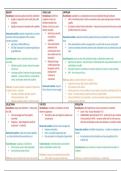
EQUALITY SOCIAL CLASS CAPITALISM
Revolutionary: absolute equality achieved by collectivism Revolutionary: belief that Revolutionary: capitalism is a corrupting force that must be abolished through revolution
Equality of opportunity will only take place after capitalism creates and After a transitional period a classless communist society would emerge based on absolute
revolution reinforces harmful class equality
Equality of outcome is impossible with capitalism divisions. Social class can be Das Kapital: outlines historical materialism – theory that economics forms the basis on whic
fixed by revolution all other human lives are based.
Democratic socialism: equality of opportunity can only be Social class cannot be
resolved by reforming capitalism until its socialist – reconciled by Democratic socialism: capitalism should be gradually reformed via parliament to make a socialist
common ownership capitalism state.
High taxes to flatten differences Class consciousness: Mass nationalisation and state management by a socialist elite to ensure social justice
BUT didn’t advocate for complete equality due to proletariat class Common ownership achieved by extensive state nationalism run by a socialism bureaucratic
wage differences consciousness means state
they will take over the
Social democracy: values social justice above common bourgeoise Social democracy: wants to work with capitalism through a redistributive welfare state
ownership Dialectical change – Reformed not replaced – mixed economy of nationalised state and privatised industry for th
Absolute equality is utopian, instead encourages conflict between the redistribution of wealth
meritocracy bourgeoisie and the Keynesian economics: stimulation of economic demand in recession via state spending
Increasing equality of outcomes through managing proletariat will NHS – free at the point of use
capitalism – economic efficiency, communitarian culminate in
society, social justice (democratic equality) communism Third way: added a neo-liberal element to socialism
Inspired New Labour, Blair, Gordon and Bill Clinton
Third way: increased emphasis on equality of opportunity Democratic socialism: rejected Free market and self reliance
via public services – education Marx’s theory of a class struggle Moving away from universal welfare to means-tested (uni students contributing to their fee
‘education, education, education’ and also Money = economic growth, prosperity and more job opportunities
introduced academies – Blair Universal healthcare is not sustainable – increase prescription charges and private healthca
Dismisses absolute equality as a flawed concept to ease pressure on the NHS
COLLECTIVISM THE STATE REVOLUTION
Revolutionary: large scale collectivism – influenced by Revolutionary: revolution is inevitable as the state Revolutionary: after Stadial theory comes communism by revolution
the USSR reinforces oppression Castro / Mao / Russian Revolution 1917
The class struggle rose from property The state has also used religion to weaken class LUXEMBOURG: Spartacist Revolt 1919 – inspired by the poor treatmen
ownership consciousness of the proletariat in WW1 – numerous strikes will turn into one mass
Gregarious – bound together by bonds of strike that will radicalise workers and culminate in a socialist revolution
compassion – a fraternity Democratic socialism: top-down state management
Extensive nationalism Democratic socialism: inevitability of gradualness – socialism is evolutionary in
Democratic socialism: accepts free market capitalism Ran by a socialism bureaucratic state manner
– so a fully collectivised state would not occur State education for all (equality of opportunity) Increasing democratic participation and securing policies for the
working class
Social democracy: suspicious of collectivism Social democracy: nationalised state and privatised
BUT pro-trade union to stop exploitation industry, redistributive welfare state Social democracy: views Marxism as irrelevant and democratic socialism as
Communitarian society instead outdated
Third way: no support to renationalise state utilities
Third way: unions should exist to preserve fair practise Active rather than passive welfare state Third way: is a renewal of social democracy – evolutionary
Revolutionary: absolute equality achieved by collectivism Revolutionary: belief that Revolutionary: capitalism is a corrupting force that must be abolished through revolution
Equality of opportunity will only take place after capitalism creates and After a transitional period a classless communist society would emerge based on absolute
revolution reinforces harmful class equality
Equality of outcome is impossible with capitalism divisions. Social class can be Das Kapital: outlines historical materialism – theory that economics forms the basis on whic
fixed by revolution all other human lives are based.
Democratic socialism: equality of opportunity can only be Social class cannot be
resolved by reforming capitalism until its socialist – reconciled by Democratic socialism: capitalism should be gradually reformed via parliament to make a socialist
common ownership capitalism state.
High taxes to flatten differences Class consciousness: Mass nationalisation and state management by a socialist elite to ensure social justice
BUT didn’t advocate for complete equality due to proletariat class Common ownership achieved by extensive state nationalism run by a socialism bureaucratic
wage differences consciousness means state
they will take over the
Social democracy: values social justice above common bourgeoise Social democracy: wants to work with capitalism through a redistributive welfare state
ownership Dialectical change – Reformed not replaced – mixed economy of nationalised state and privatised industry for th
Absolute equality is utopian, instead encourages conflict between the redistribution of wealth
meritocracy bourgeoisie and the Keynesian economics: stimulation of economic demand in recession via state spending
Increasing equality of outcomes through managing proletariat will NHS – free at the point of use
capitalism – economic efficiency, communitarian culminate in
society, social justice (democratic equality) communism Third way: added a neo-liberal element to socialism
Inspired New Labour, Blair, Gordon and Bill Clinton
Third way: increased emphasis on equality of opportunity Democratic socialism: rejected Free market and self reliance
via public services – education Marx’s theory of a class struggle Moving away from universal welfare to means-tested (uni students contributing to their fee
‘education, education, education’ and also Money = economic growth, prosperity and more job opportunities
introduced academies – Blair Universal healthcare is not sustainable – increase prescription charges and private healthca
Dismisses absolute equality as a flawed concept to ease pressure on the NHS
COLLECTIVISM THE STATE REVOLUTION
Revolutionary: large scale collectivism – influenced by Revolutionary: revolution is inevitable as the state Revolutionary: after Stadial theory comes communism by revolution
the USSR reinforces oppression Castro / Mao / Russian Revolution 1917
The class struggle rose from property The state has also used religion to weaken class LUXEMBOURG: Spartacist Revolt 1919 – inspired by the poor treatmen
ownership consciousness of the proletariat in WW1 – numerous strikes will turn into one mass
Gregarious – bound together by bonds of strike that will radicalise workers and culminate in a socialist revolution
compassion – a fraternity Democratic socialism: top-down state management
Extensive nationalism Democratic socialism: inevitability of gradualness – socialism is evolutionary in
Democratic socialism: accepts free market capitalism Ran by a socialism bureaucratic state manner
– so a fully collectivised state would not occur State education for all (equality of opportunity) Increasing democratic participation and securing policies for the
working class
Social democracy: suspicious of collectivism Social democracy: nationalised state and privatised
BUT pro-trade union to stop exploitation industry, redistributive welfare state Social democracy: views Marxism as irrelevant and democratic socialism as
Communitarian society instead outdated
Third way: no support to renationalise state utilities
Third way: unions should exist to preserve fair practise Active rather than passive welfare state Third way: is a renewal of social democracy – evolutionary


