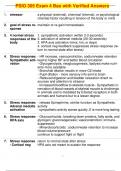
PSIO 305 Exam 4 Bao with Verified Answers
1. stressor a physical (external), chemical (internal), or psychological
(mental) factor resulting in tension of the body or mind
2. goal of stress re- maintain or re-gain homeostasis
sponse
3. 4 normal stress 1. sympathetic activation (within 2-3 seconds)
responses of the 2. activation of adrenal medulla (20-30 seconds)
body 3. HPA axis activation (mins, hrs, or days)
4. cortisol neg feedback suppresses stress response (re-
turn to normal state after stress)
4. Stress response: - HR increase, vasoconstriction, sodium/water retention
Sympathetic acti- lead to higher BP and better blood circulation
vation - Glycogenolysis, neoglucogenesis, lipolysis make nutri-
ents more available
- Bronchial dilation results in more O2 intake
- Pupil dilation - more sensory info sent to brain
- Reduced digestion and bladder relaxation direct re-
sources and attention to stressor
- Increased bloodflow to skeletal muscle - Sympathetic in-
nervation of blood vessels of skeletal muscle is cholinergic
in animals and is mediated by E/beta2 receptors in both
animals and humans but to a lesser degree
5. Stress response: - release Epinephrine, similar function as Sympathetic
Adrenal medulla activity
activation - sympathetic activity wanes quickly, E is more long lasting
6. Stress response: - Glucocorticoids : breaking down proteins, fatty acids, and
HPA axis glycogen; gluconeogenesis; vasoconstriction; immuno-
suppression
- Minerolocorticoids : sodium/water retention to increase
blood volume/pressure
continue to support fight or flight
7. Stress response return to normal state after stress
: Cortisol neg HPA axis not meant to sustain the response
1/5
, PSIO 305 Exam 4 Bao with Verified Answers
feedback to sup-
press response
8. Defining symp- 1. Intrusive memories - recurrent, unwanted memories of
toms of PTSD traumatic event, nightmares, etc
2. Avoidance - avoiding thinking/talking about the event,
avoiding reminders of it
3. Cognitive and mood disorder - negative thoughts about
self, other people and world, memory problems, lack of
interest, detached, etc
4. Changes in physical and emotional reactions - easily
startled, on guard, self-destructive behavior, trouble sleep-
ing, irritability, aggression, guilt/shame
9. Hypocortisolism in PTSD, NE/E and CRH levels elevated but cortisol is
reduced
- higher CRH and lower cortisol leads to overactive sym-
pathetic activity
- High CRH causes hippocampal atrophy
- Low cortisol causes autoimmune disease
10. Cortisol and - low levels of cortisol before/shortly after trauma is predic-
PTSD risk factors tive of subsequent PTSD
- high cortisol associated with low incidence of PTSD
- high dose corticosterone reduces subsequent PTSD in
animals
11. Genetic influ- -Monozygotic twins have significantly higher concordance
ences of PTSD for PTSD than dizygotic twins
-estimated 30% heritability
-genes associated with HPA axis are associated with
PTSD
12. Epigenetic influ- - changes to genome (gene expression) but not the
ences on PTSD DNA sequence --> DNA methylation, histone methyla-
tion/acetylation
2/5
1. stressor a physical (external), chemical (internal), or psychological
(mental) factor resulting in tension of the body or mind
2. goal of stress re- maintain or re-gain homeostasis
sponse
3. 4 normal stress 1. sympathetic activation (within 2-3 seconds)
responses of the 2. activation of adrenal medulla (20-30 seconds)
body 3. HPA axis activation (mins, hrs, or days)
4. cortisol neg feedback suppresses stress response (re-
turn to normal state after stress)
4. Stress response: - HR increase, vasoconstriction, sodium/water retention
Sympathetic acti- lead to higher BP and better blood circulation
vation - Glycogenolysis, neoglucogenesis, lipolysis make nutri-
ents more available
- Bronchial dilation results in more O2 intake
- Pupil dilation - more sensory info sent to brain
- Reduced digestion and bladder relaxation direct re-
sources and attention to stressor
- Increased bloodflow to skeletal muscle - Sympathetic in-
nervation of blood vessels of skeletal muscle is cholinergic
in animals and is mediated by E/beta2 receptors in both
animals and humans but to a lesser degree
5. Stress response: - release Epinephrine, similar function as Sympathetic
Adrenal medulla activity
activation - sympathetic activity wanes quickly, E is more long lasting
6. Stress response: - Glucocorticoids : breaking down proteins, fatty acids, and
HPA axis glycogen; gluconeogenesis; vasoconstriction; immuno-
suppression
- Minerolocorticoids : sodium/water retention to increase
blood volume/pressure
continue to support fight or flight
7. Stress response return to normal state after stress
: Cortisol neg HPA axis not meant to sustain the response
1/5
, PSIO 305 Exam 4 Bao with Verified Answers
feedback to sup-
press response
8. Defining symp- 1. Intrusive memories - recurrent, unwanted memories of
toms of PTSD traumatic event, nightmares, etc
2. Avoidance - avoiding thinking/talking about the event,
avoiding reminders of it
3. Cognitive and mood disorder - negative thoughts about
self, other people and world, memory problems, lack of
interest, detached, etc
4. Changes in physical and emotional reactions - easily
startled, on guard, self-destructive behavior, trouble sleep-
ing, irritability, aggression, guilt/shame
9. Hypocortisolism in PTSD, NE/E and CRH levels elevated but cortisol is
reduced
- higher CRH and lower cortisol leads to overactive sym-
pathetic activity
- High CRH causes hippocampal atrophy
- Low cortisol causes autoimmune disease
10. Cortisol and - low levels of cortisol before/shortly after trauma is predic-
PTSD risk factors tive of subsequent PTSD
- high cortisol associated with low incidence of PTSD
- high dose corticosterone reduces subsequent PTSD in
animals
11. Genetic influ- -Monozygotic twins have significantly higher concordance
ences of PTSD for PTSD than dizygotic twins
-estimated 30% heritability
-genes associated with HPA axis are associated with
PTSD
12. Epigenetic influ- - changes to genome (gene expression) but not the
ences on PTSD DNA sequence --> DNA methylation, histone methyla-
tion/acetylation
2/5