

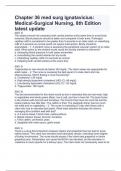
Chapter 36 med surg Ignatavicius: Medical-Surgical Nursing, 8th Edition latest update
ANS: D The student should not compress both carotid arteries at the same time to avoid brain ischemia. Blood pressure should be taken and compared in both arms. Prolonged capillary refill is considered to be greater than 5 seconds in an older adult, so classifying refill of 4 seconds as normal would not require intervention. Bruits should be auscultated. - 1. A student nurse is assessing the peripheral vascular system of an older adult. What action by the student would cause the faculty member to intervene? a. Assessing blood pressure in both upper extremities b. Auscultating the carotid arteries for any bruits c. Classifying capillary refill of 4 seconds as normal d. Palpating both carotid arteries at the same time ANS: D Triglycerides in men should be below 160 mg/dL. The other values are appropriate for adult males. - 2. The nurse is reviewing the lipid panel of a male client who has atherosclerosis. Which finding is most concerning? a. Cholesterol: 126 mg/dL b. High-density lipoprotein cholesterol (HDL-C): 48 mg/dL c. Low-density lipoprotein cholesterol (LDL-C): 122 mg/dL d. Triglycerides: 198 mg/dL ANS: B The diet recommended for this client would be low in saturated fats and red meat, high in vegetables and whole grains (fiber), low in salt, and low in trans fat. The best choice is the chicken with broccoli and tomatoes. The French fries have too much fat and the iceberg lettuce has little fiber. The catfish is fried. The spaghetti dinner has too much red meat and no vegetables. - 3. The nurse is evaluating a 3-day diet history with a client who has an elevated lipid panel. What meal selection indicates the client is managing this condition well with diet? a. A 4-ounce steak, French fries, iceberg lettuce b. Baked chicken breast, broccoli, tomatoes c. Fried catfish, cornbread, peas d. Spaghetti with meat sauce, garlic bread ANS: A There is a drug-food interaction between statins and grapefruit that can lead to acute kidney failure. This client has elevated renal laboratory results, indicating some degree of kidney involvement. The nurse should assess if the client eats grapefruit or drinks grapefruit juice. Dehydration can cause the BUN to be elevated, but the elevation in creatinine is more specific for a kidney injury. The client does not necessarily need to be admitted. A urinalysis may or may not be ordered. - 4. A nurse is working with a client who takes atorvastatin (Lipitor). The clients recent laboratory results include a blood urea nitrogen (BUN) of 33 mg/dL and creatinine of 2.8 mg/dL. What action by the nurse is best? a. Ask if the client eats grapefruit. b. Assess the client for dehydration. c. Facilitate admission to the hospital. d. Obtain a random urinalysis. ANS: B Most people with hypertension are asymptomatic, although a small percentage do have symptoms such as headache. The nurse should explain this to the client. Asking about paying for medications is not related because the client has already admitted nonadherence. Threatening the client with possible complications will not increase compliance. - 5. A client has been diagnosed with hypertension but does not take the antihypertensive medications because of a lack of symptoms. What response by the nurse is best? a. Do you have trouble affording your medications? b. Most people with hypertension do not have symptoms. c. You are lucky; most people get severe morning headaches. d. You need to take your medicine or you will get kidney failure. ANS: C Essential hypertension is the most common type of hypertension and has no specific cause such as an underlying disease process. Hypertension that is due to another disease process is called secondary hypertension. A severe, life-threatening form of hypertension is malignant hypertension. - 6. A student nurse asks what essential hypertension is. What response by the registered nurse is best? a. It means it is caused by another disease. b. It means it is essential that it be treated. c. It is hypertension with no specific cause. d. It refers to severe and life-threatening hypertension. ANS: A African Americans in the United States have one of the highest rates of hypertension in the world. The nurse has the potential to reach this priority population by providing services at African-American churches. Although hypertension education and screening are important for all groups, African Americans are the priority population for this intervention. - 7. A nurse is interested in providing community education and screening on hypertension. In order to reach a priority population, to what target audience should the nurse provide this service? a. African-American churches b. Asian-American groceries c. High school sports camps d. Womens health clinics ANS: B All options are appropriate when assessing stress and responses to stress. However, this client feels overwhelmed by the suggested lifestyle changes. Instead of looking at all the needed changes, the nurse should assist the client in choosing one the client feels optimistic about controlling. Once the client has mastered that change, he or she can move forward with another change. Determining support systems, daily stressors, and delegation opportunities does not directly impact the clients feelings of control. - 8. A client has hypertension and high risk factors for cardiovascular disease. The client is overwhelmed with the recommended lifestyle changes. What action by the nurse is best? a. Assess the clients support system. b. Assist in finding one change the client can control. c. Determine what stressors the client faces in daily life. d. Inquire about delegating some of the clients obligations. ANS: A Lasix is a loop diuretic and can cause hypokalemia. A potassium level of 2.1 mEq/L is quite low and should be reported immediately. Spironolactone is a potassium-sparing diuretic that can cause hyperkalemia. A potassium level of 5.1 mEq/L is on the high side, but it is not as critical as the low potassium with furosemide. The other two laboratory values are normal. - 9. The nurse is caring for four hypertensive clients. Which druglaboratory value combination should the nurse report immediately to the health care provider? a. Furosemide (Lasix)/potassium: 2.1 mEq/L b. Hydrochlorothiazide (Hydrodiuril)/potassium: 4.2 mEq/L c. Spironolactone (Aldactone)/potassium: 5.1 mEq/L d. Torsemide (Demadex)/sodium: 142 mEq/L ANS: A As PAD progresses, it takes less oxygen demand to cause pain. Needing to cut down on activity to be pain free indicates the clients disease is worsening. The other questions are useful, but not as important. - 10. A nurse is assessing a client with peripheral artery disease (PAD). The client states walking five blocks is possible without pain. What question asked next by the nurse will give the best information? a. Could you walk further than that a few months ago? b. Do you walk mostly uphill, downhill, or on flat surfaces? c. Have you ever considered swimming instead of walking? d. How much pain medication do you take each day? ANS: D Clients with PVD need to pay special attention to their feet. Toenails need to be kept short and cut straight across. The client whose hands shake may cause injury when trimming toenails. The nurse should refer this client to a podiatrist. Comfy sweatpants and house shoes are generally loose and not restrictive, which is important for clients with PVD. Keeping the house at a comfortable temperature makes it less likely the client will use alternative heat sources, such as heating pads, to stay warm. The client should keep the feet moist and soft with lotion. - 11. An older client with peripheral vascular disease (PVD) is explaining the daily foot care regimen to the family practice clinic nurse. What statement by the client may indicate a barrier to proper foot care? a. I nearly always wear comfy sweatpants and house shoes. b. Im glad I get energy assistance so my house isnt so cold. c. My daughter makes sure I have plenty of lotion for my feet. d. My hands shake when I try to do things requiring coordination ANS: A Many foods and drugs interfere with warfarin, St. Johns wort being one of them. The nurse should advise the client against taking it. The other answers are not accurate. - 12. A client is taking warfarin (Coumadin) and asks the nurse if taking St. Johns wort is acceptable. What response by the nurse is best? a. No, it may interfere with the warfarin. b. There isnt any information about that. c. Why would you want to take that? d. Yes, it is a good supplement for you. ANS: A Alcohol intake should be limited to two drinks a day for men and one drink a day for women. A drink is classified as one beer, 1.5 ounces of hard liquor, or 5 ounces of wine. Limited alcohol intake is acceptable with hypertension. The womans size does not matter. - 13. A nurse is teaching a larger female client about alcohol intake and how it affects hypertension. The client asks if drinking two beers a night is an acceptable intake. What answer by the nurse is best? a. No, women should only have one beer a day as a general rule. b. No, you should not drink any alcohol with hypertension. c. Yes, since you are larger, you can have more alcohol. d. Yes, two beers per day is an acceptable amount of alcohol ANS: B Angiotensin-converting enzyme inhibitors such as captopril can cause hypotension, especially after the first dose. The nurse should see this client first to prevent falling if the client decides to get up without assistance. The two blood pressure readings are abnormal but not critical. The nurse should check on the client with higher blood pressure next to assess for problems related to the reading. The nurse can administer the beta blocker as standards state to hold it if the systolic blood pressure is below 90 mm Hg. The client who needs pain medication prior to the dressing change is not a priority over client safety and assisting the other client to the bathroom. - 14. A nurse is caring for four clients. Which one should the nurse see first? a. Client who needs a beta blocker, and has a blood pressure of 92/58 mm Hg b. Client who had a first dose of captopril (Capoten) and needs to use the bathroom c. Hypertensive client with a blood pressure of 188/92 mm Hg d. Client who needs pain medication prior to a dressing change of a surgical wound ANS: B Assessing circulation distal to the puncture site is a critical nursing action. A pulse of 2+/4+ indicates good perfusion. Pain control, remaining on bedrest as directed after the procedure, and understanding are all important, but do not take priority over perfusion. - 15. A client had a percutaneous transluminal coronary angioplasty for peripheral arterial disease. What assessment finding by the nurse indicates a priority outcome for this client has been met? a. Pain rated as 2/10 after medication b. Distal pulse on affected extremity 2+/4+ c. Remains on bedrest as directed d. Verbalizes understanding of procedure ANS: B Once perfusion has been restored or improved to an extremity, clients can often feel a throbbing pain due to the increased blood flow. However, it is important to differentiate this pain from ischemia. The nurse should assess for other signs of perfusion, such as distal pulses and skin color/temperature. Administering pain medication is done once the nurse determines the clients perfusion status is normal. Documentation needs to be thorough. Notifying the surgeon is not necessary. - 16. A client is 4 hours postoperative after a femoropopliteal bypass. The client reports throbbing leg pain on the affected side, rated as 7/10. What action by the nurse takes priority? a. Administer pain medication as ordered. b. Assess distal pulses and skin color. c. Document the findings in the clients chart. d. Notify the surgeon immediately. ANS: A Hand hygiene is the best way to prevent infections in hospitalized clients. Dressing changes should be done with sterile technique. Assessing vital signs and white blood cell count will not prevent infection. - 17. A client had a femoropopliteal bypass graft with a synthetic graft. What action by the nurse is most important to prevent wound infection? a. Appropriate hand hygiene before giving care b. Assessing the clients temperature every 4 hours c. Clean technique when changing dressings d. Monitoring the clients daily white blood cell count ANS: B Clients on fibrinolytic therapy are at high risk of bleeding. The sudden onset of neurologic signs may indicate the client is having a hemorrhagic stroke. The nurse does need to complete a thorough neurological examination, but should first call the Rapid Response Team based on the clients manifestations. The nurse notifies the Rapid Response Team first. Vitamin K is not the antidote for this drug. Turning down the infusion rate will not be helpful if the client is still receiving any of the drug. - 18. A client is receiving an infusion of alteplase (Activase) for an intra-arterial clot. The client begins to mumble and is disoriented. What action by the nurse takes priority? a. Assess
Document information
- Uploaded on
- July 31, 2024
- Number of pages
- 11
- Written in
- 2023/2024
- Type
- Exam (elaborations)
- Contains
- Questions & answers


