

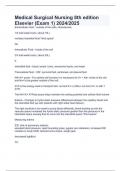
Medical Surgical Nursing 8th edition Elsevier (Exam 1) 2024/2025
Extracellular Fluid - outside of the cells, intravascular, 1/3 total water body ( about 15L) includes interstitial fluid "third space" Na Intracellular Fluid - Inside of the cell 2/3 total water body ( about 25L) K Interstitial fluid - blood, lymph, bone, connective tissue, and water Transcellular fluid - CSF, synovial fluid, peritoneal, and pleural fluid NA+/K+ pump - For optimal cell function it is necessary for K+ Na+ inside of the cell and Na+ to be greater outside of the cell. ATP is the energy used to transport NA+ out and K+ in (3Na+ out and 2 K+ in with 1 ATP) The NA+/K+ ATPase pump helps maintain the resting potential and cellular fluid volume Edema - Changes in hydro-static pressure differences between the capillary blood and the interstitial fluid (as with patients with right sided heart failure). The right ventricle is too weak to pump blood efficiently; blood backing up into the vascular space increased the hydro-static pressure greater then the pressure in the interstitial space causing fluid to move into the interstitial space "third space". Measuring edema S/S: (risk of pulmonary edema) elevated blood pressure, rapid bounding pulse, jugular vein distention, increased RR crackles in lungs SOB, reduced urine output, weight gain decreased hgb&hct TX: Na diet restrictions, diuretics, INTERVENTIONS: risk of skin breakdown, Na diet restrictions - - no added salt -2g/day -4g/day Dehydration - Fluid intake or retention is less than the body needs for homeostasis. Water shifts from the plasma into the interstitial space relative dehydration; actual water loss isotonic dehydration; electrolyte loss and fluid loss Fluid is only lost from the ECF, no fluid shift leave the ICF the same = hypovolemia. S/S: (risk of poor perfusion) low blood pressure, tachy, pulse is weak, RR increase, skin is dry and turgor is poor. Urine output 500 mL/ day, concentrated with a specific gravity 1.030, weight loss of a 0.5 lb/day. Elevated hgb&hct. TX: increase vasoconstriction and peripheral resistance to maintain blood pressure. hydration therapy, INTERVENTIONS: prevent falls d/t ortho hypo, oral re-hydration solutions with glucose and electrolytes, RAAS - Renin-Angiotensin-Aldosterone-System Compensatory mechanism that raises blood pressure and increases blood volume in response to decrease renal perfusion Low blood pressure reduces kidney perfusion; kindeys release (RENIN), liver release (ANGIOTENSINOGEN), angiotensin I is converted to angiotensis II* by the lungs with the ACE; potent vasoconstriction, adrenal gland releases (ALDOSTERONE) stimulate the nephron to increase NA and H2O reabsorption, K excretion increased blood volume/pressure *Frequent stimulation will activate genetic changes in the cardiac myocyte that lead to hypertrophy, apoptosis, and myocardial fibrosis - non contractile, non conductive
Document information
- Uploaded on
- July 31, 2024
- Number of pages
- 5
- Written in
- 2023/2024
- Type
- Exam (elaborations)
- Contains
- Questions & answers


