

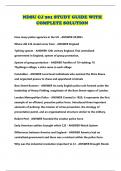
NDSU CJ 201 STU DY GUID E WITH
COMP LETE S OLU TIO N
How many police agencies in the US - ANSWER 20,000+
Where did CJS model come from - ANSWER England
Tything system - ANSWER 12th century England, first centralized
government in England, system of group protection,
System of group protection - ANSWER Families of 10=tyhting; 10
Thythings=village; a shire reeve in each village
Constables - ANSWER Local level individuals who assisted the Shire Reeve
and organized posses to chase and apprehend criminals
Bow Street Runners - ANSWER An early English police unit formed under the
leadership of Henry Fielding, magistrate of the Bow Street region of London.
London Metropolitan Police - ANSWER Created in 1829, it represents the first
example of an efficient, proactive police force. Introduced three important
elements of policing: the mission of crime prevention, the strategy of
preventative patrol, and an organizational structure similar to the military.
Robert Peel - ANSWER founded the London police force
Early American settlers brought which CJS - ANSWER Watch System
Differences between America and England - ANSWER America had no
centralized government and there was a mistrust within the police force
Why was the industrial revolution important to CJ - ANSWER Brought floods
1 / 3
of people, and over crowdedness and unhealthy conditions. Some cities
caved into starting policing but just to control immigrants
Slave Patrols - ANSWER Police-type organizations created in the American
South during colonial times to control slaves and support the southern
economic system of slavery.
Slave Codes - ANSWER Laws that controlled the lives of enslaved African
Americans and denied them basic rights. no meetings, no leaving, no
traveling w/o a pass, no reading or writing
American Police - ANSWER 1844 NYC first paid police; created locally; people
still didn't trust the government; strictly for political power
August Vollmer - ANSWER Was known as the most famous police reformer in
the early part of the twentieth century. He believed the police should be a
professional force.
Functions of Police - ANSWER 1. Law Enforcement/Investigation
2. Patrol
3. Order Maintenance/Peace Keeping
4. Crime Control/Prevention
Order Maintenance Policing - ANSWER Policy that directs police to handle
minor incidents and crimes in an effort to prevent larger crimes in the future.
community policing - ANSWER Assigning police to neighborhoods where
they walk the beat and work with churches and other community groups to
reduce crime and improve relations with minorities.
Broken Windows Theory - ANSWER a theory proposing that even small acts
2 / 3
of crime, disorder, and vandalism can threaten a neighborhood and render it
unsa fe
quality of life policing - ANSWER police strategy that targets the reduction of
physical and social disorder so that community members will work together
to promote neighborhood safety, and concomitantly reduce crime
problem-oriented policing - ANSWER an approach to policing in which
officers routinely seek to identify, analyze, and respond to the circumstances
underlying the incidents that prompt citizens to call the police
Community Policing Activities - ANSWER neighborhood stations, foot and
bike patrols, neighborhood watch, DARE, citizen feedback
Structure of American Policing - ANSWER para-military structure (hierarchal
model/ chain of command); police specializations
police specialization - ANSWER Dividing police tasks into separate units or
divisions such as patrol, detective, traffic, juvenile, etc.
Understanding Police Officers - ANSWER 3 types: legalistic; service; and
watchman
legalistic style - ANSWER style of policing that emphasizes strict enforcement
of laws and reduces officers' authority to handle matters informally
watchman style - ANSWER style of policing that emphasizes order
maintenance and tolerates minor violations of law as officers use discretion
to handle small infractions informally but make arrests for major violations
service style - ANSWER style of policing in which officers cater to citizens'
desire for favorable treatment and sensitivity to individual situations by
using discretion to handle minor matters in ways that seek to avoid Powered by TCPDF (www.tcpdf.org)
3 / 3
COMP LETE S OLU TIO N
How many police agencies in the US - ANSWER 20,000+
Where did CJS model come from - ANSWER England
Tything system - ANSWER 12th century England, first centralized
government in England, system of group protection,
System of group protection - ANSWER Families of 10=tyhting; 10
Thythings=village; a shire reeve in each village
Constables - ANSWER Local level individuals who assisted the Shire Reeve
and organized posses to chase and apprehend criminals
Bow Street Runners - ANSWER An early English police unit formed under the
leadership of Henry Fielding, magistrate of the Bow Street region of London.
London Metropolitan Police - ANSWER Created in 1829, it represents the first
example of an efficient, proactive police force. Introduced three important
elements of policing: the mission of crime prevention, the strategy of
preventative patrol, and an organizational structure similar to the military.
Robert Peel - ANSWER founded the London police force
Early American settlers brought which CJS - ANSWER Watch System
Differences between America and England - ANSWER America had no
centralized government and there was a mistrust within the police force
Why was the industrial revolution important to CJ - ANSWER Brought floods
1 / 3
of people, and over crowdedness and unhealthy conditions. Some cities
caved into starting policing but just to control immigrants
Slave Patrols - ANSWER Police-type organizations created in the American
South during colonial times to control slaves and support the southern
economic system of slavery.
Slave Codes - ANSWER Laws that controlled the lives of enslaved African
Americans and denied them basic rights. no meetings, no leaving, no
traveling w/o a pass, no reading or writing
American Police - ANSWER 1844 NYC first paid police; created locally; people
still didn't trust the government; strictly for political power
August Vollmer - ANSWER Was known as the most famous police reformer in
the early part of the twentieth century. He believed the police should be a
professional force.
Functions of Police - ANSWER 1. Law Enforcement/Investigation
2. Patrol
3. Order Maintenance/Peace Keeping
4. Crime Control/Prevention
Order Maintenance Policing - ANSWER Policy that directs police to handle
minor incidents and crimes in an effort to prevent larger crimes in the future.
community policing - ANSWER Assigning police to neighborhoods where
they walk the beat and work with churches and other community groups to
reduce crime and improve relations with minorities.
Broken Windows Theory - ANSWER a theory proposing that even small acts
2 / 3
of crime, disorder, and vandalism can threaten a neighborhood and render it
unsa fe
quality of life policing - ANSWER police strategy that targets the reduction of
physical and social disorder so that community members will work together
to promote neighborhood safety, and concomitantly reduce crime
problem-oriented policing - ANSWER an approach to policing in which
officers routinely seek to identify, analyze, and respond to the circumstances
underlying the incidents that prompt citizens to call the police
Community Policing Activities - ANSWER neighborhood stations, foot and
bike patrols, neighborhood watch, DARE, citizen feedback
Structure of American Policing - ANSWER para-military structure (hierarchal
model/ chain of command); police specializations
police specialization - ANSWER Dividing police tasks into separate units or
divisions such as patrol, detective, traffic, juvenile, etc.
Understanding Police Officers - ANSWER 3 types: legalistic; service; and
watchman
legalistic style - ANSWER style of policing that emphasizes strict enforcement
of laws and reduces officers' authority to handle matters informally
watchman style - ANSWER style of policing that emphasizes order
maintenance and tolerates minor violations of law as officers use discretion
to handle small infractions informally but make arrests for major violations
service style - ANSWER style of policing in which officers cater to citizens'
desire for favorable treatment and sensitivity to individual situations by
using discretion to handle minor matters in ways that seek to avoid Powered by TCPDF (www.tcpdf.org)
3 / 3


