

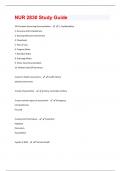
NUR 2830 Study Guide Questions And Answers With Verified Solutions Graded A+
10 Principles Governing Documentation - 1. Confidentiality 2. Accuracy and Completeness 3. Nursing Admission Assessment 4. Flowsheets 5. Plan of Care 6. Progress Notes 7. Narrative Notes 8. Discharge Notes 9. Home Care Documentation 10. Written Hand Off Summary 2 parts to health assessment - health history physical assessment 3 levels of prevention - primary, secondary, tertiary 3 most common types of assessment - Emergency Comprehensive Focused 4 assessment techniques - Inspection Palpation Percussion Auscultation 4 goals of ANA - Promote healthPrevent Illness Treat human responses to health and illness Advocate for individuals, families, communities, and populations 4 parts of interviewing process - Pre-interaction Phase Beginning phase Working phase Closing phase 4 tones of percussion - Flat Dull Resonant Tympanic 5 parts of Comprehensive patient information - physical psychological functional spiritual social 5 Steps of Nursing Process (ADPIE) - Assessment Diagnosis Planning Implementation Evaluation 6 reasons for medical records - 1. legal documentation 2. communication/care planning3. quality assurance 4. financial reimbursement 5. education 6. research 7 Potential Handoff Communication Barriers - Lack of structural format Lack of policy/procedure Responsibility Hierarchy Ethnicity Poor clinical decision making Different communication styles 9 Components of a patients medical records - Nursing Admission Assessment Primary Provider Orders Flowsheets Focussed Assessment Documentation Med Administration Record Lab tests Progress Notes Discharge Summary Consults ABCDE - Airway Breathing Circulation Disability Exposureactive listening - the ability to focus on patients and their perspectives Acute care nursing assessment - done in 24 hours acute pain - signals tissue damage Alleviating/Aggravating - What makes the pain feel worse? What makes the pain feel better? Analysis - nursing diagnosis Assessment - what did you find Ex: Vital signs, auscultation findings, inspection findings, etc. Assessment tools in order - Inspection, palpation, percussion, auscultation Assessment tools in order for the abdomen - Inspection, auscultation, percussion, palpation Palpate clockwise from area that is hurt ausculation - what you hear Ex: lungs, heart, abdomen, carotid pulse, etc. Background - related to patient Ex: medical history, current meds, allergies, surgeries, etc. Bacote's model of cultural competency - cultural awareness, knowledge, skill, encounters, and desiresBarriers to pain assessment - Prejudice/Bias which includes educational values, family values, cultural values. Beginning phase - introduction; state purpose for interview Bell of stethoscope - low frequency sounds Ex: heart sounds bimanual palpation - 2-4 cm non-dominate hand over dominate hand and apply pressure DO NOT USE OVER AREAS THAT POSE RISK TO PATIENT
Document information
- Uploaded on
- July 29, 2024
- Number of pages
- 21
- Written in
- 2023/2024
- Type
- Exam (elaborations)
- Contains
- Questions & answers


