
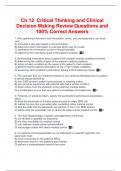
Ch 12 Critical Thinking and Clinical Decision Making Review Questions and 100% Correct Answers
1. After gathering information from the patient, scene, and any bystanders, you must next: A) formulate a care plan based on the information. B) determine which information is valid and which may be invalid. C) synthesize the information to form a thought process. D) determine the most likely cause of the patient's problem. B 2. Synthesizing information about a patient with multiple medical conditions involves: A) determining the validity of each of the patient's medical problems. B) ruling out each condition as the cause of the patient's chief complaint. C) determining the patient's perception of his or her multiple conditions. D) assessing each condition's potential for having a life-threatening impact. D 3. The care plan that you implement based on your working field diagnosis of a patient is almost always defined by: A) your EMS system's patient care protocols or standing orders. B) your previous experience with patients who had a similar condition. C) direct orders from the physician at the receiving medical facility. D) a combination of your and your partner's knowledge and experience. A 4. Protocols, or standing orders, specify the paramedic's performance parameters, which: A) allow the paramedic to function autonomously on every EMS call. B) outline the care that is provided after contacting online medical control. C) limit the skills that the paramedic can perform in his or her EMS system. D) define what the paramedic can or cannot do without direct medical control. D 5. The main disadvantage of patient care algorithms is that they: A) are revised or updated too frequently. B) are often overridden by medical control. C) only address classic patient presentations. D) discourage contact with direct medical control. C 6. If a patient's clinical presentation is not addressed in a specific algorithm, the paramedic must: A) focus exclusively on the patient's ABCs. B) determine what is in the patient's best interest. C) perform a comprehensive head-to-toe exam. D) provide supportive care and transport promptly. B
Document information
- Uploaded on
- July 25, 2024
- Number of pages
- 6
- Written in
- 2023/2024
- Type
- Exam (elaborations)
- Contains
- Questions & answers


