
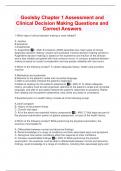
Goolsby Chapter 1 Assessment and Clinical Decision Making Questions and Correct Answers
1.Which type of clinical decision-making is most reliable? A. Intuitive B.Analytical C.Experiential D. Augenblick 1. ANS: B Croskerry (2009) describes two major types of clinical diagnostic decision-making: intuitive and analytical. Intuitive decision-making (similar to Augenblink decision-making) is based on the experience and intuition of the clinician and is less reliable and paired with fairly common errors. In contrast, analytical decision-making is based on careful consideration and has greater reliability with rare errors. 2.Which of the following is false? To obtain adequate history, health-care providers must be: A.Methodical and systematic B.Attentive to the patient's verbal and nonverbal language C.Able to accurately interpret the patient's responses D.Adept at reading into the patient's statements 2. ANS: D To obtain adequate history, providers must be well organized, attentive to the patient's verbal and nonverbal language, and able to accurately interpret the patient's responses to questions. Rather than reading into the patient's statements, they clarify any areas of uncertainty. 3.Essential parts of a health history include all of the following except A.Chief complaint B. History of the present illness C. Current vital signs D. All of the above are essential history components 3. ANS: C Vital signs are part of the physical examination portion of patient assessment, not part of the health history. 4.Which of the following is false? While performing the physical examination, the examiner must beable to: A. Differentiate between normal and abnormal findings B. Recall knowledge of a range of conditions and their associated signs and symptoms C. Recognize how certain conditions affect the response to other conditions D. Foresee unpredictable findings 4. ANS: D While performing the physical examination, the examiner must be able to differentiate between normal and abnormal findings, recall knowledge of a range of conditions, including their associated signs and symptoms, recognize how certain conditions affect the response to other conditions, and distinguish the relevance of varied abnormal findings.
Document information
- Uploaded on
- July 25, 2024
- Number of pages
- 3
- Written in
- 2023/2024
- Type
- Exam (elaborations)
- Contains
- Questions & answers


