

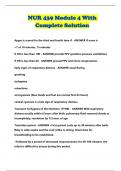
NUR 439 Module 4 With Comp lete Solut ion Apgar is scored for the third and fourth time if - ANSWER if score is <7 at 10 minutes, 15 minutes If HR is less than 100 - ANSWER provide PPV (positive pressure ventilation) If HR is less than 60 - ANSWER proved PPV and chest compressions Early signs of respiratory distress - ANSWER nasal flaring grunting tachypnea retractions acrocyanosis (blue hands and feet are normal first 24 hours) central cyanosis is a late sign of respiratory distress Transient Tachypnea of the Newborn (TTNB) - ANSWER Mild respiratory distress usually within 6 hours after birth; pulmonary fluid removed slowly or incompletely; resolution by 72 hours of age Transition period - ANSWER •First period: Lasts up to 30 minutes after birth. Baby is wide awake and the suck reflex is strong. Great time for breastfeeding to be established. •Followed by a period of decreased responsiveness for 60-100 minutes, the infant is difficult to arouse during this period. •Second period of reactivity occurs 4-6 hours after birth •Normal newborn breathing is 30-60 bpm, above 60 is considered tachypnea. Factors predisposing to heat loss - ANSWER •Thin skin; blood vessels close to the surface •Lack of shivering ability; limited stores of metabolic substrates (glucose, glycogen, fat) •Limited use of voluntary muscle activity •Large body surface area relative to body weight •Lack of subcutaneous fat; little ability to conserve heat by changing posture •No ability to adjust own clothing or blankets to achieve warmth •Infants cannot communicate that they are too cold or too warm •Optimal temp 36.5-37.5 degrees C. or (97.9-99.7 degrees F.) Brown fat - ANSWER •Areas of vascular fat tissue in the newborn located between the scapulae, at the nape of the neck, in the mediastinum, and in areas surrounding kidneys and adrenal glands. •It is a means of heat production through "non-shivering" thermogenesis (babies cannot shiver) •Brown fat generates heat in the newborn Convection - ANSWER is the flow of heat from the body surface to cooler ambient air. Newborns in open bassinets must be wrapped with a hat worn. Radiation - ANSWER is the loss of heat from the body surface to a cooler
Preview 2 out of 14 pages
Exam (elaborations)
NUR 439 Module 4 With Complete Solution
Preview 2 out of 14 pages
NUR 439 Module 4 With Complete Solution...
Content preview
Document information
- Uploaded on
- July 25, 2024
- Number of pages
- 14
- Written in
- 2023/2024
- Type
- Exam (elaborations)
- Contains
- Questions & answers
$10.49
Wrong document? Swap it for free
Within 14 days of purchase and before downloading, you can choose a different document. You can simply spend the amount again.
Written by students who passed
Immediately available after payment
Read online or as PDF

Reputation scores are based on the amount of documents a seller has sold for a fee and the reviews they have received for those documents. There are three levels: Bronze, Silver and Gold. The better the reputation, the more your can rely on the quality of the sellers work.
Available in package deal
Package deal
NUR 439 BUNDLED EXAMS WITH SOLUTION

