
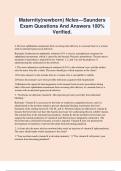
Maternity(newborn) Nclex—Saunders Exam Questions And Answers 100% Verified.
Maternity(newborn) Nclex—Saunders Exam Questions And Answers 100% Verified. 4. Prevents ophthalmia neonatorum from occurring after delivery to a neonate born to a woman with an untreated gonococcal infection Rationale: Erythromycin ophthalmic ointment 0.5% is used as a prophylactic treatment for ophthalmia neonatorum, which is caused by the bacteria Neisseria gonorrhoeae. The preventive treatment of gonorrhea is required by law. Options 1, 2, and 3 are not the purposes of administering this medication to the newborn. 1. The nurse administers erythromycin ointment (0.5%) to the newborn's eyes and the mother asks the nurse why this is done. The nurse should give which response to the client? 1.Prevents cataracts in the neonate born to a woman who is susceptible to rubella 2.Protects the neonate's eyes from possible infections acquired while hospitalized 3.Minimizes the spread of microorganisms to the neonate from invasive procedures during labor 4.Prevents ophthalmia neonatorum from occurring after delivery to a neonate born to a woman with an untreated gonococcal infection 3. "Newborns are deficient vitamin K. This injection prevents your baby from abnormal bleeding." Rationale: Vitamin K is necessary for the body to synthesize coagulation factors, and it is administered to the newborn infant to prevent abnormal bleeding. It promotes the liver's formation of the clotting factors II, VII, IX, and X. Newborn infants are deficient in vitamin K because the bowel does not have the bacteria necessary for synthesizing this fat-soluble vitamin. The normal flora in the intestinal tract produces vitamin K, but the newborn's bowel does not support the normal production of vitamin K until bacteria have adequately colonized it. The bowel becomes colonized by bacteria as food is ingested. Vitamin K does not promote the development of immunity or prevent the infant from becoming jaundiced. 2. A client asks the nurse why her newborn baby needs an injection of vitamin K (phytonadione). The nurse should make which statement to the client? 1."Your newborn needs vitamin K to develop immunity." 2."The vitamin K will protect your newborn from becoming jaundiced." 3."Newborns are deficient in vitamin K. This injection prevents your baby from abnormal bleeding." 4."Newborns have sterile bowels. The vitamin K will give the bowel the necessary bacteria." Previous Play Next Rewind 10 seconds Move forward 10 seconds Unmute 0:01 / 0:15 Full screen Brainpower Read More 2. Maintaining standard precautions at all times while caring for the neonate. Rationale: The neonate born to a mother who is HIV-positive must be cared for with strict attention to standard precautions. This prevents the transmission of the infection from the neonate, if he or she is infected, to others, and it prevents the transmission of other infectious agents to the possibly immunocompromised neonate. The mother should not breastfeed, unless the primary health care provider has specific recommendations about doing so. Monitoring vital signs and referring for sensory/cognitive problems are not care measures specifically associated with the care of a potentially AIDS-infected neonate. 3. The nurse is assigned to assist with caring for a neonate born to a mother who is human immunodeficiency virus (HIV)-positive. The nurse understands that which should be included in the plan of care? 1.Monitoring the neonate's vital signs routinely 2.Maintaining standard precautions at all times while caring for the neonate 3.Instructing breastfeeding mothers regarding the treatment of their nipples with an antifungal cream 4.Initiating a referral to evaluate for blindness, deafness, learning, or behavioral problems in the neonate 2. Blood glucose level Rationale: The most common metabolic complication in the post-term newborn is hypoglycemia, which can produce central nervous system abnormalities and cognitive impairment if it is not corrected immediately. Urinary output, although important, is not the highest priority action. The polycythemia contributes to increased bilirubin levels, usually beginning on the second day after delivery. Hemoglobin and hematocrit levels are monitored, because the post-term neonate may exhibit polycythemia; however, this also does not require immediate attention. 4. The nurse is assisting in caring for a post-term neonate immediately after admission to the nursery. The priority nursing action should be to monitor which clinical parameter? 1.Urinary output 2.Blood glucose level 3.Total bilirubin level 4.Hemoglobin and hematocrit levels 2. A moist cord with discharge Rationale: Signs of infection of the umbilical cord are moistness, oozing, discharge, and a reddened base. If signs of infection occur, the primary health care provider is notified. Antibiotic treatment may be necessary. 5. The nurse is reinforcing instructions to a new mother about cord care and how to monitor for the presence of an infection. The nurse should tell the mother that which is a sign of infection? 1.A darkened drying stump 2.A moist cord with discharge 3.A purple stump that shows pinkness around the base 4.A purple stump that shows some moistness at the base 1. Begin with the eyes and face. Rationale: Bathing should start at the eyes and face, which are usually the cleanest areas. Next, the external portion of the ears and behind the ears are cleansed. The newborn's neck should be washed, because formula, breast milk, or lint will often accumulate in the folds of the neck. The hands and arms are then washed. The baby's legs are washed, with the diaper area being washed last. 6. The nurse is reinforcing measures regarding the care of the newborn with a mother. To bathe the newborn, the mother should be taught which intervention? 1.Begin with the eyes and face. 2.Start with the dirtiest area first. 3.Begin with the feet and work upward. 4.Only wash the diaper area, because this is the only part of the baby that gets soiled. 3. Drying the baby with a warm blanket. Rationale: Evaporation occurs when moisture from the newborn's wet body surface dissipates heat along with moisture. By keeping the newborn dry (and by drying the wet newborn at birth), evaporation is prevented. Conduction occurs when the newborn is on a cold surface, such as a cold pad or mattress. Convection occurs as air moves across the newborn's skin from an open door and heat is transferred to the air. Radiation occurs when heat from the newborn radiates to a colder surface. 7. After birth the nurse prevents hypothermia as a result of evaporation by performing which action? 1.Warming the crib pad 2.Closing the doors of the room 3.Drying the baby with a warm blanket 4.Turning on the overhead radiant warmer Correct Answer: 4, 5, 6 Rationale: Phototherapy is the use of intense fluorescent lights to reduce serum bilirubin levels in the newborn. Injury from treatment (e.g., eye damage, dehydration, sensory deprivation) can occur. Interventions include exposing as much of the newborn's skin as possible; however, the genital area is covered. The newborn's eyes are also covered with shields or patches to ensure that the eyelids are closed. The shields or patches are removed at least once per shift to inspect the eyes for infection or irritation and to allow for eye contact. The nurse measures the quantity of light every 8 hours, monitors the skin temperature closely, and increases fluids to compensate for water loss. The newborn will have loos
Document information
- Uploaded on
- July 22, 2024
- Number of pages
- 36
- Written in
- 2023/2024
- Type
- Exam (elaborations)
- Contains
- Questions & answers


