
Dysrhythmias (Part 2) Exam questions with 100% Verified Answers
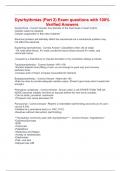
________________________________________ Dysrhythmias (Part 2) Exam questions with 100% Verified Answers Dysrhythmia - Correct Answer Any disorder of the heart beat or heart rhythm. Cardiac output is impaired. Cellular oxygenation is then also impaired Electrical problem will definitely effect the mechanical but a mechanical problem may not effect the electrical. Explaining dysrhythmias - Correct Answer -Classified to their site of origin -SA node atrial tissue, AV node, junctional tissue (tissue around AV node), and ventricular tissue -Caused by a disturbance in impulse formation or by conduction delays or blocks Tachydysrhythmias - Correct Answer -HR 100 -Shorten diastolic time (filling of vent. so not enough to push out) and coronary perfusion time. -Increase work of heart, increase myocardial O2 demand Bradydysrhythmias - Correct Answer -Heart rate 60 -Rate too slow to provide adequate cardiac output. (Doesn't give body what it needs fast enough) Premature complexes - Correct Answer -Occurs when a cell OTHER THAN THE SA NODE becomes irritable and fires an impulse before the next sinus complex -Can be atrial, junctional, ventricular -If frequent can cause decrease CO Paroxysmal - Correct Answer -Rhythm is intermittent (self limiting and ends on it's own - can be A.Fib) -Initiated be a premature beat (i.e. PAC, PVC) -Resolves without intervention (self limiting) ***Symptoms commonly seen with dysrhythmias*** - Correct Answer -Hypotension* -Dizziness/Syncope -SOB -Chest pain -Palpitations -Weakness and fatigue -Anxiety or restlessness -Diaphoresis -Pale, cool skin -Delayed cap refill
Document information
- Uploaded on
- July 20, 2024
- Number of pages
- 17
- Written in
- 2023/2024
- Type
- Exam (elaborations)
- Contains
- Questions & answers


