
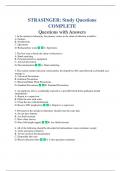
Exam (elaborations) STRASINGER
1. In the urinalysis laboratory the primary source in the chain of infection would be: A. Patients B. Needlesticks C. Specimens D. Biohazardous waste C. Specimens 2. The best way to break the chain of infection is: A. Hand sanitizing B. Personal protective equipment C. Aerosol prevention D. Decontamination A. Hand sanitizing 3. The current routine infection control policy developed by CDC and followed in all health-care settings is: A. Universal Precautions B. Isolation Precautions C. Blood and Body Fluid Precautions D. Standard Precautions D. Standard Precautions 4. An employee who is accidentally exposed to a possible blood-borne pathogen should immediately: A. Report to a supervisor B. Flush the area with water C. Clean the area with disinfectant D. Receive HIV prophylaxis A. Report to a supervisor 5. Personnel in the urinalysis laboratory should wear lab coats that: A. Do not have buttons B. Are fluid-resistant C. Have short sleeves D. Have full-length zippers B. Are fluid-resistant 6. All of the following should be discarded in biohazardous waste containers except: A. Urine specimen containers B. Towels used for decontamination C. Disposable lab coats D. Blood collection tubes A. Urine specimen containers 7. An employer who fails to provide sufficient gloves for the employees may be fined by the: A. CDC B. NFPA C. OSHA D. FDA C. OSHA 8. An acceptable disinfectant for blood and body fluid decontamination is: A. Sodium hydroxide B. Antimicrobial soap C. Hydrogen peroxide D. Sodium hypochlorite D. Sodium hypochlorite 9. Proper handwashing includes all of the following except: A. Using warm water B. Rubbing to create a lather C. Rinsing hands in a downward position D. Turning on the water with a paper towel D. Turning on the water with a paper towel 10. Centrifuging an uncapped specimen may produce a biologic hazard in the form of: A. Vectors B. Sharps contamination C. Aerosols D. Specimen contamination C. Aerosols 11. An employee who accidentally spills acid on his arm should immediately: A. Neutralize the acid with a base B. Hold the arm under running water for 15 minutes C. Consult the MSDSs D. Wrap the arm in gauze and go to the emergency department B. Hold the arm under running water for 15 minutes 12. When combining acid and water, ensure that: A. Acid is added to water B. Water is added to acid C. They are added simultaneously D. Water is slowly added to acid A. Acid is added to water 13. An employee can learn the carcinogenic potential of potassium chloride by consulting the: A. Chemical hygiene plan B. Material safety data sheets C. OSHA standards D. Urinalysis procedure manual B. Material safety data sheets 14. Employees should not work with radioisotopes if they are: A. Wearing contact lenses B. Allergic to iodine C. Sensitive to latex D. Pregnant D. Pregnant 15. All of the following are safe to do when removing the source of an electric shock except: A. Pulling the person away from the instrument B. Turning off the circuit breaker C. Using a glass container to move the instrument D. Unplugging the instrument A. Pulling the person away from the instrument 16. The acronym PASS refers to: A. Presence of vital chemicals B. Operation of a fire extinguisher C. Labeling of hazardous material D. Presence of radioactive substances B. Operation of a fire extinguisher 17. The system used by firefighters when a fire occurs in the laboratory is: A. MSDS B. RACE C. NFPA D. PASS C. NFPA 18. A class ABC fire extinguisher contains: A. Sand B. Water C. Dry chemicals D. Acid C. Dry chemicals 19. The first thing to do when a fire is discovered is to: A. Rescue persons in danger B. Activate the alarm system C. Close doors to other areas D. Extinguish the fire if possible A. Rescue persons in danger 20. If a red rash is observed after removing gloves, the employee: A. May be washing her hands too often B. May have developed a latex allergy C. Should apply cortisone cream D. Should not rub the hands so vigorously B. May have developed a latex allergy 21. Pipetting by mouth is: A. Acceptable for urine but not serum B. Not acceptable without proper training C. Acceptable for reagents but not specime
Document information
- Uploaded on
- July 20, 2024
- Number of pages
- 43
- Written in
- 2023/2024
- Type
- Exam (elaborations)
- Contains
- Questions & answers


