
The Carbon Cycle and Energy Security
EQ1: How does the carbon cycle operate to maintain planetary health
6.1 Most global carbon is locked in terrestrial stores as part of the long-term geological
cycle
Biogeochemical – includes carbon, hydrological and nitrogen cycles
Terrestrial – land
Fluxes – rate of exchange between stores. They create cycles and feedbacks
Stores – stores of carbon are sometimes called pools, stocks or reservoirs. There are
oceanic stores, atmospheric stores and terrestrial (land) stores
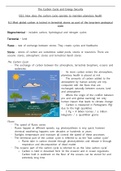
The Carbon Cycle
- The exchange of carbon between the atmosphere, terrestrial biosphere, oceans and
sediments
- As more carbon enters the atmosphere,
planetary health is placed at risk
- The amounts of carbon added to the
atmosphere by human activity are tiny
compared with the flows that are
exchanged naturally between oceans, land
and atmosphere
- Where the origin of the conflict between
pro and anti global warming} not only
human impact that leads to climate change
- Carbon is measured in Pentagrams (Pg)
due to the high quantities
- 1 Pg = A billion tonnes / a trillion
kilograms / a quadrillion grams
Fluxes
- The speed of fluxes varies
- Fluxes happen at different speeds, e.g. photosynthesis is very quick, however
chemical weathering happens over decades or hundreds or years
- Sunlight, temperature and moisture all control the speed of these processes
- The terrestrial part of the carbon cycle is referred to as the ‘fast carbon cycle’
o Plants take in carbon dioxide through photosynthesis and release it through
respiration and decomposition of dead matter
- The oceanic part of the carbon cycle is referred to as the ‘slow carbon cycle’
o Carbon is held in dissolved form (in the oceans) and in ocean organisms.
Carbon held in sediment on the floor of the oceans can be stored for and
extremely long time
EQ1: How does the carbon cycle operate to maintain planetary health
6.1 Most global carbon is locked in terrestrial stores as part of the long-term geological
cycle
Biogeochemical – includes carbon, hydrological and nitrogen cycles
Terrestrial – land
Fluxes – rate of exchange between stores. They create cycles and feedbacks
Stores – stores of carbon are sometimes called pools, stocks or reservoirs. There are
oceanic stores, atmospheric stores and terrestrial (land) stores
The Carbon Cycle
- The exchange of carbon between the atmosphere, terrestrial biosphere, oceans and
sediments
- As more carbon enters the atmosphere,
planetary health is placed at risk
- The amounts of carbon added to the
atmosphere by human activity are tiny
compared with the flows that are
exchanged naturally between oceans, land
and atmosphere
- Where the origin of the conflict between
pro and anti global warming} not only
human impact that leads to climate change
- Carbon is measured in Pentagrams (Pg)
due to the high quantities
- 1 Pg = A billion tonnes / a trillion
kilograms / a quadrillion grams
Fluxes
- The speed of fluxes varies
- Fluxes happen at different speeds, e.g. photosynthesis is very quick, however
chemical weathering happens over decades or hundreds or years
- Sunlight, temperature and moisture all control the speed of these processes
- The terrestrial part of the carbon cycle is referred to as the ‘fast carbon cycle’
o Plants take in carbon dioxide through photosynthesis and release it through
respiration and decomposition of dead matter
- The oceanic part of the carbon cycle is referred to as the ‘slow carbon cycle’
o Carbon is held in dissolved form (in the oceans) and in ocean organisms.
Carbon held in sediment on the floor of the oceans can be stored for and
extremely long time


