BIOS 242 Week 2 Assignment; Lab 3 of 14 Onsite; Microscopy Observation of Cells
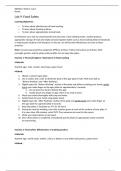
BIOS 242 Week 2 Assignment; Lab 3 of 14 Onsite; Microscopy Observation of Cells Lab 3: Microscopy- Observation of Cells Learning Objectives: Use the compound light microscope for observation of cells. Identify different types of bacteria based on their shapes. Identify a variety of eukaryotic cells. Introduction: Microbiology is the study of organisms, which cannot be seen with naked eye. You will need help of a microscope to observe these “tiny animalcules” as they were described by Antoni Von Leeuwenhoek. Microscopes can either be simple (contains single lens) or compound (contains series of lens systems to achieve higher magnification). Principle of microscopy: In a compound microscope, the light passes from the specimen into the objective lens which magnifies the image to 4x, 10x, 40x, or 100x (depending upon the power of objective lens used) which then enters eye piece and is further magnified 10x. Final magnification is hence the product of power of objective lens (4x, 10x, 40x, or 100x) multiplied by the power of the eyepiece (10x). Total Magnification of a Microscope = Magnification of Objective Lens x Magnification of Ocular Lens Exercise 1: Parts of a Microscope Eyepiece Lens: the lens at the top of the microscope that you look through Arm: supports the tube and connects the head containing the eyepiece to the base of the microscope Illuminator: a steady light source (110 volts) used in place of a mirror. Stage: This is the flat platform where you place your slides. Stage clips hold the slides in place and can be moved around by turning two knobs. One of the knobs moves the stage left and right (horizontal movement), the other knob moves the stage up and down (vertical movement). Objective Lenses: Usually you will find 3 or 4 objective lenses on a microscope. They almost always consist of 4X (scanning), 10X (low power), 40X (high power) and 100X (oil immersion) lenses. When coupled with a 10X (most common) eyepiece lens, we get total magnifications of 40X (4X times 10X), 100X, 400X and 1000X. Condenser Lens: The purpose of the condenser lens is to focus the light onto the specimen……
Written for
- Institution
- BIOS 242
- Course
- BIOS 242
Document information
- Uploaded on
- July 17, 2024
- Number of pages
- 10
- Written in
- 2023/2024
- Type
- OTHER
- Person
- Unknown
Subjects
-
bios 242 week 2 assignment lab 3 of 14 onsite
-
microscopy observation of cells