Topic LA- Cell Structure + Division
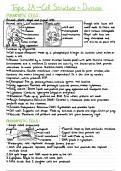
EUKARYOTIC CELLS :
Animal plant algal and
fungal cells
·
, ,
.
Animal cells : cell membrane Plant cells :
fungal cells have cell
· ·
·
-
se brane
j -
·
cell wall walls made of Chitin and
lysosome T
>
- don't contain
chloroplasts chloroplasts.
>mitochondria
-
Algal as has one
large chloroplast and
↓ ope are similar to plant cells .
SER RER
golgi apparatus
function of
organelles :
·
↳ Cell surface membrane : made
of a phospholipid bilayer . It controls what enters or
leaves a cell.
↳ Nucleus : Surrounded envelope (double pores) . Nucleus contains
by a nuclear with ports
chromosomes and a . It controls cell
nucleolus
activity via transcription .
DNA provide
instructions to make proteins. Nucleolus makes ribosomes
.
↳ Mitochondria : Double membrane ,
inner membrane folds to form Cristae , also
contains the matrix
(enzymes used in respiration) .
It is the site of aerobic
respiration which produces ATP
, I
↳ Chloroplast : Site
of photosynthesis contains grana and lamellae .
,
Golgi apparatus Processes and packages lipids and protiens makes lysosomes
↳ :
,
.
↳
Golgi Vesicle : Stores lipids and proteins from golgi apparatus and transports them .
↳
Lysosome : Contains lysozymes (digestive enzymes ( I
↳ Ribosome : Made up of proteins and RNA . Site where proteins are made.
↳
Rough Endoplasmic Reticulum (RER) : Covered in ribosomes folds and processes ,
proteins made at the ribosome
.
↳ Smooth Reticulum (SER) :
Endoplasmic Synthesises and processes lipids.
↳ Cell wall :
Supports cell shape Made of . cellulose in plants and
algae ,
Chitin for
fungi .
↳ Vacuole : Maintains cell
pressure and prevents cell from becoming rigid .
PROKARYOTIC CELLS :
celled
single organisms.
·
·
plasmid -Capsule Plasmid : loops of DNA , antibiotic resistance
-
·
flagellum .
*
Capsid : Slime
wala
·
that protects cell .
brane
·
Cell wall : Made of murein.
DNA > ribosome
- DNA : floats in
cytoplasm
·
.
Prokaryotic replicate through binary fission
cells :
·
1. DNA and plasmids replicate DNA replicates once but plasmids
,
can replicate
multiple times
.
2 Cell and DNA moves to
.
gets bigger poles of the cell .
.
3
Cytoplasm begins to divide , cell walls form .
. Cells divide and 2
4 produced.
daughter cells are
, Viruses - (not proteins).
acellular cells , but nucleic acids
by They
·
surrounded
invade and
⑧
reproduce inside cells-host cells
.
·
attatchment proteins
·
·
*> core
-
↳
·
capsid
of genetic material (DNA/RNA)
(protein coat)
&
Viral Replication :
·
1. Virus attatches to host cell receptor proteins.
2 Genetic material
. is released into host cell .
3 Genetic material and
.
proteins are
replicated by host cell
machinery .
. Viral
4 components assemble.
. Replicated viruses released from host cell.
S
ANALYSIS OF CELL COMPONENTS :
Magnification is how much
bigger the to the specimen
·
is .
image X1000 X1000
If A M
I
image actual size
magnification --
= =
.
AxM mm lum nm
-
Resolution is how the
easily distinguished is - 1000
·
image .
= 1000
Types :
·
of microscopes
Optical : TEM-Transmission Electron SEM-
Scanning Electron
use
light to
form image Electromagnets focus beam of Use beam of electrons across
lower (XISOO) Denser parts absorb specimen Knocked off electrons
magnification electrons . .
lower resolution more electrons,
creating 2D image. gathered in cathode, 3D
image .
Thigh resolution + thick specimens 3D image
,
.
Only used thin + dead
things lower resolution , dead
things
- -
on .
·
preparing microscope slides :
I add mount)
a drop of water onto slide
(temporary
2
. place specimen on top
. add stain
3 and then place cover slip .
·
Cell fractionation :
I HOMOGENISATION - blend cells to release . Solution must
.
organelles from membrane
be ice cold (reduce isotonic (same concentration of chemicals as cells
enzyme activity) ,
being broken down to prevent osmosis damage) and buffered (maintains pH) .
2 GILTRATION Solution is filtered to remove cell debris
. a
through gauze .
3 ULTRACENTRIFUGATION - Solution is . Heaviest
.
put in a
centrifuge and spun
organelles fall to bottom forming pellet The a . remains (supernatant) is spun again
for longer or gaster separating the organelles
, .
· ↳atta
is
supernat
-
=
↓ ↓ ↓ ↓
Solution peller / pellet 2 peller 3
EUKARYOTIC CELLS :
Animal plant algal and
fungal cells
·
, ,
.
Animal cells : cell membrane Plant cells :
fungal cells have cell
· ·
·
-
se brane
j -
·
cell wall walls made of Chitin and
lysosome T
>
- don't contain
chloroplasts chloroplasts.
>mitochondria
-
Algal as has one
large chloroplast and
↓ ope are similar to plant cells .
SER RER
golgi apparatus
function of
organelles :
·
↳ Cell surface membrane : made
of a phospholipid bilayer . It controls what enters or
leaves a cell.
↳ Nucleus : Surrounded envelope (double pores) . Nucleus contains
by a nuclear with ports
chromosomes and a . It controls cell
nucleolus
activity via transcription .
DNA provide
instructions to make proteins. Nucleolus makes ribosomes
.
↳ Mitochondria : Double membrane ,
inner membrane folds to form Cristae , also
contains the matrix
(enzymes used in respiration) .
It is the site of aerobic
respiration which produces ATP
, I
↳ Chloroplast : Site
of photosynthesis contains grana and lamellae .
,
Golgi apparatus Processes and packages lipids and protiens makes lysosomes
↳ :
,
.
↳
Golgi Vesicle : Stores lipids and proteins from golgi apparatus and transports them .
↳
Lysosome : Contains lysozymes (digestive enzymes ( I
↳ Ribosome : Made up of proteins and RNA . Site where proteins are made.
↳
Rough Endoplasmic Reticulum (RER) : Covered in ribosomes folds and processes ,
proteins made at the ribosome
.
↳ Smooth Reticulum (SER) :
Endoplasmic Synthesises and processes lipids.
↳ Cell wall :
Supports cell shape Made of . cellulose in plants and
algae ,
Chitin for
fungi .
↳ Vacuole : Maintains cell
pressure and prevents cell from becoming rigid .
PROKARYOTIC CELLS :
celled
single organisms.
·
·
plasmid -Capsule Plasmid : loops of DNA , antibiotic resistance
-
·
flagellum .
*
Capsid : Slime
wala
·
that protects cell .
brane
·
Cell wall : Made of murein.
DNA > ribosome
- DNA : floats in
cytoplasm
·
.
Prokaryotic replicate through binary fission
cells :
·
1. DNA and plasmids replicate DNA replicates once but plasmids
,
can replicate
multiple times
.
2 Cell and DNA moves to
.
gets bigger poles of the cell .
.
3
Cytoplasm begins to divide , cell walls form .
. Cells divide and 2
4 produced.
daughter cells are
, Viruses - (not proteins).
acellular cells , but nucleic acids
by They
·
surrounded
invade and
⑧
reproduce inside cells-host cells
.
·
attatchment proteins
·
·
*> core
-
↳
·
capsid
of genetic material (DNA/RNA)
(protein coat)
&
Viral Replication :
·
1. Virus attatches to host cell receptor proteins.
2 Genetic material
. is released into host cell .
3 Genetic material and
.
proteins are
replicated by host cell
machinery .
. Viral
4 components assemble.
. Replicated viruses released from host cell.
S
ANALYSIS OF CELL COMPONENTS :
Magnification is how much
bigger the to the specimen
·
is .
image X1000 X1000
If A M
I
image actual size
magnification --
= =
.
AxM mm lum nm
-
Resolution is how the
easily distinguished is - 1000
·
image .
= 1000
Types :
·
of microscopes
Optical : TEM-Transmission Electron SEM-
Scanning Electron
use
light to
form image Electromagnets focus beam of Use beam of electrons across
lower (XISOO) Denser parts absorb specimen Knocked off electrons
magnification electrons . .
lower resolution more electrons,
creating 2D image. gathered in cathode, 3D
image .
Thigh resolution + thick specimens 3D image
,
.
Only used thin + dead
things lower resolution , dead
things
- -
on .
·
preparing microscope slides :
I add mount)
a drop of water onto slide
(temporary
2
. place specimen on top
. add stain
3 and then place cover slip .
·
Cell fractionation :
I HOMOGENISATION - blend cells to release . Solution must
.
organelles from membrane
be ice cold (reduce isotonic (same concentration of chemicals as cells
enzyme activity) ,
being broken down to prevent osmosis damage) and buffered (maintains pH) .
2 GILTRATION Solution is filtered to remove cell debris
. a
through gauze .
3 ULTRACENTRIFUGATION - Solution is . Heaviest
.
put in a
centrifuge and spun
organelles fall to bottom forming pellet The a . remains (supernatant) is spun again
for longer or gaster separating the organelles
, .
· ↳atta
is
supernat
-
=
↓ ↓ ↓ ↓
Solution peller / pellet 2 peller 3