

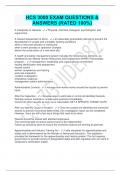
HCS 3000 EXAM QUESTIONS & ANSWERS (RATED 100%)
HCS 3000 EXAM QUESTIONS & ANSWERS (RATED 100%) 5 Categories of Hazards - Physical, chemical, biological, psychological, and ergonomics A Hazard Assessment is Done - at reasonably practicable intervals to prevent the development of unsafe and unhealthy working conditions when a new work process is introduced when a work process or operation changes before the construction of a new work site. A health and safety management system includes the following key elements, as identified by the Alberta Human Resources and Employment (AHRE) Partnerships program: - management, leadership and organizational commitment hazard identification and assessment hazard control worker competency and training work site inspection incident investigation emergency response management system administration. Administrative Controls - manage how worker works around the hazard to prevent injury After the Inspection - Develop ways to eliminate or control all identified hazards. Remedy serious hazards or unsafe work practices immediately. Control all other hazards as soon as is reasonable; SET A SPECIFIC TARGET DATE. After you Identify Cause of Incident - Once the causes are identified and corrective actions to prevent recurrence determined, the investigation report can be completed. However, there are still a few more things that need to be done: Results should be shared with affected employees. The recommended corrective actions have to be implemented. Follow up should be done to ensure the corrective actions are working as planned. Apprenticeship and Industry Training Act - sets standards for apprenticeship and trades and is administered by the Ministry of Advanced Education. The legislation provides the framework for the apprenticeship and training system. The Act requires government to provide training in designated trades and also regulates who can work in compulsory certification trades. Benefits of a Hazard Assessment - learning what could harm workers finding better and safer ways to do the job identifying the need for worker training identifying poor or missing procedures increasing workers' involvement of workplace health and safety having a useful tool when investigating an incident. Canadian Standards Association (CSA) - standards that relate to the workplace include office ergonomics, machine guarding, punch and brake press safety, fork truck safety and other standards for equipment like safety boots, hard hats, electrical appliances, ladders and fall protection. They are not laws themselves but sometimes are referred to, in Alberta legislation, as a standard for compliance with the requirements. The CSA marking on equipment gives users the assurance that it has been tested to meet tough Canadian standards. Combination - needed if any one type of control on its own is not enough Competence - a term with a specific definition in the OHS Regulation. A competent worker means someone who is "...adequately qualified, suitably trained and with sufficient experience to safely perform work without supervision or with only a minimal degree of supervision."
Document information
- Uploaded on
- July 14, 2024
- Number of pages
- 16
- Written in
- 2023/2024
- Type
- Exam (elaborations)
- Contains
- Questions & answers


