
Case 1
Part 1
1. Dsm 5 criteria panic disorder, generalized anxiety disorder, social anxiety disorder
a. Panic disorder
-
-
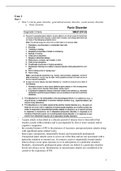
- A panic attack is described as a discrete period of intense fear or discomfort that
reaches a peak within minutes and is accompanied by four or more somatic and/or
cognitive symptoms.
- the essential feature of PD is the presence of recurrent, unexpected panic attacks along
with significant panic-related worry
- three types: unexpected, situationally bound, and situationally predisposed.
Unexpected panic attacks seem to occur out of the blue and are not associated with a
particular situation or internal cue. In contrast, cued or situationally bound attacks
almost always occur upon exposure to or in anticipation of a particular situation.
Similarly, situationally predisposed panic attacks are linked to a particular situation
but do not always occur. Spontaneous or uncued panic attacks are considered to be
central to the experience of PD.
1
, - Limited-symptom attacks (attacks that are identical to “full” panic attacks except that
the sudden fear or anxiety is accompanied by fewer than 4 of the 13 panic symptoms)
are also very common in people that develop PD.
- Dsm 4: panic disorder with or without agoraphobia. DSM 5: agoraphobia is a disorder
on its own.
b. Generalized anxiety disorder
-
- GAD participants report a greater number of worry topics compared to control
participants, and that GAD participants have a greater number of worries pertaining to
miscellaneous topics (e.g., daily hassles).
- In contrast to other anxiety syndromes, GAD is not characterized by motoric
avoidance of disorder-specific situations. Instead, current theoretical models
conceptualize worry as entailing cognitive avoidance of threatening material
-
c. Social anxiety disorder
-
2
Part 1
1. Dsm 5 criteria panic disorder, generalized anxiety disorder, social anxiety disorder
a. Panic disorder
-
-
- A panic attack is described as a discrete period of intense fear or discomfort that
reaches a peak within minutes and is accompanied by four or more somatic and/or
cognitive symptoms.
- the essential feature of PD is the presence of recurrent, unexpected panic attacks along
with significant panic-related worry
- three types: unexpected, situationally bound, and situationally predisposed.
Unexpected panic attacks seem to occur out of the blue and are not associated with a
particular situation or internal cue. In contrast, cued or situationally bound attacks
almost always occur upon exposure to or in anticipation of a particular situation.
Similarly, situationally predisposed panic attacks are linked to a particular situation
but do not always occur. Spontaneous or uncued panic attacks are considered to be
central to the experience of PD.
1
, - Limited-symptom attacks (attacks that are identical to “full” panic attacks except that
the sudden fear or anxiety is accompanied by fewer than 4 of the 13 panic symptoms)
are also very common in people that develop PD.
- Dsm 4: panic disorder with or without agoraphobia. DSM 5: agoraphobia is a disorder
on its own.
b. Generalized anxiety disorder
-
- GAD participants report a greater number of worry topics compared to control
participants, and that GAD participants have a greater number of worries pertaining to
miscellaneous topics (e.g., daily hassles).
- In contrast to other anxiety syndromes, GAD is not characterized by motoric
avoidance of disorder-specific situations. Instead, current theoretical models
conceptualize worry as entailing cognitive avoidance of threatening material
-
c. Social anxiety disorder
-
2


