

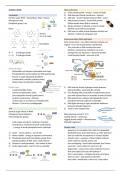
NUCLEIC ACIDS DNA purification
1) Grind sample pestle + mortar - break cell walls
Nucleotide 2) Add detergent (break membrane + release)
Pentose sugar (DNA = deoxyribose, RNA = ribose) 3) Add salts – break H bonds between DNA + water
Nitrogenous base 4) Add protease enzyme - break DNA protein
Phosphate group (-ve) (RNase breaks down RNA in mixture)
5) Slowly add layer of ethanol on top of sample
Bases Alcohol causes SNA to precipitate
6) DNA seen as white strands between alcohol and
Purines solution + picked up using glass rod
(2 x C-N rings)
Semiconservative DNA replication
Semi-conservative = new DNA molecule contains one
Pyrimidines original + one new strand (before cell division)
- Very accurate so DNA remains the same
- Random, spontaneous mutations can occur
A=T 2 hydrogen bonds - Change the base sequence = abnormal protein
CG 3 hydrogen bonds - Could function better / not work at all
Polynucleotides
- Nucleotides join between phosphate and sugar
- Phosphodiester bond (catalyse by DNA polymerase)
- Known as sugar-phosphate backbone
- Condensation reaction (releases water)
- Broken down by hydrolysis reaction
Double helix 1) DNA helicase breaks hydrogen bonds between
- 2 polynucleotide chains polynucleotides, separating the strands
- H bond complimentary bases 2) Free floating DNA nucleotides complementary base
- One antiparallel strand (upside down) pair with exposed base on template strands (H bond)
- Contains nucleosome + histones 3) DNA polymerase catalyses phosphodiester bond
- 10 base pairs in one full turn of double helix formation between adjacent nucleotides
- Watson + Crick Xray Crystallography 4) DNA ligase forming a sugar-phosphate backbone
between Okazaki fragments
ATP 5) Twist to form double helix
pentose sugar (ribose in RNA)
nitrogenous base (adenine), DNA polymerase bond 3’ to 5’
three phosphate groups Leading strand = continuous
Lagging strand (antipl) = discontinuous
- Cells require energy for synthesis, transport (Okazaki fragments)
(membrane), movement (muscle contractions)
- ↓ energy to break phosphate bond, hydrolysis Genetic code
- Sequence of nucleotides that code for polypeptide
1) Small – moves easily in / out of cells - Nucleotide base order determines aa order (primary)
2) Water soluble – energy in aqueous environment - Each aa coded for by sequence of 3 bases (triplet)
3) Phosphate bonds with immediate energy (from - Genetic code = sequence of base triplets (codons)
phosphorylation of ADP, store small amount) which codes for specific amino acid
4) Release in small quantities – not wasted as heat - non overlapping = each triplet separate, don’t share
5) Easily regenerated – bad LT store as unstable - universal = same codon for same aa in all
- degenerate = some amino acids coded for by more
than one triplet (20 aa but 64 triplets) 43
- start / stop codons = at beginning and end of gene
when to start + stop protein production
start code = methionine + there are 3 stop codes
1) Grind sample pestle + mortar - break cell walls
Nucleotide 2) Add detergent (break membrane + release)
Pentose sugar (DNA = deoxyribose, RNA = ribose) 3) Add salts – break H bonds between DNA + water
Nitrogenous base 4) Add protease enzyme - break DNA protein
Phosphate group (-ve) (RNase breaks down RNA in mixture)
5) Slowly add layer of ethanol on top of sample
Bases Alcohol causes SNA to precipitate
6) DNA seen as white strands between alcohol and
Purines solution + picked up using glass rod
(2 x C-N rings)
Semiconservative DNA replication
Semi-conservative = new DNA molecule contains one
Pyrimidines original + one new strand (before cell division)
- Very accurate so DNA remains the same
- Random, spontaneous mutations can occur
A=T 2 hydrogen bonds - Change the base sequence = abnormal protein
CG 3 hydrogen bonds - Could function better / not work at all
Polynucleotides
- Nucleotides join between phosphate and sugar
- Phosphodiester bond (catalyse by DNA polymerase)
- Known as sugar-phosphate backbone
- Condensation reaction (releases water)
- Broken down by hydrolysis reaction
Double helix 1) DNA helicase breaks hydrogen bonds between
- 2 polynucleotide chains polynucleotides, separating the strands
- H bond complimentary bases 2) Free floating DNA nucleotides complementary base
- One antiparallel strand (upside down) pair with exposed base on template strands (H bond)
- Contains nucleosome + histones 3) DNA polymerase catalyses phosphodiester bond
- 10 base pairs in one full turn of double helix formation between adjacent nucleotides
- Watson + Crick Xray Crystallography 4) DNA ligase forming a sugar-phosphate backbone
between Okazaki fragments
ATP 5) Twist to form double helix
pentose sugar (ribose in RNA)
nitrogenous base (adenine), DNA polymerase bond 3’ to 5’
three phosphate groups Leading strand = continuous
Lagging strand (antipl) = discontinuous
- Cells require energy for synthesis, transport (Okazaki fragments)
(membrane), movement (muscle contractions)
- ↓ energy to break phosphate bond, hydrolysis Genetic code
- Sequence of nucleotides that code for polypeptide
1) Small – moves easily in / out of cells - Nucleotide base order determines aa order (primary)
2) Water soluble – energy in aqueous environment - Each aa coded for by sequence of 3 bases (triplet)
3) Phosphate bonds with immediate energy (from - Genetic code = sequence of base triplets (codons)
phosphorylation of ADP, store small amount) which codes for specific amino acid
4) Release in small quantities – not wasted as heat - non overlapping = each triplet separate, don’t share
5) Easily regenerated – bad LT store as unstable - universal = same codon for same aa in all
- degenerate = some amino acids coded for by more
than one triplet (20 aa but 64 triplets) 43
- start / stop codons = at beginning and end of gene
when to start + stop protein production
start code = methionine + there are 3 stop codes


