

PECT Module 1 Questions And Answers With Verified Quiz
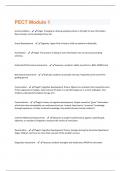
Accommodation - Piaget. Changing or altering existing schema in the light of new information. New schemas can be developed here too. Actual Development - Vygotsky. Upper limit of tasks a child can perform individually Assimilation - Piaget. The process of taking in new information into our previously existing schemas. Authentic/Performance Assessment - Assesses a student's ability to perform a REAL WORLD task Benchmark Assessment - Evaluates students at periodic intervals, frequently at the end of the grading period Conservation - Piaget's Cognitive Development Theory. Objects can maintain their properties even if their appearance changes. Same amount of water in a tall skinny glass as in a short wide glass. Few children understand this before the age of 5. Constructivism - Piaget's theory of cognitive development. People cannot be "given" information which then they immediately can understand and use. Instead, they have to "construct" knowledge through experience. As they construct knowledge, they build schemas (mental models) t Criterion-Referenced Assessment - Measures a student's performance against a specific goal, objective, or standard. Designed to measure the results of instruction. Decentration - Piaget's Cognitive Development Theory. Emerges during the Concrete Operational Stage. Children can focus on more than one part of the problem at once. Diagnostic Assessment - Assesses students strengths and weaknesses PRIOR to instructionDomains of Early Childhood Development: Cognitive - The ability to think, reason, and learn. This includes cause-and-effect, early-math skills, counting, and patterning. Domains of Early Childhood Development: Lanugage - The ability to understand the spoken word and express herself verbally. Can have back-and-forth conversation. Domains of Early Childhood Development: Physical - First to develop after birth. Includes gross and fine motor, sensory, perceptional. Domains of Early Childhood Development: Self-Help/Adaptive - Everything a child needs to know to be independent: learning to dress oneself, , feed oneself, using the toilet, brushing teeth, bathing, tying shoes. Domains of Early Childhood Development: Social/Emotional - The ability to build and maintain relationships. Includes cooperative play, conflict resolution, empathy, manners, and fairness. Ability to recognize own emotions. Egocentrism - Piaget's Cognitive Development Theory. Children in the Preoperational Stage are unable to look (both emotionally and concretely) from another's viewpoint. Erikson Stage 1: Age 0-1 (Infancy) - Trust vs. Mistrust: In the first year of life, infants depend on others for food, warmth, and affection, and therefore must be able to blindly trust the parents (or caregivers) for providing those. Erikson Stage 2: Age 1-2 (Toddler) - Autonomy (Independence) vs. Doubt (or Shame): Toddlers learn to walk, talk, use toilets, and do things for themselves. Their self-control and self-confidence begin to develop at this stage. Erikson Stage 3: Age 2-6 (Early Childhood) - Initiative vs. Guilt: Children have newfound power at this stage as they have developed motor skills and become more and more engaged in social interaction with people around them. They now must learn to achieve a balance between eagerness for more adventure and more responsibility, and learning to control impulses and childish fantasies.Erikson Stage 4: Age 6-12 (Elementary & Middle School) - Competence (aka. "Industry") vs. Inferiority: School is the important event at this stage. Children learn to make things, use tools, and acquire the skills to be a worker and a potential provider. And they do all these while making the transition from the world of home into the world of peers. Erikson's Stages of Development - Each individual passes through 8 stages of development, each characterized by a distinct psychological "crisis." Each must be resolved before moving to the next stage. If the person copes with a crisis in a maladaptive manner, the outcome will be more struggles with that issue later in life. Examples of Authentic/Performance Assessment - Science experiment, give a speech, presentation, or performance, long-term project, using math to buy an item with exact change Examples of Benchmark Assessment - PA LEAP test, DIBELS Examples of Criterion-Referenced Assessment - AP Exams, Unit-Midterms/Final exams Examples of Formative Assessment - Curriculum-based assessment, exit tickets, think-pair-share, white boards, response cards Examples of Normative/Norm-Referenced Assessment - IQ tests, SAT, ACT Examples of Summative Assessment - PSSAs, Terra Novas, end of unit tests Fine Motor Development - Moving the small muscles in coordination with the eyes. Activities to develop: putting together puzzles with small pieces, peg board games, painting, drawing, cutting, stringing and lacing activities, construction and building sets like Legos, buttons, snaps, and tying Formative Assessment - Assesses students DURING instruction. Low stakes and worth no points.Gross Motor Development - Moving the large muscle groups. Activities to develop: walking on their toes or heels; walking with toes pointed in or out; walking or moving like a certain animal; playing kickball, basketball, or skating; swinging, sliding, climbing on monkey bars; balancing while walking along a curb; walking while balancing a book on the head; jumping, doing jumping jacks, and jumping over obstacles. Participating in sports groups. Level of Potential Development - Vygotsky. The upper limit of tasks a child can perform with the assistance of a more competent individual. Maslow's Hierarchy of Needs - Humans are motivated by needs. There are 5 levels of need. When one has been fulfilled, a human seeks the next level. One must satisfy the basic needs before moving to the higher, growth needs. (1) Biological and Physiological needs - air, food, drink, shelter, warmth, sex, sleep. (2) Safety needs - protection from elements, security, order, law, stability, freedom from fear. (3) Love and belongingness needs - friendship, intimacy, affection and love, - from work group, family, friends, romantic relationships. (4) Esteem needs - achievement, mastery, independence, status, dominance, prestige, self-respect, respect from others (5) Self-Actualization needs - realizing personal potential, self-fulfillment, seeking personal growth and peak experiences.
Document information
- Uploaded on
- July 10, 2024
- Number of pages
- 5
- Written in
- 2023/2024
- Type
- Exam (elaborations)
- Contains
- Questions & answers


