

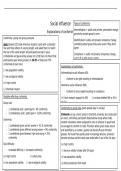
Social influence Types of conformity-
Internalisation = public and private, permanent change,
Explanations of conformity genuinely accepts group’s norm
Conformity- giving into group pressure
Identification= public and private, temporary change,
Asch showed 123 male American students cards with a standard something about group they value even if they don’t
line and three others of varying length, and asked them to match agree
the two of the same length. All participants except 1 was a
Compliance = public not private, temporary change, ,
confederate and gave wrong answer on 12/18 trials. He found that
just to fit in with group’s norms
participants gave wrong answer on 36.8% of trials and 75%
conformed at least once
Explanations of conformity-
(-) low population validity
Informational social influence (ISI)
(-) low ecological validity
- Conform to be right resulting in internalisation
(+) high control
Normative social influence (NSI)
(-) informed consent
- Conform to be accepted resulting in compliance
Variables effecting conformity (+) Asch research support for NSI (-) unclear whether NSI or ISI in
Group size: studies
- 1 confederate and 1 participant = 4% conformity Conformity to social roles (parts people play in society)
- 3 confederates and 1 participant = 31.8% conformity Zimbardo set up a mock prison in Stanford university and conducted
Unanimity: an overt, controlled, participant observational study where male
student volunteers where assigned to roles of prisoner or guard and
- 1 confederate gives correct answer = 5.5.% conformity encouraged to conform to roles. Prisoners where given loose smock
- 1 confederate gives different wrong answer = 9% conformity and identified by a number, guards had handcuffs and mirrored
- 1 confederate goes between right and wrong = 25% glasses. He found that guards grew increasingly abusive, prisoners
conformity became anxious and the study was ended after 6 out of the 14 days.
Task difficulty: (+) high control
- Increased difficulty = increased conformity (-) low eco validity (ended after 24 days)
(+) high control (-) culture bias (-) low population validity
(-) low population validity (-) low ecological validity (-) ethical protection from harm
Internalisation = public and private, permanent change,
Explanations of conformity genuinely accepts group’s norm
Conformity- giving into group pressure
Identification= public and private, temporary change,
Asch showed 123 male American students cards with a standard something about group they value even if they don’t
line and three others of varying length, and asked them to match agree
the two of the same length. All participants except 1 was a
Compliance = public not private, temporary change, ,
confederate and gave wrong answer on 12/18 trials. He found that
just to fit in with group’s norms
participants gave wrong answer on 36.8% of trials and 75%
conformed at least once
Explanations of conformity-
(-) low population validity
Informational social influence (ISI)
(-) low ecological validity
- Conform to be right resulting in internalisation
(+) high control
Normative social influence (NSI)
(-) informed consent
- Conform to be accepted resulting in compliance
Variables effecting conformity (+) Asch research support for NSI (-) unclear whether NSI or ISI in
Group size: studies
- 1 confederate and 1 participant = 4% conformity Conformity to social roles (parts people play in society)
- 3 confederates and 1 participant = 31.8% conformity Zimbardo set up a mock prison in Stanford university and conducted
Unanimity: an overt, controlled, participant observational study where male
student volunteers where assigned to roles of prisoner or guard and
- 1 confederate gives correct answer = 5.5.% conformity encouraged to conform to roles. Prisoners where given loose smock
- 1 confederate gives different wrong answer = 9% conformity and identified by a number, guards had handcuffs and mirrored
- 1 confederate goes between right and wrong = 25% glasses. He found that guards grew increasingly abusive, prisoners
conformity became anxious and the study was ended after 6 out of the 14 days.
Task difficulty: (+) high control
- Increased difficulty = increased conformity (-) low eco validity (ended after 24 days)
(+) high control (-) culture bias (-) low population validity
(-) low population validity (-) low ecological validity (-) ethical protection from harm


