

CSCC Psychology - Exam 2 Questions and Answers Solved 100%
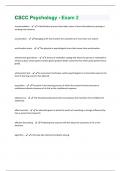
accommodation - A classification process that makes sense of new information by revising or creating new schemas. acculturation - Managing a life that involves the coexistence of more than one culture. acculturative stress - The physical or psychological stress that comes from acculturation. achievement goal theory - A theory of motivation stating that when the person is motivated to achieve a goal, certain goals (mastery goals) produce better outcomes than other goals (performance goals). achievement test - An assessment technique used by psychologists to numerically measure the level of learning a person has attained. acquisition - The point in the learning process at which the neutral stimulus becomes a conditioned stimulus because of its link to the conditioned response. adolescence - The developmental period that encompasses the transition from childhood to adulthood. affect heuristic - An educated guess in which the worth of something is strongly influenced by how a person feels toward it. affective forecasting - Predicting how a person will feel about the outcomes of his or her decisions. algorithm - A formula-like method of problem ring heuristic - An educated guess in which the starting point has a strong influence on the conclusion that is ultimately reached. arousal theory - A theory of motivation stating that the person is motivated to obtain and maintain an optimal level of arousal. assimilation - A classification process that makes sense of new information by sorting into already existing schemas. assimilation - An acculturation strategy in which the person adopts the new culture and rejects the old culture. attachment - A close emotional bond between two people, particularly a young child and a caregiver. authoritarian parenting style - An approach to parenting in which parents require children to obey unquestionable, strict rules. authoritative parenting style - An approach to parenting in which parents set rules, but also explain and negotiate those rules with their children. availability heuristic - An educated guess based on the information that most quickly and easily comes to mind. babbling - An early stage of speech development during which the baby vocalizes a wide variety of nonword sounds. biological preparedness - An animal's evolutionary predisposition to learn that which is most relevant to the survival of that species. bisexual - The sexual orientation of a person who is attracted to people of both the other and the same sex.Cannon-Bard theory - A theory of emotion stating that the person experiences emotion by simultaneously becoming aware of bodily changes and feelings. cisgender - A person whose gender and sex match classical conditioning - A form of learning in which animals or people make a connection between two stimuli that have occurred together, such that one predicts the other. cognition - What the brain does with information, including understanding it, organizing it, analyzing it, and communicating it. cognitive appraisal theory - A theory of emotion stating that what the person thinks about a stimulus causes the emotion. cognitive map - A mental diagram of the physical environment as it is initially explored when no reinforcement is available. collectivism - A worldview that emphasizes the well-being of the group over the well-being of the individual. concept - A mental representation of a category of similar things, actions, or people. concrete operational stage - The third stage in Piaget's theory of development, from about age 7 to about age 11, in which children acquire the ability to think logically about concrete things. conditioned response - The response to a conditioned stimulus acquired through learning. conditioned stimulus - A formerly neutral stimulus that now causes a response because of its link to an unconditioned rmation bias - A tendency to prefer information that confirms what a person thought in the first place. conservation - A mental operation in which an amount or quantity remains the same regardless of the shape it takes. continuous reinforcement - A pattern by which a behavior is reinforced every time it occurs. conventional morality - A moral decision-making strategy driven by the desire to follow society's norms and laws. convergent thinking - A problem-solving strategy in which a person uses logic to deduce the single best solution. creativity - The capacity to come up with original ideas or approaches to a problem. critical period - A period of time during which a particular developmental task is especially likely to be influenced by outside events. cross-sectional design - A research design in which people of different ages are compared to each other at the same point in time. cultural intelligence - A person's ability to live and interact effectively in a multicultural society. culture - A group of similar people who share beliefs, values, and patterns of behavior. culture-fair intelligence tests - Intelligence tests that aim to reduce or remove any cultural factors that could lead to bias. decision making - Using cognition to choose between available opmental psychology - The study of the changes to body, mind, and interpersonal interaction that people experience across the life span. dialect - A group's particular version of a language with its own unique characteristics. discrimination - The learning process by which stimuli that are different from the conditioned stimulus fail to cause the same conditioned response. discriminative stimulus - A signal indicating that a particular behavior will be followed by a particular consequence. display rules - Norms within a group about the acceptable verbal and nonverbal expression of emotion. divergent thinking - A problem-solving strategy in which a person comes up with lots of different possible solutions. drive reduction theory - A theory of motivation stating that unmet biological drives cause unpleasant sensations that motivate the person to meet those needs. dual-process theory - The notion that every person possesses two separate types of thinking, one automatic and one deliberate. durability bias - The overestimation of the expected length of the feeling produced by the outcome of a decision. dynamic sizing - The ability to simultaneously know the norm for a group and recognize that the norm might not apply to every member of that group.
Document information
- Uploaded on
- June 29, 2024
- Number of pages
- 17
- Written in
- 2023/2024
- Type
- Exam (elaborations)
- Contains
- Questions & answers


