Themes in King Lear
Order and Chaos
Most of the chaos is caused directly or indirectly by Lear’s decision to divide his kingdom. It had both a
personal and a political effect because he is the king – Shakespeare shows that these are linked. Lear is the king
and therefore, the chaos in his kingdom is reflected in his own internal chaos; king and country cannot be
separated just as the kingdom cannot be separated. There is the breaking up of trust and betrayal between family
and friends; a reversal of roles (people don’t know who has the authority anymore); disruption of the natural
order and premature/unnatural death. The Fool’s topsy-turvy language reflects the disorder in Lear’s kingdom.
However, at the end of the play order is restored when evil is purged from the play. Edgar doesn’t jump to
power at the end as his brother would’ve done which reassures the audience of a lesson learned and that evil has
been vanquished.
The concept of The Great Chain of Being was important at the time. It is a strict hierarchical structure of all
matter and life, thought, in medieval Christianity, to have been decreed by God. Chaos can take place when this
is disrupted e.g when Lear’s gives up his sovereign power England loses its king and there is a confusion of
power.
• ‘Love cools, friendships fall off, brothers divide, in cities mutinies, in countries discord, in palaces,
treason and the bond cracked ‘twixt son and father’ – Gloucester 1:2
• ‘Better thou hadst not been born than not to have pleased me better’ – Lear 1:1
• ‘Epicurism and lust makes it more like a tavern or and brothel than a graced palace’ – Goneril 1:4
• ‘Fetch forth the stocks’ – Cornwall 2:2
• ‘Pinion him like a thief’ – Cornwall 3:7
• ‘From that place, I will no leading need’ Gloucester 4:1
• ‘‘Tis the time’s plague where madmen lead the blind’ Gloucester 4:1
• ‘Let this kiss repair the violent harms that my two sisters have in thy reverence made’ Cordelia 4:7
• ‘Why should a dog, a horse have life, and thou no breath at all?’ Lear 5:3
• ‘The weight of this sad time we must obey, speak what we feel, not what we ought to say’ Edgar 5:3
Tragic Heroism
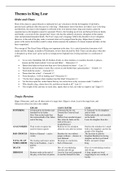
Edgar, Gloucester, and Lear all share traits of a tragic hero. Edgar is a hero, Lear is the tragic hero, and
Gloucester reflects his role in the subplot
EDGAR GLOUCESTER LEAR
SUFFERING Is betrayed by his brother and It betrayed by his son Is ‘betrayed’ by his daughters
banished by his father Tortured by Cornwall and and his lords
Poor Tom on the heath Sees Regan Suffers physically and mentally
this torturer/death of his father Suffers from suicidal despair on the heath
and of the king Dies when he finds out the Loses his daughter then dies
truth of his son’s
loyalty/betrayal
ANAGNORISIS Final words recognise the Realises he was mistaken Realises the mistakes he’s made
need for honest speech about his sons after his torture both to his daughters and for the
people of his kingdom
BAD CHOICES Believes Edmund – a naïve Banishes his son without The decision to split his
victim proper evidence – chooses to kingdom Banishes his loving
trust Edmund daughter and his loyal friend
FATAL FLAW His trusting and honest nature He jumps to conclusions Hubris and quick temper
NOBEL BIRTH Heir to the Earldom – Lear’s Earl of Gloucester King
godson
DEATH N/A Dies of overwhelming Dies of overwhelming emotion
emotion and old age and old age
HEROISM Restores order at the end of Loyal to Lear and is prepared A king- people are loyal
the play, is the force of justice to sacrifice himself for him suggesting he was worthy of
loyalty
Order and Chaos
Most of the chaos is caused directly or indirectly by Lear’s decision to divide his kingdom. It had both a
personal and a political effect because he is the king – Shakespeare shows that these are linked. Lear is the king
and therefore, the chaos in his kingdom is reflected in his own internal chaos; king and country cannot be
separated just as the kingdom cannot be separated. There is the breaking up of trust and betrayal between family
and friends; a reversal of roles (people don’t know who has the authority anymore); disruption of the natural
order and premature/unnatural death. The Fool’s topsy-turvy language reflects the disorder in Lear’s kingdom.
However, at the end of the play order is restored when evil is purged from the play. Edgar doesn’t jump to
power at the end as his brother would’ve done which reassures the audience of a lesson learned and that evil has
been vanquished.
The concept of The Great Chain of Being was important at the time. It is a strict hierarchical structure of all
matter and life, thought, in medieval Christianity, to have been decreed by God. Chaos can take place when this
is disrupted e.g when Lear’s gives up his sovereign power England loses its king and there is a confusion of
power.
• ‘Love cools, friendships fall off, brothers divide, in cities mutinies, in countries discord, in palaces,
treason and the bond cracked ‘twixt son and father’ – Gloucester 1:2
• ‘Better thou hadst not been born than not to have pleased me better’ – Lear 1:1
• ‘Epicurism and lust makes it more like a tavern or and brothel than a graced palace’ – Goneril 1:4
• ‘Fetch forth the stocks’ – Cornwall 2:2
• ‘Pinion him like a thief’ – Cornwall 3:7
• ‘From that place, I will no leading need’ Gloucester 4:1
• ‘‘Tis the time’s plague where madmen lead the blind’ Gloucester 4:1
• ‘Let this kiss repair the violent harms that my two sisters have in thy reverence made’ Cordelia 4:7
• ‘Why should a dog, a horse have life, and thou no breath at all?’ Lear 5:3
• ‘The weight of this sad time we must obey, speak what we feel, not what we ought to say’ Edgar 5:3
Tragic Heroism
Edgar, Gloucester, and Lear all share traits of a tragic hero. Edgar is a hero, Lear is the tragic hero, and
Gloucester reflects his role in the subplot
EDGAR GLOUCESTER LEAR
SUFFERING Is betrayed by his brother and It betrayed by his son Is ‘betrayed’ by his daughters
banished by his father Tortured by Cornwall and and his lords
Poor Tom on the heath Sees Regan Suffers physically and mentally
this torturer/death of his father Suffers from suicidal despair on the heath
and of the king Dies when he finds out the Loses his daughter then dies
truth of his son’s
loyalty/betrayal
ANAGNORISIS Final words recognise the Realises he was mistaken Realises the mistakes he’s made
need for honest speech about his sons after his torture both to his daughters and for the
people of his kingdom
BAD CHOICES Believes Edmund – a naïve Banishes his son without The decision to split his
victim proper evidence – chooses to kingdom Banishes his loving
trust Edmund daughter and his loyal friend
FATAL FLAW His trusting and honest nature He jumps to conclusions Hubris and quick temper
NOBEL BIRTH Heir to the Earldom – Lear’s Earl of Gloucester King
godson
DEATH N/A Dies of overwhelming Dies of overwhelming emotion
emotion and old age and old age
HEROISM Restores order at the end of Loyal to Lear and is prepared A king- people are loyal
the play, is the force of justice to sacrifice himself for him suggesting he was worthy of
loyalty