Emotion
• Temporary state that is encompassed of experiences (subjective) and
physiological activities and responses.
• Not location specific in the brain
• Consists of mental and physical aspects
• Emotions are generated in response to appraisals
o Appraisals are subjective interpretations of an event that generate
emotions
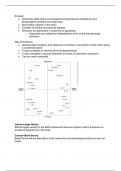
Map of emotions
• Approximates locations and distances of emotion in proximity to each other along
a coordinate plane.
• X-axis correlates to valence (level of pleasantness)
• Y-axis correlates to arousal (intensity and level of autonomic activation)
• Can be used universally
James-Lange theory
Stimuli trigger activity in the ANS (Autonomic Nervous System) which produces an
emotional experience in the brain.
Cannon-Bard theory
Belief that emotions take place at the same time as physiological activity but are not
linked.
, James-Lange theory does not take three facts into account
1. Some emotional experiences occur before we have a physiological response.
2. Physiological responses can be triggered by a variety of things without
concurrently causing emotions.
3. In order for the James-Lange theory to be correct each emotion would have to
have an individually unique bodily response(s) ergo every emotion would have a
“physiological footprint” unique to it.
Two-factor theory
Stimuli trigger a general state of physiological arousal, which is then interpreted as a
specific emotion.
• Formulated by Stanley Schachter and Jerome Singer
• Humans have a singular physiological response to all emotional stimuli.
• Interpretation of the physiological response depends upon the environment
and/or occasion e.g. fear vs excitement
• Criticized for the idea that a singular bodily response is not universal for all
emotions.
The amygdala plays an essential role in emotion and threat detection
• Appraisals are made by the amygdala.
Pathways of fear
Fast- Thalamus to amygdala
Slow- Thalamus to cortex to amygdala
Because the pathways are working at the same time yet one is moving quicker you fcan
eel afraid before you are aware what it is you are afraid of
• Temporary state that is encompassed of experiences (subjective) and
physiological activities and responses.
• Not location specific in the brain
• Consists of mental and physical aspects
• Emotions are generated in response to appraisals
o Appraisals are subjective interpretations of an event that generate
emotions
Map of emotions
• Approximates locations and distances of emotion in proximity to each other along
a coordinate plane.
• X-axis correlates to valence (level of pleasantness)
• Y-axis correlates to arousal (intensity and level of autonomic activation)
• Can be used universally
James-Lange theory
Stimuli trigger activity in the ANS (Autonomic Nervous System) which produces an
emotional experience in the brain.
Cannon-Bard theory
Belief that emotions take place at the same time as physiological activity but are not
linked.
, James-Lange theory does not take three facts into account
1. Some emotional experiences occur before we have a physiological response.
2. Physiological responses can be triggered by a variety of things without
concurrently causing emotions.
3. In order for the James-Lange theory to be correct each emotion would have to
have an individually unique bodily response(s) ergo every emotion would have a
“physiological footprint” unique to it.
Two-factor theory
Stimuli trigger a general state of physiological arousal, which is then interpreted as a
specific emotion.
• Formulated by Stanley Schachter and Jerome Singer
• Humans have a singular physiological response to all emotional stimuli.
• Interpretation of the physiological response depends upon the environment
and/or occasion e.g. fear vs excitement
• Criticized for the idea that a singular bodily response is not universal for all
emotions.
The amygdala plays an essential role in emotion and threat detection
• Appraisals are made by the amygdala.
Pathways of fear
Fast- Thalamus to amygdala
Slow- Thalamus to cortex to amygdala
Because the pathways are working at the same time yet one is moving quicker you fcan
eel afraid before you are aware what it is you are afraid of