

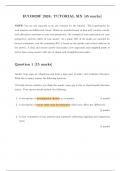
ECO3020F 2024: TUTORIAL SIX [45 marks]
NOTE: You are not expected to do any research for the tutorial. The requirements for
your answers are deliberately broad. Marks are awarded based on how well you have consid-
ered alternative positions to your own perspective, the strength of your motivation for your
perspective, and the clarity of your answer. As a guide, 80% of the marks are awarded for
factual statements, and the remaining 20% is based on the quality and critical reflecion in
the answer. A clear and concise answer that makes a few important and insightful points is
better than a long answer with lots of simple and straightforward points.
Question 1 [15 marks]
Gender wage gaps are ubiquitous and form a large part of policy and workplace discourse.
With this in mind, answer the following question.
Critically discuss whether you think the gender wage gap is due to objectionable discrimi-
nation. Your answer should include the following:
1. A description of discrimination theories in economics. [5 marks]
2. A description of factors other than discrimination which may a↵ect pay di↵erences.
[5 marks]
3. A clear statement of your position and argument addressing opposing and supporting
views.
[5 marks]
, Di erent discrimination theories are used in economics to explain how biases and prejudices can
lead to di erential treatment in the labor market which can result in a gender wage gap. Of these
theories, there is the taste-based discrimination theory which assumes that employers (or
employees) have an overt prejudice towards a particular group and are willing to pay a premium to
avoid having individuals from the group. Under the taste-based discrimination model, employers
may be willing to sacri ce higher productivity and pro ts which may result from hiring a more
quali ed woman in favour of a less productive man, thus leading to adverse hiring and promotion
decisions for men. In other words, employers will satisfy their tastes but in doing so, they will hire
less e cient workers. Another form of discrimination is the statistical discrimination theory arising
from market failure caused by asymmetric problems between employers and employees. Because
employers do not know enough about a potential applicant, this means that the employers will use
some of the group’s statistical characteristics to draw conclusions on the applicant’s qualities.
Therefore, statistical discrimination is a product of both asymmetric information and a statistical
characterisation of a particular group. Lastly, explicit or implicit stereotyping (occupational
segregation) is when certain jobs are dominated by a speci c gender because of societal norms,
stereotypes or structural barriers which can result in a gender wage gap.
Factors that in uence the pay di erence other than discrimination include occupational choice
which can lead to di erences in pay between men and women, work experience and hours\ years
worked in the company can also play a role in in uencing the pay di erence in men and women as
women tend to traditionally take maternity leave once they fall pregnant and hence might not be
viewed as valuable of an asset to a company as a man. Lastly, the employee’s negotiation skills also
play a role in the pay di erence as employees can negotiate for a higher salary while the ones who
are less aggressive at the negotiations table get the shorter end of the stick. The di erence in the
negotiations tactic between genders can grow over time thus resulting in a gap in pay between the
genders.
Overall, while the gender wage gap may not be solely due to objectionable discrimination but is
rather in uenced by both a combination of structural factors and discriminatory practices, the
discrimination theories in economics are useful in that they provide insight into how the biases and
prejudices can in uence labor market outcomes and ultimately result in the gender wage gap which
can grow over time if not properly addressed. Therefore, it is important to address these structural
inequalities by implementing policies that aim at creating more equitable opportunities for both men
and women, such as pay transparency, anti-discrimination laws while creating an inclusive
environment in which both men and women can succeed.
ff
ff
NOTE: You are not expected to do any research for the tutorial. The requirements for
your answers are deliberately broad. Marks are awarded based on how well you have consid-
ered alternative positions to your own perspective, the strength of your motivation for your
perspective, and the clarity of your answer. As a guide, 80% of the marks are awarded for
factual statements, and the remaining 20% is based on the quality and critical reflecion in
the answer. A clear and concise answer that makes a few important and insightful points is
better than a long answer with lots of simple and straightforward points.
Question 1 [15 marks]
Gender wage gaps are ubiquitous and form a large part of policy and workplace discourse.
With this in mind, answer the following question.
Critically discuss whether you think the gender wage gap is due to objectionable discrimi-
nation. Your answer should include the following:
1. A description of discrimination theories in economics. [5 marks]
2. A description of factors other than discrimination which may a↵ect pay di↵erences.
[5 marks]
3. A clear statement of your position and argument addressing opposing and supporting
views.
[5 marks]
, Di erent discrimination theories are used in economics to explain how biases and prejudices can
lead to di erential treatment in the labor market which can result in a gender wage gap. Of these
theories, there is the taste-based discrimination theory which assumes that employers (or
employees) have an overt prejudice towards a particular group and are willing to pay a premium to
avoid having individuals from the group. Under the taste-based discrimination model, employers
may be willing to sacri ce higher productivity and pro ts which may result from hiring a more
quali ed woman in favour of a less productive man, thus leading to adverse hiring and promotion
decisions for men. In other words, employers will satisfy their tastes but in doing so, they will hire
less e cient workers. Another form of discrimination is the statistical discrimination theory arising
from market failure caused by asymmetric problems between employers and employees. Because
employers do not know enough about a potential applicant, this means that the employers will use
some of the group’s statistical characteristics to draw conclusions on the applicant’s qualities.
Therefore, statistical discrimination is a product of both asymmetric information and a statistical
characterisation of a particular group. Lastly, explicit or implicit stereotyping (occupational
segregation) is when certain jobs are dominated by a speci c gender because of societal norms,
stereotypes or structural barriers which can result in a gender wage gap.
Factors that in uence the pay di erence other than discrimination include occupational choice
which can lead to di erences in pay between men and women, work experience and hours\ years
worked in the company can also play a role in in uencing the pay di erence in men and women as
women tend to traditionally take maternity leave once they fall pregnant and hence might not be
viewed as valuable of an asset to a company as a man. Lastly, the employee’s negotiation skills also
play a role in the pay di erence as employees can negotiate for a higher salary while the ones who
are less aggressive at the negotiations table get the shorter end of the stick. The di erence in the
negotiations tactic between genders can grow over time thus resulting in a gap in pay between the
genders.
Overall, while the gender wage gap may not be solely due to objectionable discrimination but is
rather in uenced by both a combination of structural factors and discriminatory practices, the
discrimination theories in economics are useful in that they provide insight into how the biases and
prejudices can in uence labor market outcomes and ultimately result in the gender wage gap which
can grow over time if not properly addressed. Therefore, it is important to address these structural
inequalities by implementing policies that aim at creating more equitable opportunities for both men
and women, such as pay transparency, anti-discrimination laws while creating an inclusive
environment in which both men and women can succeed.
ff
ff


