Computer Logic (COM1031)
https://azeria-labs.com/downloads/cheatsheetv1.3-1920x1080.png
(Assembly Language Cheat Sheet)
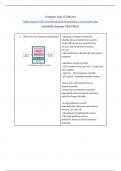
1) What is the Von Neumann Architecture? • Designed a computer architecture
whereby data and instructions would be
retrieved from memory, operated on by
an ALU, and moved back to memory
(or I/O).
• This architecture is the basis for most modern
computers.
• Hardware consists of 3 units:
• CPU (Central Processing Unit) - Control unit,
ALU, registers.
• Memory - Stores programs and data.
• I/O System - Including secondary storage
• Bus to move information from one
element to another.
• Instructions in memory are executed
sequentially unless a program instruction
explicitly changes the order.
• A single pathway is used to
move both data and instructions between
memory, I/O and CPU
• The pathway is implemented as a bus.
• The single pathway creates a
Bottleneck known as the von Neumann
bottleneck.
,2) What are other variations of the Von • A variation of this architecture is the
Neumann Architecture? Harvard architecture which separates
data and instructions into two
pathways.
• Another variation, used in most
computers, is the system bus version in
which there are different buses
between CPU and memory and
memory and I/O.
3) What is an ARM Processor? • ARM processors are a family of central
processing units (CPUs) based on a
reduced instruction set computer (RISC)
architecture.
• ARM stands for Advanced RISC Machine.
• Low costs, minimal power consumption,
and lower heat generation than their
competitors
• Smartphones, laptops, tablet computers,
etc.
4) What is the main memory? • Memory stores data and programs
Organised as:
• bit (0/1)
• byte = 8 bits (smallest addressable location)
• word = 4 bytes (typically; machine dependent)
• Volatile vs non-volatile memory
• Volatile: Dynamic RAM (DRAM),
Static RAM (SRAM)
• Non-volatile: ROM, Flash memory
5) What is secondary storage? • Range of non-volatile storage formats.
Most common forms:
• Optical disks
• Magnetic disks
• Flash memory
• Magnetic tape
,6) What is the NOT Gate? Inverts the output.
7) What is the AND Gate? IF both inputs are 1, THEN output is 1. ELSE
output is 0.
8) What is the NAND Gate? IF both inputs are 1, THEN output is 0
ELSE output is 1.
, 9) What is the OR Gate? IF at least one input is 1, THEN output is 1. ELSE
output is 0.
10) What is a Logic Buffer Gate? • A Buffer performs no inversion or
decision making capabilities but
instead produces an output which
exactly matches that of its input.
• Digital amplification capability to
ensure suitable signal strength at
the next input.
https://azeria-labs.com/downloads/cheatsheetv1.3-1920x1080.png
(Assembly Language Cheat Sheet)
1) What is the Von Neumann Architecture? • Designed a computer architecture
whereby data and instructions would be
retrieved from memory, operated on by
an ALU, and moved back to memory
(or I/O).
• This architecture is the basis for most modern
computers.
• Hardware consists of 3 units:
• CPU (Central Processing Unit) - Control unit,
ALU, registers.
• Memory - Stores programs and data.
• I/O System - Including secondary storage
• Bus to move information from one
element to another.
• Instructions in memory are executed
sequentially unless a program instruction
explicitly changes the order.
• A single pathway is used to
move both data and instructions between
memory, I/O and CPU
• The pathway is implemented as a bus.
• The single pathway creates a
Bottleneck known as the von Neumann
bottleneck.
,2) What are other variations of the Von • A variation of this architecture is the
Neumann Architecture? Harvard architecture which separates
data and instructions into two
pathways.
• Another variation, used in most
computers, is the system bus version in
which there are different buses
between CPU and memory and
memory and I/O.
3) What is an ARM Processor? • ARM processors are a family of central
processing units (CPUs) based on a
reduced instruction set computer (RISC)
architecture.
• ARM stands for Advanced RISC Machine.
• Low costs, minimal power consumption,
and lower heat generation than their
competitors
• Smartphones, laptops, tablet computers,
etc.
4) What is the main memory? • Memory stores data and programs
Organised as:
• bit (0/1)
• byte = 8 bits (smallest addressable location)
• word = 4 bytes (typically; machine dependent)
• Volatile vs non-volatile memory
• Volatile: Dynamic RAM (DRAM),
Static RAM (SRAM)
• Non-volatile: ROM, Flash memory
5) What is secondary storage? • Range of non-volatile storage formats.
Most common forms:
• Optical disks
• Magnetic disks
• Flash memory
• Magnetic tape
,6) What is the NOT Gate? Inverts the output.
7) What is the AND Gate? IF both inputs are 1, THEN output is 1. ELSE
output is 0.
8) What is the NAND Gate? IF both inputs are 1, THEN output is 0
ELSE output is 1.
, 9) What is the OR Gate? IF at least one input is 1, THEN output is 1. ELSE
output is 0.
10) What is a Logic Buffer Gate? • A Buffer performs no inversion or
decision making capabilities but
instead produces an output which
exactly matches that of its input.
• Digital amplification capability to
ensure suitable signal strength at
the next input.