Bio 100 Exam 1 Study Guide Rated A+
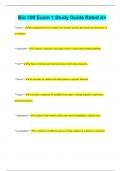
Bio 100 Exam 1 Study Guide Rated A+ **atom** the fundamental unit of matter, the smallest particle that retains the properties of an element **molecule** a chemical structure consisting of two or more atoms bonded together **cell** the basic structural and functional unit of all living organisms **tissue** an assembly of similar cells that perform a specific function **organ** a structure composed of multiple tissue types working together to perform a particular function **population** a group of individuals of the same species inhabiting a specific area **community** a collection of different species living together in a shared environment **ecosystem** a system comprising all biotic (living) and abiotic (nonliving) components that interact within a particular area **niche** the role or function of an organism within its ecosystem, including its use of resources and relationships with other organisms **abiogenesis** the hypothesis that life can originate from non-living matter **cell theory** the scientific theory stating that all living organisms are composed of cells **van Helmont** scientist known for creating a "recipe" to supposedly generate mice **Hooke** the first scientist to observe cells under a microscope **Pasteur** the scientist who ultimately disproved the theory of abiogenesis through his experiments **Redi** scientist who demonstrated, using the scientific method, that the theory of spontaneous generation (abiogenesis) was incorrect; regarded as the father of the scientific method **Schleiden and Schwann** the scientists who formulated the cell theory induction reasoning from a set of specific observations to reach a general conclusion deduction reasoning that involves drawing specific results from general premises; "if...then" reasoning hypothetico-deductive reasoning that uses a hypothesis and experimentation to reach specific conclusions element matter composed of by only one type of atom; cannot be broken down to other substances by chemical means valence number of bonds an atom can make; an atom's bonding capacity covalent bond a bond in which electrons are shared; the most versatile of all chemical bonds carbon the element that is the basis of all organic chemistry dehydration (or condensation) synthesis removal of water to form a bond carbohydrates sugar and its polymers monosaccharide a single unit of a carbohydrate molecule disaccharide two monosaccharide molecules linked together polysaccharide many monosaccharide molecules linked together fat a molecule composed of a glycerol and three fatty acids phospholipid a molecule consisting of a lipid and a phosphate; found in the cell membrane
Written for
- Institution
- Bio 100
- Course
- Bio 100
Document information
- Uploaded on
- June 23, 2024
- File latest updated on
- June 23, 2024
- Number of pages
- 12
- Written in
- 2023/2024
- Type
- Exam (elaborations)
- Contains
- Questions & answers
Subjects
-
bio 100 exam 1 study guide rated a

Also available in package deal