
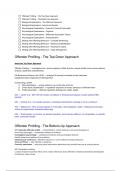
Offender Profiling - The Top Down Approach
Offender Profiling - The Bottom Up Approach
Biological Explanations - The Historical Approach
Biological Explanations - Neural and Genetic
Psychological Explanations - Eysenck’s Criminal Personality
Psychological Explanations - Cognitive
Psychological Explanations - Differential Association Theory
Psychological Explanations - Psychodynamic
Dealing with Offending Behaviour - Custodial Sentencing
Dealing with Offending Behaviour - Behavioural Modification
Dealing with Offending Behaviour - Restorative Justice
Dealing with Offending Behaviour - Anger Management
Offender Profiling - The Top-Down Approach
American Top Down Approach
Offender Profiling → Investigative tool, narrow suspects, profiler & police, compile profile (crime scene evidence
analysis, hypothesis characteristics)
FBI Behavioural Science Unit 1970s → analysed 36 sexually motivated murder interviews
Categorised data: Organised and Disorganised
Constructing a profile
1) Data Assimilation → review evidence e.g murder type and time
2) Crime Scene Classification → hypothesis sequence of events, behaviour of offender/victim
3) Profile Generation → offender hypothesis (background, habits, belief)
A03 → Canter et al - SSA 100 US murders correlations in 39 behavioural aspects, results matched FBI’s
typology
A03 → Godwin et al - not mutually exclusive, contrasting characteristics, typology is more a continuum
A03 → Meketa et al - 85% solved burglaries in 3 US states. Used categories, added - interpersonal (knowing
victim) and opportunistic (inexperienced/young)
A03 → Small sample, not random, no standard questions, each interview different, not comparable, no scientific
basis, conclusions limited
Offender Profiling - The Bottom-Up Approach
A01 Generate offender profile → characteristics, routine behaviour and social background
Avoid fixed typologies → systematic analysis of evidence
Investigative psychology → statistical procedures and psychological theories
Identify behavioural patterns from evidence
Interpersonal coherence - offenders behaviour in crime reflects everyday behaviour
Time and Place → infer offender’s residence
Forensic awareness → previous police intervention determines how mindful they are at covering tracks
A01 Geographic profiling
Location analysis examines linked crime, draws inferences about offender's residence/operational baseSpatial
consistency maps crimes
, Serial offend in familiar areas
Centre of Gravity (Canter's circle)
Marauder and commuter
Provides info about the nature of offence and considers factors like transport, employment and age.
Canter and Heritage - SSA of 66 SA cases, behavioural patterns linking cases, supporting investigative
psychology
Lundrigan and Canter - SSA of 120 US murder cases. Spatial consistency, centre of gravity, marauders support
geographical profiling.
Relies on quality of police-provided data.
- Crime recordings often inaccurate
- 75% unreported crimes; accuracy of geographical data crucial.
- Other factors important: time, age/experience (Ainsworth).
Case study → Rachel Nickel stabbed + SA, 2-year-old son witness.
- Police + Profiler accused Coli Stagg for 5 months - feigned romantic interest.
- Actual suspect taller than profiled.
- Profiling doesn't always identify correct offender.
- Vague characteristics = innocent people suspected.
- Limited usefulness → misapplied.
Biological Explanations of Offending Behaviour - The Historical
Approach
A01 Lombroso (Italian physician and psychiatrist) worked with mentally ill prison patients. Offenders similar
features to lower primate/ less developed (‘atavistic’ - primitive ancestor) - explains criminality - Darwin’s theory of
evolution. Not responsible. Genetic throwbacks
A01 Examined features of 3839 criminals and 383 dead skulls. Narrow, sloping brow - low intelligence, strong
jaw, high cheekbones, extra toes, fingers and nipples and dark skin, insensitivity to pain, slang, unemployment.
Murderers - bloodshot eyes, curly hair, long ears. Social deviants - glinting eyes, swollen, fleshy lops, projecting
ears. Fraudsters - thin, reedy lips. 40% features
A03 ‘father of modern criminology’ - coined term, criminals not morally wicked - biologically scientific instead.
Strength - evolutionary nature, no blame for actions, credible, beginning offender profiling. Contributions.
A03 Delisis- features found of african decent, racist. Eugenics are popular, social groups more genetically fit
(breeders) or unifit. Racial prejudices
A03 - No control group
- No control → confounding variables e.g poverty/poorly educated (Hay and Forrest)
Explains why offenders are more likely to be e.g unemployed
- Gender bias - 19th century views
Androcentric
Women were not studied directly, assumptions made
Assumed women less evolved than men with less intelligence → Criminal women had more masculine
characteristics
A03 Limitation - Goring compared features of 3000 offenders to 3000 non offenders, no distinct group - cant be
physically distinguished.


