
• Wrong document? Swap it for free
  • Written by students who passed
  • Immediately available after payment
  • Read online or as PDF
Sell
Where do you study
Your language
Document preview thumbnail
Preview 1 out of 3 pages
Exam (elaborations)

Test Bank For Primary Care Art And Science Of Advanced Practice

Document preview thumbnail
Preview 1 out of 3 pages

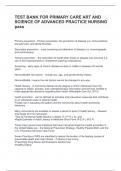
TEST BANK FOR PRIMARY CARE ART AND SCIENCE OF ADVANCED PRACTICE NURSING pass Primary prevention - Primary prevention: the prevention of disease (i.e. immunizations, prenatal care, and dental fluoride). Secondary prevention: - early screening and detection of disease (i.e. mammography and colonoscopy) Tertiary prevention: - the restoration of health after illness or disease has occurred (i.e. use of anti-hypertensives or cholesterol lowering medications). Screening - early signs of chronic disease surface in midlife or between 40 and 65 years. Nonmodifiable risk factors - include sex, age, and genetic/family history. Nonmodifiable - means the risk factors cannot be changed in any way. Health literacy - is commonly defined as the degree to which individuals have the capacity to obtain, process, and understand basic information and services needed to make appropriate decisions regarding their health (Affordable Care Act, 2010). health promotion - can be defined as activities and preventive measures that contribute to an individual's state of optimal health. Pivotal role in educating the patient and the community about health-promoting behaviors Many instruments are available to assess a person's level of health literacy - •Newest Vital Scale (N V S) instrument; •Test of Functional Health literacy in Adults (T O F H L A); and •Rapid Estimate of Adult Literacy in Medicine-Short Form (R E A L M-S F). Three major government initiatives that have had great impact on health promotion in the United States are - the National Prevention Strategy, Healthy People 2020, and the U.S. Preventive Services Task Force Seven Priorities of NPS are identified to reduce the burden of the leading causes of preventable death and major illness - •Tobacco-Free Living •Preventing Drug Abuse and Excessive Alcohol Use •Healthy Eating •Active Living •Injury and Violence-Free Living •Reproductive and Sexual Health •Mental and Emotional Well-being Immunization Practices - §Children should receive approximately 25 vaccines by age 5 years. §Should continue to receive one Tdap every 10 years. §Recommendations for adults include annual flu immunizations, as well as pneumococcal, meningococcal, Hep A, and Hep B immunizations for those with certain risk factors related to their health, job, or lifestyle. §Older adults should receive a V Z V immunization at age 60 to prevent shingles and a pneumococcal polysaccharide vaccine at age 65 to protect them from pneumonia. §Immunization schedules change rapidly; the most current information can be obtained at the C D C's website. In 1986, the National Childhood Vaccine Injury Act required that all health-care providers report any severe adverse reactions to whom? - Vaccine Adverse Event Reporting System (V A E R S) and Centers for Disease Control and Prevention (C D C). The length of time from administration to the appearance of an adverse reaction is - between 7 and 30 days and is dependent on whether the vaccine contains live virus. When in doubt, it is best to report the event. The information regarding potential reactions for each vaccine is available in the - Red Book developed by the American Academy of Pediatrics () or on the C D C Web site under the Morbidity and Mortality Weekly Reports (M M W R) ( prevalence rate - refers to the number of cases of a particular disease at a particular point in time divided by the percentage of the population at a point in time *The prevalence rate does not distinguish between new and old cases incidence rate - is the number of new cases of a disease diagnosed at a point in time (example, 1 year). Morbidity - number of people who have been diagnosed with a disease divided by the number of total population at risk

Content preview

TEST BANK FOR PRIMARY CARE ART AND
SCIENCE OF ADVANCED PRACTICE NURSING
pass


Primary prevention - Primary prevention: the prevention of disease (i.e. immunizations,
prenatal care, and dental fluoride).

Secondary prevention: - early screening and detection of disease (i.e. mammography
and colonoscopy)

Tertiary prevention: - the restoration of health after illness or disease has occurred (i.e.
use of anti-hypertensives or cholesterol lowering medications).

Screening - early signs of chronic disease surface in midlife or between 40 and 65
years.

Nonmodifiable risk factors - include sex, age, and genetic/family history.

Nonmodifiable - means the risk factors cannot be changed in any way.

Health literacy - is commonly defined as the degree to which individuals have the
capacity to obtain, process, and understand basic information and services needed to
make appropriate decisions regarding their health (Affordable Care Act, 2010).

health promotion - can be defined as activities and preventive measures that contribute
to an individual's state of optimal health.
Pivotal role in educating the patient and the community about health-promoting
behaviors

Many instruments are available to assess a person's level of health literacy - •Newest
Vital Scale (N V S) instrument;
•Test of Functional Health literacy in Adults (T O F H L A); and
•Rapid Estimate of Adult Literacy in Medicine-Short Form (R E A L M-S F).

Three major government initiatives that have had great impact on health promotion in
the United States are - the National Prevention Strategy, Healthy People 2020, and the
U.S. Preventive Services Task Force

Seven Priorities of NPS are identified to reduce the burden of the leading causes of
preventable death and major illness - •Tobacco-Free Living
•Preventing Drug Abuse and Excessive Alcohol Use
•Healthy Eating


Document information

Uploaded on
June 19, 2024
Number of pages
3
Written in
2023/2024
Type
Exam (elaborations)
Contains
Questions & answers
$14.99

Wrong document? Swap it for free Within 14 days of purchase and before downloading, you can choose a different document. You can simply spend the amount again.
Written by students who passed
Immediately available after payment
Read online or as PDF

Seller avatar
Reputation scores are based on the amount of documents a seller has sold for a fee and the reviews they have received for those documents. There are three levels: Bronze, Silver and Gold. The better the reputation, the more your can rely on the quality of the sellers work.
chareiezekiell
4.9
(997)
Sold
109
Followers
23
Items
3148
Last sold
2 weeks ago


Why students choose Stuvia

Created by fellow students, verified by reviews

Quality you can trust: written by students who passed their tests and reviewed by others who've used these notes.

Didn't get what you expected? Choose another document

No worries! You can instantly pick a different document that better fits what you're looking for.

Pay as you like, start learning right away

No subscription, no commitments. Pay the way you're used to via credit card and download your PDF document instantly.

Student with book image

“Bought, downloaded, and aced it. It really can be that simple.”

Alisha Student

Working on your references?

Create accurate citations in APA, MLA and Harvard with our free citation generator.

Working on your references?

Frequently asked questions
