

Chapter 8 Mng Practice Exam Questions And Answers Graded A+.
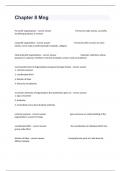
For-profit organizations - correct answer Formed to make money, or profits, by offering products or services nonprofit organization - correct answer Formed to offer services to some clients, not to make a profit (example: hospitals, colleges) Mutual-benefit organizations - correct answer Voluntary collectives whose purpose is to advance members' interests (example: unions, trade associations) Common Elements of Organizations proposed by Edgar Schein - correct answer 1. common purpose 2. coordinated effort 3. division of labor 4. hierarchy of authority 3 common elements of organizations that authorities agree on - correct answer 1. Span of Control 2. Authority 3. Centralized versus decentralized authority common purpose - correct answer gives everyone an understanding of the organization's reason for being coordinated effort - correct answer the coordination of individual effort into group-wide effort division of labor - correct answer having discrete parts of a task done by different people hierarchy of authority - correct answer making sure the right people do the right things at the right time (unity of command) span of control - correct answer the number of people reporting directly to a given manager; narrow or wide Authority - correct answer accountability, responsibility, and delegation; line versus staff positions Centralized versus decentralized authority - correct answer who makes decisions; upper management or middle organizational culture - correct answer The set of shared, taken-for-granted implicit assumptions that a group holds and that determines how it perceives, thinks about, and reacts to its various environments What drives an organizational culture? - correct answer -Founder's values -Industry and business environment -National culture -Organization's vision and strategies -Behavior of leaders organizational structure - correct answer -A formal system of task and reporting relationships that coordinates and motivates an organization's members so that they can work together to achieve the organization's goals -Concerned with who reports to whom and who specializes in what work Three Levels of Organizational Culture - correct answer Level 1: Observable Artifacts - Physical Manifestations of Culture Level 2: Espoused Values - Explicitly Stated Values & Norms Level 3: Basic Assumptions - Core Values of the Organization clan culture - correct answer -Has an internal focus -Values flexibility rather than stability -Encourages collaboration among employees Adhocracy culture - correct answer -Has an external focus -Values flexibility -Adaptable, creative, and quick to respond to changes in the marketplace Market culture - correct answer -Focused on the external environment -Values stability and control -Driven by competition and a strong desire to deliver results hierarchy culture - correct answer -Has an internal focus -Values stability and control over flexibility -Formalized, structured work environment Symbol - correct answer an object, an act, a quality, or event that conveys meaning to others Stories - correct answer narrative based on true events repeated—and sometimes embellished upon—to emphasize a particular value heroes - correct answer person whose accomplishments embody the values of the organization Rites and rituals - correct answer activities and ceremonies that celebrate important occasions and accomplishments Organizational socialization - correct answer the process by which people learn the values, norms, and required behaviors of an organization Person-organization fit - correct answer Reflects the extent to which your personality and values match the climate and culture in an organization A Dozen Ways to Change Organizational Culture - correct answer 1. Formal statements 2. Language, Slogans, sayings, and acronyms 3. Rites & rituals 4. Stories, legends, & myths 5. Managerial responses to critical incidents 6. Role modeling, training, & coaching 7. Physical design 8. Rewards, titles, promotions, & bonuses 9. Establishing goals & performance criteria 10. Measurable & controllable activities 11. By changing Organizational structure 12. Using
Document information
- Uploaded on
- June 18, 2024
- Number of pages
- 4
- Written in
- 2023/2024
- Type
- Exam (elaborations)
- Contains
- Questions & answers


