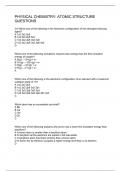
PHYSICAL CHEMISTRY: ATOMIC STRUCTURE QUESTIONS
Q1.Which one of the following is the electronic configuration of the strongest reducing agent? A 1s2 2s2 2p5 B 1s2 2s2 2p6 3s2 C 1s2 2s2 2p6 3s2 3p5 D 1s2 2s2 2p6 3s2 3p6 4s2 D Which one of the following ionisations requires less energy than the first ionisation energy of oxygen? A S(g) → S+(g) + e− B O+(g) → O2+(g) + e− C N(g) → N+(g) + e− D F(g) → F+(g) + e− A Which one of the following is the electronic configuration of an element with a maximum oxidation state of +5? A 1s2 2s2 2p5 B 1s2 2s2 2p6 3s2 3p1 C 1s2 2s2 2p6 3s2 3p3 D 1s2 2s2 2p6 3s2 3p6 3d7 4s2 C Which atom has an incomplete sub-shell? A Be B Ca C Ge D Zn C Which one of the following explains why boron has a lower first ionisation energy than beryllium? A A boron atom is smaller than a beryllium atom. B In beryllium all the electrons are paired in full sub-shells. C A beryllium atom has fewer protons than a boron atom. D In boron the 2p electron occupies a higher energy level than a 2s electron. D Which one of the following atoms has only two unpaired electrons in its ground (lowest energy) state? A helium B beryllium
Document information
- Uploaded on
- June 17, 2024
- Number of pages
- 34
- Written in
- 2023/2024
- Type
- Exam (elaborations)
- Contains
- Questions & answers