

OTP 550 FINAL EXAM All Questions And Answers
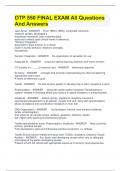
OTP 550 FINAL EXAM All Questions And Answers Jean Ayres - ANSWER From 1960's-1980's, conducted numerous research studies, developed a theoretical framework, sets of standardized tests and a widely used clinical frame of reference: "Sensory Integration" Assumption: brain function is a critical factor in human behavior related to everyday occupations Sensory Integration - ANSWER the organization of sensation for use Adequate SI - ANSWER crucial for optimal learning, behavior and motor function OT focuses on _____ to sensory input - ANSWER behavioral response SI theory - ANSWER concepts that promote understanding the child and planning appropriate intervention A frame of reference to guid Tactile - ANSWER the first sensory system to develop fully in utero (receptors in skin) Proprioception - ANSWER along with tactile system comprise "Somatosensory system" needed for knowing where your body is in space (receptors in joints/muscles) Vestibular - ANSWER detects gravity, equilibrium reactions movement, (acceleration/deceleration in all planes), muscle tone and, along with proprioception, allows for balance and coordination (receptors in inner ear) CNS Organization - ANSWER 1st developed: internal, near senses (vestibular, tactile, proprioception) 2nd: external, far senses (visual, auditory, gustatory, olfactory, tactile) 3rd: Higher level learning and behaviors (praxis) Tactile (spinothalamic tract); Proprioception; Vestibular - ANSWER Near, proximal, primary, primitive senses Fully developed in utero and influences primitive movement, i.e. reflexes Tactile (Dorsal column-medial lemniscus tract- DCML); Gustatory; Olfactory; Visual: Auditory - ANSWER Far, distal, later developing senses which rely on adequate processing of the earlier developing senses Present at birth but refined with appropriate exposure to sensory input/experiences "Little cup" - ANSWER Easily over "filled" Sensory avoiding; "fight/flight response" Hypersensitive or hyper-responsive - ANSWER Easily irritated, "fussy" Low tolerance/threshold - ANSWER Difficult to calm Big cup - ANSWER Sensory seeking or not registering input -Hyposensitive or hyporesponsive - ANSWER Sluggish; slow moving High tolerance/threshold - ANSWER Slow to warm up or slow to alert to input Problems in SI - ANSWER An "invisible" handicap Children my look typically developing Poor coordination, behavior, learning, social difficulties Identified often in children with LD and ASD Prevalence of sensory processing issues: 1 in 20 to 1 in 6.25 children in the US general population The majority (69%-93%) of children with ASD exhibit sensory processing and praxis difficulties adolescence - ANSWER 10-24 years A time of separation from primary caretakers to developing adult relationships outside of the family unit Critical period to develop patterns of physical and mental health for continued quality of life through the lifespan Characterized by neurophysiological, psychological, cognitive changes early adolescence - ANSWER 10-13 years middle adolescence - ANSWER 14-17 years late adolescence - ANSWER 17-21 years adolescent changes - ANSWER Physical Cognitive Psychological Psychosocia
Document information
- Uploaded on
- June 13, 2024
- Number of pages
- 25
- Written in
- 2023/2024
- Type
- Exam (elaborations)
- Contains
- Questions & answers


