
• Wrong document? Swap it for free
  • Written by students who passed
  • Immediately available after payment
  • Read online or as PDF
Sell
Where do you study
Your language
Document preview thumbnail
Preview 2 out of 8 pages
Exam (elaborations)

Geriatric Nursing Midterm

Document preview thumbnail
Preview 2 out of 8 pages

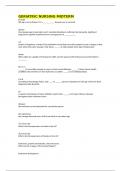
GERIATRIC NURSING MIDTERM triumph Old age is not a disease. It's a ___________, because you've survived. disease Most people age 65 and older aren't mentally disturbed or suffering from dementia. Significant progressive cognitive impairments are consequences of ___________ 1/3 Studies of happiness, morale & life satisfaction reveal that most older people are just as happy as they were when they were younger. Only about ______ of older people show signs of depression. slower Older adults are capable of learning new skills, but the speed at which they process information is ________. 80, 15, 5 _______% are healthy enough to carry on their normal lifestyles. ______% have chronic health conditions that interfere w/ their daily lives & another _____% are institutionalized. 6 to 8 According to Psychology Today, only ____ to ______ percent of people over the age of 65 have been diagnosed with dementia. 24 A report by the Bureau of Labor Statistics reports that ______% of senior citizens volunteer throughout their retirement years Lifespan the maximum survival potential for a particular species Life expectancy the average observed years of life from birth or any stated age 70.7 years old What is the life expectancy of males in the US? 78.3 years old What is the life expectancy of females in the US? Embryonic, growth and maturity, and senescence What are the 3 stages of the human lifespan? Embryonic development This stage of the human lifespan occurs from conception to birth Growth and Maturity This stage of the human lifespan occurs from birth though adulthood Senescence

Content preview

GERIATRIC NURSING MIDTERM
triumph
Old age is not a disease. It's a ___________, because you've survived.


disease
Most people age 65 and older aren't mentally disturbed or suffering from dementia. Significant
progressive cognitive impairments are consequences of ___________


1/3
Studies of happiness, morale & life satisfaction reveal that most older people are just as happy as they
were when they were younger. Only about ______ of older people show signs of depression.


slower
Older adults are capable of learning new skills, but the speed at which they process information is
________.


80, 15, 5
_______% are healthy enough to carry on their normal lifestyles. ______% have chronic health
conditions that interfere w/ their daily lives & another _____% are institutionalized.


6 to 8
According to Psychology Today, only ____ to ______ percent of people over the age of 65 have been
diagnosed with dementia.


24
A report by the Bureau of Labor Statistics reports that ______% of senior citizens volunteer
throughout their retirement years


Lifespan
the maximum survival potential for a particular species


Life expectancy
the average observed years of life from birth or any stated age


70.7 years old
What is the life expectancy of males in the US?


78.3 years old
What is the life expectancy of females in the US?


Embryonic, growth and maturity, and senescence
What are the 3 stages of the human lifespan?


Embryonic development

, This stage of the human lifespan occurs from conception to birth


Growth and Maturity
This stage of the human lifespan occurs from birth though adulthood


Senescence
This stage of the human lifespan occurs at the last stages of adulthood through death


sclerosis & fibrosis
heart valves become thicker & more rigid


calcium deposits
less elasticity of vessels - accumulation of ______________


decreased
(increased or decreased?) cardiac output - heart muscle losses efficiency & contractile strength


increases
BP ______________ to compensate for increased peripheral resistance


foreign/accumulated matter
weaker respiratory muscles decreases ability to expel ___________


elasticity
alveoli fewer in number & larger in size - loss of _________


rigid
thoracic muscles become more ____________


larger
lungs appear ____________ due to loss of elasticity


ptyalin
decrease in a salivary enzyme called _______ - interferes w/ breakdown of starches


aspiration
weaker gag reflex & esophageal emptying can lead to _________


decrease
(increase or decrease?) in HCl Acid, Pepsin, lipase & pancreatic enzymes produced indigestion


constipation
decreased colonic peristalsis leads to ___________

Document information

Uploaded on
June 13, 2024
Number of pages
8
Written in
2023/2024
Type
Exam (elaborations)
Contains
Questions & answers
$11.49

Wrong document? Swap it for free Within 14 days of purchase and before downloading, you can choose a different document. You can simply spend the amount again.
Written by students who passed
Immediately available after payment
Read online or as PDF

Seller avatar
Reputation scores are based on the amount of documents a seller has sold for a fee and the reviews they have received for those documents. There are three levels: Bronze, Silver and Gold. The better the reputation, the more your can rely on the quality of the sellers work.
ACADEMICAIDSTORE
4.1
(176)
Sold
1224
Followers
895
Items
12883
Last sold
1 month ago


Why students choose Stuvia

Created by fellow students, verified by reviews

Quality you can trust: written by students who passed their tests and reviewed by others who've used these notes.

Didn't get what you expected? Choose another document

No worries! You can instantly pick a different document that better fits what you're looking for.

Pay as you like, start learning right away

No subscription, no commitments. Pay the way you're used to via credit card and download your PDF document instantly.

Student with book image

“Bought, downloaded, and aced it. It really can be that simple.”

Alisha Student

Working on your references?

Create accurate citations in APA, MLA and Harvard with our free citation generator.

Working on your references?

Frequently asked questions

