Network Protocols Test with Complete Solutions.docx
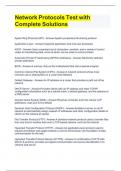
Network Protocols Test with Complete S Apple Filing Protocol (AFP) - Answer-Apple's proprietary file sharing protocol Application Layer - Answer-Supports application and end-user processes ASCII - Answer-Uses a standard set of characters, symbols, and a variety of control codes for transferring data, some of which can be used to control printers Automatic Private IP Addressing (APIPA) Addresses - Answer-Randomly selected private addresses BIOS - Answer-A memory chip on the motherboard that has a special program Common Internet File System (CIFS) - Answer-A network protocol whose most common use is sharing files on a Local Area Network Default Gateway - Answer-An IP address on a router that provides a path out of the network DHCP Server - Answer-Provides clients with an IP address and other TCP/IP configuration information such as a subnet mask, a default gateway, and the address of a DNS server Domain Name System (DNS) - Answer-Resolves computer and host names to IP addresses; uses port 53 by default Dynamic Host Configuration Protocol (DHCP) - Answer-Enables a server on an IP network to automatically assign network IP addresses and other configuration details to clients on the network at startup File Transfer Protocol (FTP) - Answer-A standard network protocol used to transfer files from one host to another host over a TCP-based network, such as the Internet Hypertext Transfer Protocol (HTTP) - Answer-An application-level protocol used to request and deliver web pages between a server and browser; the foundation of data communication for the web Hypertext Transfer Protocol Secure (HTTPS) - Answer-A combination of HTTP with SSL/TLS protocol; provides encrypted communication and secure identification of a network web server Internet Assigned Numbers Authority (IANA) - Answer-Responsible for registering IP address ranges to organizations and Internet Service Providers Internet layer - Answer-Connects hosts across independent networks and establish internetworking Internet Message Access Protocol (IMAP) - Answer-The other most prevalent Internet standard protocols for email retrieval, after POP Internet protocol (IP) - Answer-Used to route information to the proper address IPv4 Addresses - Answer-Use 32 bits and are displayed in dotted decimal format IPv6 Addresses - Answer-Use 128 bits and are displayed in hexadecimal format separated by colons Lightweight Directory Access Protocol (LDAP) - Answer-A software protocol for enabling anyone to locate organizations, individuals, and other resources such as files and devices in a network, whether on the public Internet or on a corporate Intranet Logical Link Control (LLC) Layer - Answer-Controls frame synchronization, flow control, and error checking Media Access Control (MAC) Layer - Answer-Controls how a computer on the network gains access to the data and permissions to transmit it Network Layer - Answer-Provides switching and routing technologies, including creating logical paths for transmitting data from node to node, routing and forwarding, addressing, and packet sequencing Open Systems Interconnection (OSI model) - Answer-Defines a networking framework to implement protocols in seven layers Port - Answer-An interface between the computer and other peripheral devices or another computer Post Office Protocol (POP3) - Answer-A simple, standardized application-layer protocol used for retrieving incoming email from a remote mail server over a TCP/IP connection and saving to a local device Presentation Layer - Answer-Provides independence from differences in data representation by translating from an application to a network format, and vice versa Protocols - Answer-Standard methods of transmitting and processing information RDP Protocol - Answer-Allows communication to up to 64,000 channels Secure Shell (SSH) - Answer-A cryptographic remote login protocol for secure data communication over an unsecure network Service Message Block (SMB) - Answer-Used to transfer files over a network in a Microsoft network Simple Mail Transfer Protocol, aka SMTP - Answer-A reliable and efficient mail transport and delivery protocol that is capable of transporting outgoing email across multiple networks Simple Network Management Protocol - Answer-Used to communicate with and manage network devices on IP networks Static IP - Answer-Manually set-up and assigned by your ISP and will not change unless you change over to another Internet Service Provider TCP - Answer-Provides flow-control, connection establishment, and reliable transmission of data Telecommunications Network (Telnet) - Answer-A text-based interface protocol that provides remote access to other computers Transmission Control Protocol/Internet Protocol (TCP/IP) - Answer-Two different procedures that are often linked together
Document information
- Uploaded on
- June 10, 2024
- Number of pages
- 3
- Written in
- 2023/2024
- Type
- Exam (elaborations)
- Contains
- Questions & answers