

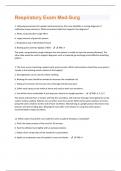
Respiratory Exam Med-Surg Questions And Answers | 2024 Latest Study Solutions
1. Following assessment of a patient with pneumonia, the nurse identifies a nursing diagnosis of ineffective airway clearance. Which assessment data best supports this diagnosis? a. Weak, nonproductive cough effort b. Large amounts of greenish sputum c. Respiratory rate of 28 breaths/minute d. Resting pulse oximetry (SpO2) of 85% - ANS: A The weak, nonproductive cough indicates that the patient is unable to clear the airway effectively. The other data would be used to support diagnoses such as impaired gas exchange and ineffective breathing pattern. 1. The clinic nurse is teaching a patient with acute sinusitis. Which interventions should the nurse plan to include in the teaching session (select all that apply)? a. Decongestants can be used to relieve swelling. b. Blowing the nose should be avoided to decrease the nosebleed risk. c. Taking a hot shower will increase sinus drainage and decrease pain. d. Saline nasal spray can be made at home and used to wash out secretions. e. You will be more comfortable if you keep your head in an upright position. - ANS: A, C, D, E The steam and heat from a shower will help thin secretions and improve drainage. Decongestants can be used to relieve swelling. Patients can use either over-the-counter (OTC) sterile saline solutions or homeprepared saline solutions to thin and remove secretions. Maintaining an upright posture decreases sinus pressure and the resulting pain. Blowing the nose after a hot shower or using the saline spray is recommended to expel secretions. 12. Which action should the nurse take first when a patient develops a nosebleed? a. Pinch the lower portion of the nose for 10 minutes. b. Pack the affected nare tightly with an epistaxis balloon. c. Obtain silver nitrate that will be needed for cauterization. d. Apply ice compresses over the patient's nose and cheeks. - ANS: AThe first nursing action for epistaxis is to apply direct pressure by pinching the nostrils. Application of cold packs may decrease blood flow to the area, but will not be sufficient to stop bleeding. Cauterization and nasal packing are medical interventions that may be needed if pressure to the nares does not stop the bleeding, but these are not the first actions to take for a nosebleed. 15. Which patient in the ear, nose, and throat (ENT) clinic should the nurse assess first? a. A 23-year-old who is complaining of a sore throat and has a muffled voice b. A 34-year-old who has a "scratchy throat" and a positive rapid strep antigen test c. A 55-year-old who is receiving radiation for throat cancer and has severe fatigue d. A 72-year-old with a history of a total laryngectomy whose stoma is red and inflamed - ANS: A The patient's clinical manifestation of a muffled voice suggests a possible peritonsillar abscess that could lead to an airway obstruction requiring rapid assessment and potential treatment. The other patients do not have diagnoses or symptoms that indicate any life-threatening problems. 16. The nurse obtains the following assessment data on an older patient who has influenza. Which information will be most important for the nurse to communicate to the health care provider? a. Fever of 100.4° F (38° C) b. Diffuse crackles in the lungs c. Sore throat and frequent cough d. Myalgia and persistent headache - ANS: B The crackles indicate that the patient may be developing pneumonia, a common complication of influenza, which would require aggressive treatment. Myalgia, headache, mild temperature elevation, and sore throat with cough are typical manifestations of influenza and are treated with supportive care measures such as over-the-counter (OTC) pain relievers and increased fluid intake. 18. The nurse is caring for a hospitalized older patient who has nasal packing in place to treat a nosebleed. Which assessment finding will require the most immediate action by the nurse? a. The oxygen saturation is 89%. b. The nose appears red and swollen. c. The patient's temperature is 100.1° F (37.8° C). d. The patient complains of level 8 (0 to 10 scale) pain. - ANS: A
Document information
- Uploaded on
- June 9, 2024
- Number of pages
- 10
- Written in
- 2023/2024
- Type
- Exam (elaborations)
- Contains
- Questions & answers


