Greek Theatre 1.1 Prescribed Sources
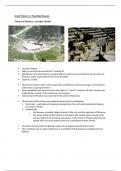
Theatre of Dionysus / Lycurgan Theatre
Location: Athens
Date: in use from second half of 6th century BC
Significance: the main theatre in ancient Athens, which was located above the sanctuary of
Dionysus at the south-eastern foot of the Acropolis.
Capacity: 17,000
First built in stone in 320’s under supervision of Athenian salesman Lycurgus, so sometimes
referred to as Lycurgan theatre.
Was remodelled over time but most noticeably in 1st and 3rd centuries AD when Greece was
under Roman control ( from circular to semi-circular ).
Central seat of theatron was reserved for the priest of Dionysus.
The location of the theatre was important practically & symbolically:
Practically – south side of acropolis protected from the cold north winds which blew in
the winter months.
Symbolically:
o Sat between acropolis (religious heart of the city) and the sanctuary of Dionysus.
o The street which led the theatre to the agora (city market place) around north
and east sides of the acropolis was known as the Street of Tripods where bronze
tripods were set up by festival victors as a monument of their victory.
Orchestra was 20 metres in diameter with seats wrapped around the front half.
Near orchestra was an altar to Dionysus as a reminder that the god was watching over his
festival.
, Theatre of Thorikos
Location: Thorikos, a deme on the south east coats of Attica.
Date: in use from the late sixth or early fifth century BC.
Significance: a regional theatre of attica which has a different layout from circular acting area
of the theatre of Dionysus.
Would have seen performances of the Rural Dionysia.
Capacity: just over 3000 – large for a deme theatre.
Orchestra = rectangular / trapezoidal.
Theatron = largely straight facing with curved seating at either end.
A temple and altar at either side of orchestra.
No trace of a per any building (skēnē) behind the acting area.
Shape presumably allowed for good acoustics.
Theatre of Dionysus / Lycurgan Theatre
Location: Athens
Date: in use from second half of 6th century BC
Significance: the main theatre in ancient Athens, which was located above the sanctuary of
Dionysus at the south-eastern foot of the Acropolis.
Capacity: 17,000
First built in stone in 320’s under supervision of Athenian salesman Lycurgus, so sometimes
referred to as Lycurgan theatre.
Was remodelled over time but most noticeably in 1st and 3rd centuries AD when Greece was
under Roman control ( from circular to semi-circular ).
Central seat of theatron was reserved for the priest of Dionysus.
The location of the theatre was important practically & symbolically:
Practically – south side of acropolis protected from the cold north winds which blew in
the winter months.
Symbolically:
o Sat between acropolis (religious heart of the city) and the sanctuary of Dionysus.
o The street which led the theatre to the agora (city market place) around north
and east sides of the acropolis was known as the Street of Tripods where bronze
tripods were set up by festival victors as a monument of their victory.
Orchestra was 20 metres in diameter with seats wrapped around the front half.
Near orchestra was an altar to Dionysus as a reminder that the god was watching over his
festival.
, Theatre of Thorikos
Location: Thorikos, a deme on the south east coats of Attica.
Date: in use from the late sixth or early fifth century BC.
Significance: a regional theatre of attica which has a different layout from circular acting area
of the theatre of Dionysus.
Would have seen performances of the Rural Dionysia.
Capacity: just over 3000 – large for a deme theatre.
Orchestra = rectangular / trapezoidal.
Theatron = largely straight facing with curved seating at either end.
A temple and altar at either side of orchestra.
No trace of a per any building (skēnē) behind the acting area.
Shape presumably allowed for good acoustics.