
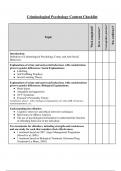
Criminological Psychology Content Checklist
Topic
Introduction:
Definition of Criminological Psychology, Crime, and Anti-Social
Behaviour.
Explanations of crime and anti-social behaviour, with consideration
given to gender differences: Social Explanations:
● Labelling
● Self-Fulfilling Prophecy
● Social Learning Theory
Explanations of crime and anti-social behaviour, with considerations
given to gender differences: Biological Explanations:
● Brain Injury
● Amygdala and aggression
● XYY Syndrome
● Eysenck’s Personality Theory
Could know about: ‘other biological explanations of crime/ASB: hormones,
neurotransmitters, etc.
Understanding the offender:
● Cognitive interview and ethical interview techniques
● Brief notes on Offence Analysis
● The use of psychological formulation to understand the function
of offending behaviour in the individual.
Two treatments for offenders, including strengths and weaknesses
and one study for each that considers their effectiveness:
● 1 treatment based on CBT: Anger Management Programme
(Howell et al, 2005).
● 1 treatment based on Biological Treatment: Hormone/Drug
Treatment (Le Blanc, 2005).
, Factors influencing Eye-witness Testimony:
● Issues of reliability: Post event information and Weapon focus.
Factors influencing Jury Decision Making:
● Characteristics of the defendant, i.e. Race, Accent, Attractiveness.
● Pre-trial Publicity
Individual Differences:
● Personality as a factor in criminal/anti-social behaviour.
● Individual differences affect whether a self-fulfilling prophecy
occurs, for example, with regard to developing criminal or
anti-social behaviour.
Developmental Psychology:
● The self-fulfilling prophecy is an explanation for
criminal/anti-social behaviour that explains development of some
individuals.
● Social learning theory is a theory of human development that can
account for criminal/anti-social behaviour.
● Other causes for criminal/anti-social behaviour, including
biological, can explain development.
Classic study: Loftus & Palmer (1974) ‘Reconstruction of
Auto-Mobile destruction: An example of the interaction between
language and memory’.
Contemporary study: Consider using Bradbury and Williams (2013)
‘Diversity and citizen participation. The effect of race on juror
decision-making’.


