

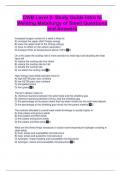
CWB Level 2 - Study Guide Intro to Welding Metallurgy of Steel | Questions and Answers Increased oxygen content of a weld is likely to: A) increase the upper shelf Charpy energy B) lower the upper shelf of the Charpy energy C) have no effect on the carbon equivalent D) produce HICC at temperatures above 150°C ✅B On a thin plate the cooling rate is more sensitive to heat input and doubling the heat input will A) reduce the cooling rate four times B) reduce the cooling rate by half C) double the cooling rate D) not affect the cooling rate ✅A High energy input welds typically result in: A) high ASTM grain size numbers B) low ASTM grain size numbers C) elongated grains D) thin grains ✅B The term dilution refers to: A) chemical reactions between the weld metal and the shielding gas B) chemical reactions between the flux and the shielding gas C) the percentage of the parent metal that has been mixed into the total weld deposit D) the percentage of the shielding gas mixed into the parent material ✅C The restraint afforded to overall weld metal shrinkage is usually higher in: A) thick plates and groove welds B) thick plates and fillet welds C) thin plates and groove welds D) thin plates and fillet welds ✅A What are the three things necessary to cause room temperature hydrogen cracking in steel welds A) heat, stress and susceptible microstructure B) heat, stress and austenitic microstructure C) hydrogen, impact loading and susceptible microstructure D) hydrogen, stress and susceptible microstructure ✅D Which of the following statement is true with respect to cooling rate: A) the cooling rate is always dependant on the plate thickness B) the cooling rate variations decrease with thick sections C) the cooling rate is always dependant on the welding process used D) the cooling rate is always dependant on the welding electrode used ✅A Basic electrode coatings release carbon dioxide into the arc atmosphere and: A) lower the amount of hydrogen gas in the arc B) increase the amount of hydrogen gas in the arc C) stabilize the amount of hydrogen in the arc D) do not do anything to the amount of hydrogen gas in the arc ✅A Welding codes usually require a waiting period between welding and inspection because: A) the weld is full of gas bubbles that may appear as porosity during testing B) the final microstructure requires several hours to transform into the end product C) The competed weld will require a rest period for stress relief of the microstructure D) hydrogen induced cracks may occur several hours after the weld has solidified ✅D What is the main reason for preheating? A) to heat up the steel so that adequate fusion can occur B) to improve arc ignition C) to reduce the hydrogen content of the weld by diffusion D) to reduce shrinkage stresses ✅C The Tekken test is suitable to study crack susceptibility in a: A) groove weld B) fillet weld C) lap weld D) corner weld ✅A Lamellar tearing is most likely to occur in which of the following? A) thick T groove welds B) T groove welds in thin materials C) large groove welds D) groove welds in thin material ✅A During welding the proportion of heat energy that enters the plate is referred to as its efficiency. What is this efficiency dependant on? A) the welding amperage B) the welding voltage C) the welding process D) the hydrogen content of the electrode ✅C
Preview 2 out of 8 pages
Exam (elaborations)
CWB Level 2- Study Guide Intro to Welding Metallurgy of Steel| Questions and Answers
Preview 2 out of 8 pages
Increased oxygen content of a weld is likely to: A) increase the upper shelf Charpy energy B) lower the upper shelf of the Charpy energy C) have no effect on the carbon equivalent D) produce HICC at temperatures above 150°CB On a thin plate the cooling rate is more sensitive to heat input and doubling the heat input will A) reduce the cooling rate four times B) reduce the cooling rate by half C) double the cooling rate D) not affect the cooling rateA High energy input welds typically result in: A) high ASTM grain size numbers B) low ASTM grain size numbers C) elongated grains D) thin grainsB The term dilution refers to: A) chemical reactions between the weld metal and the shielding gas B) chemical reactions between the flux and the shielding gas C) the percentage of the parent metal that has been mixed into the total weld deposit D) the percentage of the shielding gas mixed into the parent materialC The restraint afforded to overall weld metal shrinkage is usually higher in: A) thick plates and groove welds B) thick plates and fillet welds C) thin plates and groove welds D) thin plates and fillet weldsA What are the three things necessary to cause room temperature hydrogen cracking in steel welds A) heat, stress and susceptible microstructure B) heat, stress and austenitic microstructure C) hydrogen, impact loading and susceptible microstructure D) hydrogen, stress and susceptible microstructureD
Content preview
Document information
- Uploaded on
- June 4, 2024
- Number of pages
- 8
- Written in
- 2023/2024
- Type
- Exam (elaborations)
- Contains
- Questions & answers
$11.49
Wrong document? Swap it for free
Within 14 days of purchase and before downloading, you can choose a different document. You can simply spend the amount again.
Written by students who passed
Immediately available after payment
Read online or as PDF

Available in package deal
Package deal
CWB LEVEL I & 2 Q&A Exam Compilation Bundle

