
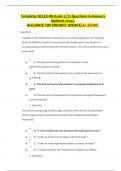
Complete; NCLEX-RN Exam 3 (75 Questions & Answers Updated 2024). ACCURATE TOP PRIORITY UPDATE| A+ SCORE.
Complete; NCLEX-RN Exam 3 (75 Questions & Answers Updated 2024). ACCURATE TOP PRIORITY UPDATE| A+ SCORE. 1. Question A patient with Parkinson’s disease has a nursing diagnosis of Impaired Physical Mobility related to neuromuscular impairment. You observe a nursing assistant performing all of these actions. For which action must you intervene? o A. The NA assists the patient to ambulate to the bathroom and back to bed. o B. The NA reminds the patient not to look at his feet when he is walking. o C. The NA performs the patient’s complete bath and oral care. o D. The NA sets up the patient’s tray and encourages the patient to feed himself. • 2. Question The nurse is preparing to discharge a patient with chronic low back pain. Which statement by the patient indicates that additional teaching is necessary? o A. “I will avoid exercise because the pain gets worse.” o B. “I will use heat or ice to help control the pain.” o C. “I will not wear high-heeled shoes at home or work.” o D. “I will purchase a firm mattress to replace my old one. • 3. Question A patient with a spinal cord injury (SCI) complains about a severe throbbing headache that suddenly started a short time ago. Assessment of the patient reveals increased blood pressure (168/94) and decreased heart rate (48/minute), diaphoresis, and flushing of the face and neck. What action should you take first? o A. Administer the ordered acetaminophen (Tylenol). o B. Check the Foley tubing for kinks or obstruction. o C. Adjust the temperature in the patient’s room. o D. Notify the physician about the change in status. • 4. Question Which patient should you, as charge nurse, assign to a new graduate RN who is orienting to the neurologic unit? o A. A 28-year-old newly admitted patient with spinal cord injury. o B. A 67-year-old patient with stroke 3 days ago and left-sided weakness. o C. An 85-year-old dementia patient to be transferred to long-term care today. o D. A 54-year-old patient with Parkinson’s who needs assistance with bathing. • 5. Question A patient with a spinal cord injury at level C3-4 is being cared for in the ED. What is the priority assessment? o A. Determine the level at which the patient has intact sensation. o B. Assess the level at which the patient has retained mobility. o C. Check blood pressure and pulse for signs of spinal shock. o D. Monitor respiratory effort and oxygen saturation level. • 6. Question You are pulled from the ED to the neurologic floor. Which action should you delegate to the nursing assistant when providing nursing care for a patient with SCI? o A. Assess the patient's respiratory status every 4 hours. o B. Take the patient’s vital signs and record them every 4 hours. o C. Monitor nutritional status including calorie counts. o D. Have the patient turn, cough, and deep breathe every 3 hours. • 7. Question You are helping the patient with an SCI to establish a bladder- retraining program. What strategies may stimulate the patient to void? Select all that apply. o A. Stroke the patient’s inner thigh. o B. Pull on the patient’s pubic hair. o C. Initiate intermittent straight catheterization. o D. Pour warm water over the perineum. o E. Tap the bladder to stimulate detrusor muscle. • 8. Question The patient with a cervical SCI has been placed in fixed skeletal traction with a halo fixation device. When caring for this patient the nurse may delegate which action (s) to the LPN/LVN? Select all that apply. o A. Check the patient’s skin for pressure from the device. o B. Assess the patient’s neurologic status for changes. o C. Observe the halo insertion sites for signs of infection. o D. Clean the halo insertion sites with hydrogen peroxide. • 9. Question You are preparing a nursing care plan for the patient with SCI including the nursing diagnosis Impaired Physical Mobility and Self-Care Deficit. The patient tells you, “I don’t know why we’re doing all this. My life’s over.” What additional nursing diagnosis takes priority based on this statement? o A. Risk for Injury related to altered mobility o B. Imbalanced Nutrition, Less Than Body Requirements o C. Impaired Adjustment to Spinal Cord Injury o D. Poor Body Image related to immobilization • 10. Question Which patient should be assigned to the traveling nurse, new to neurologic nursing care, who has been in the neurologic unit for 1 week? o A. A 34-year-old patient newly diagnosed with multiple sclerosis (MS). o B. A 68-year-old patient with chronic amyotrophic lateral sclerosis (ALS). o C. A 56-year-old patient with Guillain-Barre syndrome (GBS) in respiratory distress. o D. A 25-year-old patient admitted with CA level spinal cord injury (SCI). • 11. Question The patient with multiple sclerosis tells the nursing assistant that after physical therapy she is too tired to take a bath. What is your priority nursing diagnosis at this time? o A. Fatigue related to disease state o B. Activity Intolerance due to generalized weakness o C. Impaired Physical Mobility related to neuromuscular impairment o D. Self-care Deficit related to fatigue and neuromuscular weakness • 12. Question The LPN/LVN, under your supervision, is providing nursing care for a patient with GBS. What observation would you instruct the LPN/LVN to report immediately? o A. Complaints of numbness and tingling. o B. Facial weakness and difficulty speaking. o C. Rapid heart rate of 102 beats per minute. o D. Shallow respirations and decreased breath sounds. • 13. Question The nursing assistant reports to you, the RN, that the patient with myasthenia gravis (MG) has an elevated temperature (102.20 F), heart rate of 120/minute, rise in blood pressure (158/94), and was incontinent of urine and stool. What is your best first action at this time? o A. Administer an acetaminophen suppository o B. Notify the physician immediately o C. Recheck vital signs in 1 hour o D. Reschedule patient’s physical therapy session • 14. Question You are providing care for a patient with an acute hemorrhage stroke. The patient’s husband has been reading a lot about strokes and asks why his wife did not receive alteplase. What is your best response? o A. “Your wife was not admitted within the time frame that alteplase is usually given.” o B. “This drug is used primarily for patients who experience an acute heart attack.” o C. “Alteplase dissolves clots and may cause more bleeding into your wife’s brain.” o D. “Your wife had gallbladder surgery just 6 months ago and this prevents the use of alteplase.” • 15. Question You are supervising a senior nursing student who is caring for a patient with a right hemisphere stroke. Which action by the student nurse requires that you intervene? o A. The student instructs the patient to sit up straight, resulting in the patient’s puzzled expression. o B. The student moves the patient’s tray to the right side of her over-bed tray. o C. The student assists the patient with passive range-of- motion (ROM) exercises. o D. The student combs the left side of the patient’s hair when the patient combs only the right side. • 16. Question Which of the following arteries primarily feeds the anterior wall of the heart? o A. Circumflex artery o B. Internal mammary artery o C. Left anterior descending artery o D. Right coronary artery • 17. Question When do coronary arteries primarily receive blood flow? o A. During inspiration o B. During diastole o C. During expiration o D. During systole • 18. Question Which of the following illnesses is the leading cause of death in the US? o A. Cancer o B. Coronary artery disease o C. Liver failure o D. Renal failure • 19. Question Which of the following conditions most commonly results in CAD? o A. Atherosclerosis o B. DM o C. MI o D. Renal failure o • 20. Question Atherosclerosis impedes coronary blood flow by which of the following mechanisms? o A. Plaques obstruct the vein o B. Plaques obstruct the artery o C. Blood clots form outside the vessel wall o D. Hardened vessels dilate to allow the blood to flow through • 21. Question Which of the following risk factors for coronary artery disease cannot be corrected? o A. Cigarette smoking o B. DM o C. Heredity o D. HPN • 22. Question Exceeding which of the following serum cholesterol levels significantly increases the risk of coronary artery disease? o A. 100 mg/dl o B. 150 mg/dl o C. 175 mg/dl o D. 200 mg/dl • 23. Question Which of the following actions is the first priority care for a client exhibiting signs and symptoms of coronary artery disease?
Document information
- Uploaded on
- June 2, 2024
- Number of pages
- 28
- Written in
- 2023/2024
- Type
- Exam (elaborations)
- Contains
- Questions & answers


