
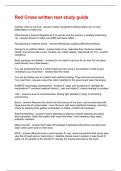
Red Cross written test study guide
Cardiac chain of survival - answer-1)early recognition/calling 2)early cpr 3) early defibrillation 4) early ems What should a second lifeguard do if he arrives and the primary is already preforming cpr - answer-Check to make sure EMS has been called Recognizing an asthma attack - answer-Wheezing coughing difficulty breathing Caring for an asthma attack - answer-Help sit up, help take their medicine (shake inhaler and remove the cover), breathe out, inhale deeply, hold breath for 10 s, monitor conditions Body piercings and jewlery - answer-Do not need to remove for an aed. Do not place pads directly over metal jewlery You are positioned above a child's head and are using a resuscitation mask to give ventilations you must then - answer-Seal the mask You are providing care to a patron who started choking. They become unconscious. You must then - answer-Lower the victim carefully to the ground and open his airway SAMPLE (secondary assessment) - answer-S: signs and symptoms A: allergies M: medications P: pertinent medical history L: last oral intake E: events leading to accident LOC - answer-Level of consciousness; feeling light headed or dizzy or becoming unconscious Burns - answer-Remove the victim from the source of the burn, cool burned area with large amounts of cooled water, cover the burn with loose sterilized dressing, minimize shock by keeping from getting overheated or chilled, comfort and reassure External bleeding - answer-Control bleeding by placing a sterile dressing and place direct pressure; clean thoroughly with soap and water; once bleeding stops apply antibiotic ointment Major wounds - answer-Don't take off bandage if saturated with blood, just add more; keep victim warm and on their back RICE - answer-(Muscle bone or joint injuries) R: rest, avoid movements that cause pain, stay flat of head neck or back injury I: stabilize injured area in position it was found C: apply ice for periods of 20 minutes E: elevate the injured area above the heart General care for sudden illness - answer-1) care for life threatening conditions first 2) monitor and watch for changes in LOC 3)keep victim comfortable 4)don't give anything to eat or drink unless fully conscious and not in shock 5) care for any other problems that develop, such as vomiting Diabetic emergencies - answer-If conscious and can safely swallow, give sugar (preferably in liquid form); call EMS if: unconscious, unable to swallow, doesn't feel better within 5 min, no sugar is found Fainting - answer-Lower onto ground and position on back; losen tight clothing; make sure they are breathing Seizure general - answer-Move away nearby objects; position person on side; call EMS if: it happens in water, more than 4 min, repeated seizures, pregnant, diabetes, doesn't regain consciousness, elderly, if it's first seizure Seizure in water - answer-Call ems; support person with head above water; remove from water asap after the seizure; position on back and preform primary assesment Stroke - answer-Call ems; (FAST) F: weakness on one side of face A: weakness or numbness in arm S: slurred speech or trouble speaking T: time to summon ems if these symptoms The victim vomits while giving ventilations you must - answer-Turn victim onto side and clear airway
Document information
- Uploaded on
- May 30, 2024
- Number of pages
- 4
- Written in
- 2023/2024
- Type
- Exam (elaborations)
- Contains
- Questions & answers


