

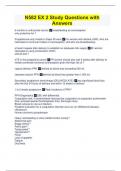
N582 EX 2 Study Questions with Answers 6 months or until period returns ✅breastfeeding as contraception only protective for ? Progesterone -only minipill or Depo -Provera ✅For women who decline LARC, who are interested in hormonal modes of contraception, and who are breastfeeding: at least 4 weeks after delivery to establish an adequate milk supply ✅BF women interested in using combination OCPs should wait ? VTE in the postpartum period ✅PP women should also wait 3 weeks after delivery to initiate combined hormonal contraception given the high risk of ? vaginal delivery PPH ✅defined as blood loss exceeding 500 mL cesarean section PPH ✅defined as blood loss greater than 1,000 mL Secondary postpartum hemorrhage (DELAYED/LATE) ✅any significant blood loss after the first 24 hours of delivery and within 12 weeks of delivery 1 to 2 weeks postpartum ✅Peak incidence of PPH? PPH Diagnostics ✅CBC with differential. Coagulation test, if disseminated intravascular coagulation is suspected: prothrombin time, activated partial thromboplastin time, fibrinogen level. Blood cultures to rule out infection. Possible evaluation for a coagulation disorder such as von Willebrand disease. Ultrasound. Human chorionic gonadotropin Heavy red bleeding or slow reddish -brown oozing** Abdominal pain Boggy uterus** Pelvic pain** Tachycardia** Hypotension** Fever Loss of appetite. Fatigue Dizziness. Weakness. Foul odor ✅PPH S/S: PPH causes ✅Vaginal laceration/hematomas Cervical lacerations Uterine atony Retained POCs Placenta accreta Uterine rupture Uterine inversion Uterine atony ✅(leading cause of PPH) - uterus is soft and boggy & large Mastitis ✅focal tenderness, erythema, and differences in temperature from one region of the breast to another engorgement or milk letdown Make sure to differentiate this from mastitis** ✅Lactating women will often have bilaterally warm, diffusely tender, and firm breasts, particularly at the time of ? dicloxacillin is the treatment of choice (Oral AB) ✅Mastitis TX? YES- prevents intraductal accumulation of infected material not breastfeeding should be encouraged to use a breast pump in the acute phase of the infection ✅Should patients be encouraged to continue breastfeeding with mastitis? PREECLAMPSIA ✅The new onset of HTN with proteinuria that develops after 20 week gestation in pregnancy or develops up to 6 months PP in a previously normotensive women ECLAMPSIA ✅Occurrence of grand mal seizures in the preeclamptic patient that cannot be attributed to other causes tonic -clonic in nature HELLP syndrome. ✅Any patient who presents with RUQ pain, epigastric pain, or nausea and vomiting in the third trimester should be seen immediately to rule out? Hemolytic anemia Elevated liver enzymes (ALT/AST) Low Platelets (Thrombocytopenia) ✅H E L P
Preview 2 out of 5 pages
Exam (elaborations)
N582 EX 2 Study Questions with Answers
Preview 2 out of 5 pages
6 months or until period returns breastfeeding as contraception only protective for ? Progesterone-only minipill or Depo-Provera For women who decline LARC, who are interested in hormonal modes of contraception, and who are breastfeeding: at least 4 weeks after delivery to establish an adequate milk supply BF women interested in using combination OCPs should wait ? VTE in the postpartum period PP women should also wait 3 weeks after delivery to initiate combined hormonal contraception given the high risk of ? vaginal delivery PPH defined as blood loss exceeding 500 mL cesarean section PPH defined as blood loss greater than 1,000 mL Secondary postpartum hemorrhage (DELAYED/LATE) any significant blood loss after the first 24 hours of delivery and within 12 weeks of delivery 1 to 2 weeks postpartum Peak incidence of PPH? PPH Diagnostics CBC with differential. Coagulation test, if disseminated intravascular coagulation is suspected: prothrombin time, activated partial thromboplastin time, fibrinogen level. Blood cultures to rule out infection. Possible evaluation for a coagulation disorder such as von Willebrand disease. Ultrasound. Human chorionic gonadotropin Heavy red bleeding or slow reddish-brown oozing** Abdominal pain Boggy uterus** Pelvic pain** Tachycardia** Hypotension** Fever Loss of appetite. Fatigue Dizziness. Weakness. Foul odor PPH S/S: PPH causes Vaginal laceration/hematomas Cervical lacerations Uterine atony Retained POCs Placenta accreta Uterine rupture Uterine inversion
Content preview
Document information
- Uploaded on
- May 29, 2024
- Number of pages
- 5
- Written in
- 2023/2024
- Type
- Exam (elaborations)
- Contains
- Questions & answers
$9.49
Wrong document? Swap it for free
Within 14 days of purchase and before downloading, you can choose a different document. You can simply spend the amount again.
Written by students who passed
Immediately available after payment
Read online or as PDF

Reputation scores are based on the amount of documents a seller has sold for a fee and the reviews they have received for those documents. There are three levels: Bronze, Silver and Gold. The better the reputation, the more your can rely on the quality of the sellers work.
Available in package deal
Package deal
N582 Q&A Exam Compilation Bundle

