

ATI Nutrition Final exam 100% Questions and Answers
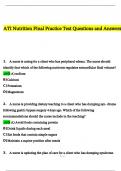
ATI Nutrition Final exam 100% Questions and Answers ATI Nutrition Final exam 100% Questions and Answers ATI Nutrition Final exam 100% Questions and Answers 1. A nurse is caring for a client who has peripheral edema. The nurse should identify that which of the following nutrients regulates extracellular fluid volume? ANS A) sodium B) Calcium C) Potassium D) Magnesium 2. A nurse is providing dietary teaching to a client who has dumping syn- drome following gastric bypass surgery 4 days ago. Which of the following recommendations should the nurse include in the teaching? ANS A) Avoid foods containing protein B) Drink liquids during each meal C) Eat foods that contain simple sugars D) Maintain a supine position after meals 3. A nurse is updating the plan of care for a client who has dumping syndrome. Which of the following instructions should the nurse include? ANS A) Consume beverages with meals B) Eat 3 large meals per day C) Include high-fiber foods in the diet D) Eat a source of protein with each meal 4. A nurse is planning care for a client who has anorexia and nausea due to cancer treatment. Which of the following interventions should the nurse include? ANS A) Serve foods at warm or hot temperatures B) Offer the client low-density foods C) Make sure the client lies supine after meals D) Limit drinking liquids with food 5. A nurse is presenting a in-service training session about nutrition. Which of the following simple sugars should the nurse identify as the carbohydrate found in milk? ANS A) Lactose B) Sucrose C) Maltose D) Fructose 6. A nurse is providing teaching to a client who has COPD about maintaing proper nutrition. Which of the following statements by the client indicates an understanding of the teaching? ANS A) "I will increase my fluid intake when I eat a meal." B) "I will eat more cold foods at meals rather than hot foods." C) "I will avoid high-fat foods like butter and gravies." D) "I will cook my meals instead of eating convenience foods." 7. A nurse is conducting dietary teaching with a client who has a history of renal calculi. Which of the following instructions should the nurse include in the teaching? ANS A) Consume foods containing vitamin C B) Drink 3.8 L (4 qt) of water throughout the day C) Suggest almonds as a snack D) Limit sodium intake to 3 g per day 8. A nurse in a provider's office is teaching a client about foods that are high in fiber. Which of the following food choices made by the client indicate an understanding of the teaching? (Select all that apply) ANS A) Canned peaches B) White rice C) Black beans D) Whole-grain bread E) Tomato juice 9. A nurse is providing nutritional counseling for a client who is pregnant. Which of the following nutrients should the nurse instruct the client to in- crease in her daily diet? ANS A) Iron B) Calcium C) Vitamin E D) Vitamin K 10. A nurse is presenting an in-service training session about nutrition. How many of the amino acids must be obtained from dietary intake? ANS A) 6 B) 9 C) 11 D) 15 11. A nurse is caring for a client during her first prenatal visit and notes that she is lactose-intolerant. Which of the following foods should the nurse include on a lost of calcium sources for this client? ANS A) Collard greens B) Cottage cheese C) Orange juice D) Broccoli 12. A nurse is reviewing the laboratory findings of a client who has pro- tein-calorie malnutrition. Which of the following findings should the nurse expect? ANS A) Decreased albumin B) Elevated hemoglobin C) Elevated lymphocytes D) Decreased cortisol 13. A nurse is caring for a client who has diverticulitis and a new prescription for a low-fiber diet. Which of the following food items should the nurse remove from the client's meal tray ANS A) Canned fruit B) White bread C) Broiled hamburger D) Coleslaw 14. A nurse is teaching a client with heart disease about a low-cholesterol diet. Which of the following client statements indicated the teaching was effective? ANS A) "I should remove the skin from poultry before eating it." B) "I will eat seafood once per week." C) "I should use margarine when preparing meals." D) "I can use whole milk in my oatmeal." 15. A nurse is caring for a client who is receiving radiation therapy for breast cancer and reports a metallic taste in the mouth. Which of the following dietary recommendations should the nurse share with the client? ANS A) Eat with metal utensils B) Limit coffee C) Avoid citrus foods D) Offer mints 16. A nurse is caring for a client who has xerostomia with a lack of saliva. Which of the following nutrients will be affected by the lack of salivary amy- lase? ANS A) Fat B) Protein C) Starch D) Fiber 17. A nurse is providing nutritional teaching to a group of clients. Which of the following definitions for the recommended dietary allowance (RDA) should the nurse include in the teaching? ANS A) The RDA is a comprehensive term that includes various dietary standards and scales. B) The RDA defines the level of nutrient intake that meets the needs of healthy people in various groups. C) The RDA defines the level of nutrients that should not be exceeded to prevent adverse health effects. D) The RDA is the daily percentage of energy intake values for fat, carbohydrate, and protein. 18. A nurse is reviewing the laboratory results of a client who has end-stage renal disease and reports fatigue. The client's hemoglobin level is 8g/dL. The nurse should expect a prescription for which of the following medications? ANS A) Erythropoietin B) Erythromycin C) Filgrastim D) Calcitriol 19. A nurse is planning care for a client who is recieving chemotherapy and has protein deficiency. Which of the following interventions should the nurse include in the plan of care? (Select all that apply) ANS A) Mix powdered skim milk into liquid milk B) Add a raw egg to fruit smoothie C) Add a slice of cheese to hot vegetables D) Add honey to hot tea E) Mix yogurt into fresh fruit 20. A nurse is caring for a client who has a deficiency of vitamin D. Which of the following foods should the nurse recommend the client include in his diet? ANS A) Whole milk B) Chicken C) Oranges Dried peas
Document information
- Uploaded on
- May 29, 2024
- Number of pages
- 30
- Written in
- 2023/2024
- Type
- Exam (elaborations)
- Contains
- Questions & answers


