

ATI Fundamentals Final Exam Verified Questions and Answers
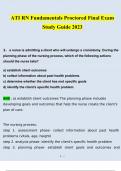
ATI Fundamentals Final Exam Verified Questions and Answers ATI Fundamentals Final Exam Verified Questions and Answers ATI Fundamentals Final Exam Verified Questions and Answers 1. a nurse is admitting a client who will undergo a craniotomy. During the planning phase of the nursing process, which of the following actions should the nurse take? a) establish client outcomes b) collect information about past health problems c) determine whether the client has met specific goals d) identify the client's specific health problem ANS : a) establish client outcomes The planning phase includes developing goals and outcomes that help the nurse create the client's plan of care. The nursing process: step 1. assessment phase- collect information about past health problems (vitals, age, height) step 2. analysis phase- identify the client's specific health problem step 3. planning phase- establish client goals and outcomes and selects interven- tions that will help to achieve them. Also involves setting care priorities. step 4. implementation- provides client care and uses interpersonal/technical skills when implementing nursing interventions step 5. evaluation phase- use critical thinking skills to determine whether the client has met a specific goal. examines results, compares the data, identifies errors, and considers pt's situation 2. a client who reports shortness of breath requests the nurse's help in chang- ing positions. After repositioning the client, which of the following actions should the nurse take next? a) encourage the client to take deep breaths b) observe the client's rate, depth, and character of respirations c) prepare to administer oxygen d) give the client a backrub to promote relaxation ANS: b) observe the client's rate, depth, and character of respirations 3. a nurse is collecting health history data from a client who is deaf and uses American sign language(ASL) to communicate. The nurse will be working with an ASL interpreter. Which of the following actions should the nurse take when working with the interpreter? a) face away from the client to avoid distractions b) pace speech to allow time for the interpreter to convey the words c) make eye contact with the interpreter when explaining the procedure d) stand in the background while the interpreter translates the message ANS: b) pace speech to allow time for the interpreter to convey the words 4. a nurse manager is providing teaching to a group of newly licensed nurses about the ways that clients acquire healthcare-associated-infections (HAI's). Which of the following routes of infection should the manager identify as an iatrogenic HAI? a) infection required from improper hand hygiene b) infection acquired by drug resistance c) infection acquired by inappropriate waste disposal d) infection acquired from diagnostic procedure ANS: d) infection acquired from diagnostic procedure Iatrogenic HAIs directly result from diagnostic or therapeutic procedures 5. a nurse is caring for a client who has Clostridium difficile infection and is in contact isolation. Which of the following actions should the nurse take? a) wear gloves when changing the clients gown b) use alcohol-based sanitizers to cleanse the hands c) wear a mask when assisting the client with his meal tray d) place the client on a complete bed rest ANS: a) wear gloves when changing the clients gown -alcohol-based sanitizers are ineffective against the spores of C.difficile -nurse should wear a mask when working within 3 ft of a patient with droplet precautions -the nurse should not place the client on complete bed rest because this places him at risk for the hazards of immobility, such as impaired skin integrity and retained respiratory secretions. The nurse should instruct the patient to stay in his room but to move, cough, and deep breathe at least every 2 hours 6. a nurse is reviewing the use of side rails with an A.P. Which of the following statements by the A.P indicates that further teaching is required? a) "I should not leave all 4 side rails up unless there is a prescription for restraints" b) "an alert client will be the safest if I raise the 2 upper side rails at the head of the bed" c) "if the client seems confused, I'll raise all 4 side rails so that he doesn't hurt himself" d) "if a client is sedated, I should raise all 4 side rails to prevent a fall out of bed" ANS: c) "if the client seems confused, I'll raise all 4 side rails so that he doesn't hurt himself" 7. which diseases have airborne precautions?: Varicella, TB, and measles 8. which diseases have contact precautions?: C.diff, MRSA, scabies, van- comycin resistant enterococci 9. which diseases have droplet precautions?: rubella, influenza, meningoccal, pneumonia, streptococcal pharyngitis 10. A nurse in a provider's office is measuring a client & notes a loss in height from the previous year. The nurse should identify this finding as a manifestation of which of the following musculoskeletal system disorders? a) osteoporosis b) scoliosis c) kyphosis d) lordosis: a) osteoporosis A loss of height is often an early indication of osteoporosis with occurs due to a loss of calcium in the vertebrae which can cause them to fracture and collapse. - scoliosis does not precipitate a decrease in the height of the client. It is an abnormal lateral curve of the sign - kyphosis does not precipitate a decrease in the height of a client. It is an exagger- ated posterior curvature of the thoracic spine hunchback - lordosis does not precipitate a decrease in the height of a client. It is an exaggerated lumbar curvature way back 11. Not on ATI: The nurse is planning care for a pt with severe burns. Which of the following is this pt at risk for developing? 1. intracellular fluid deficit 2. intracellular fluid overload 3. extracellular fluid deficit 4. interstitial fluid deficit: 1. intracellular fluid deficit Because this pt was severely burned, the fluid within the cells is diminished, leading to an intracellular fluid deficit. 12. Not on ATI: The nurse is to obtain a stool specimen from a client who reported that he is taking iron supplements. The nurse would expect the stool to be which color? a) Black b) Red c) Dark brown d) Green: Black 13. A nurse is obtaining a health history from the newly admitted client who has chronic pain in the knee. What should the nurse include in the pain assessment? Select all that apply. 1) Pain history, including location, intensity, and quality of pain 2) Client's purposeful body movement in arranging the papers on the bedside table 3) Pain pattern, including precipitating and alleviating factors 4) Vital signs such as increased blood pressure and heart rate 5) The client's family statement about increases in pain with ambulation: 1) Pain history, including location, intensity, and quality of pain 3) Pain pattern, including precipitating and alleviating factors 14. A nurse is obtaining a clients blood pressure in a client's lower extremity. Which of the following actions should the nurse take? a) auscultate the BP at the dorsalis pedis artery b) measure the clients BP with the client sitting at the side of the bed c) place the cuff 7.6cm (3in) above the popliteal artery d) place the bladder of the cuff over the posterior aspect of the thigh: d) place the bladder of the cuff over the posterior aspect of the thigh This is the correct position for the bladder of the class when the nurse is measuring a lower extremity blood pressure - a nurse should auscultate the blood pressure at the popliteal artery - the nurse should measure the blood pressure with the client prone is possible otherwise the client should lie supine with knee flexed - the nurse should position the cuff 2.5cm (1 in) above the popliteal artery 15. NOT ATI The nurse is performing nasotracheal suctioning. After suctioning the client's trachea for fifteen seconds, large amounts of thick yellow secretions return. What action should the nurse implement next? A. Encourage the client to cough to help loosen secretions. B. Advise the client to increase the intake of oral fluids. C. Rotate the suction catheter to obtain any remaining secretions. D. Re-oxygenate the client before attempting to suction again.: D) Re-oxy- genate the client before attempting to suction again. 16. a nurse is performing an admission assessment for a client who has asthma and several food allergies. Which of the following actions should the nurse take first? a) document the clients food allergies b) ask the client to identify the specific food allergies c) monitor the client for signs of anaphylaxis d) have epinephrine available for administration: b) ask the client to identify the specific food allergies The nurse should apply the nursing process priority-setting framework in order to plan client care and prioritize nursing actions. Each step the nursing process builds on the previous steps beginning with an assessment or data collection, before the nurse can formulate a plan of action implement a nursing intervention or notify the provider of a change in the client status. the nurse must first collect adequate data from the client assessing or collecting additional data will provide the nurse with the knowledge to make an appropriate decision. Therefore the nurse should first assess the client's allergies and identify specific allergens to ensure the specific foods are not ordered to the client during meals 17. NOT ON ATI The nurse is assessing the nutritional status of several clients. Which client has the greatest nutritional need for additional intake of protein? A. A college-age track runner with a sprained ankle. B. A lactating woman nursing her 3-day-old infant. C. A school-aged child with Type 2 diabetes. D. An elderly man being treated for a peptic ulcer.: B) A lactating woman nursing her 3-day-old infantA lactating woman (B) has the greatest need for additional protein intake. (A, C, and D) are all conditions that require protein, but do not have the increased metabolic protein demands of lactation 18. A nurse is assessing a client's thyroid gland. Which of the following in- structions should the nurse give to the client before inspecting and palpating this gland? a) "tilt your head slightly forward" b) "keep your head straight and look ahead of you" c) "tilt your head back and swallow" d) "turn your head to the side against my hand": c) "tilt your head back and swallow" to examine the thyroid gland the nurse should instruct the client to extend her head backward into swallow the nurse should be able to feel the thyroid gland is ascend as the client swallows in observe any enlargement of the gland - to palpate the supraclavicular lymph nodes, the nurse should instruct the client to tilt her head forward and relax their shoulders - to palpate the trachea for any deviation to the side, the nurse should instruct the client to keep her head in an erect neutral position - to evaluate the strength of the neck muscles the nurse should place a hand on the side of the clients head and ask her to turn her head against the resistance of the hand then there should then repeat this step on the other side of the client said (ROM) 19. A nurse is talking with a client whose provider recently informed him of terminal pancreatic cancer. When the client reports that he understands the full impact of this diagnosis, the nurse identifies that the client is in which of the following stages of dying? a) anger b) bargaining c) depression d) acceptance: c) depression during this stage of depression, the client has realized the full impact of the loss in might express hopelessness and despair - anger: during the stage of anger the client shows resistance or blames other people, a higher power, or the situation - bargaining: stalls awareness of the loss by trying to keep it from occurring - acceptance: integrate the loss (ex. by making final arrangements) 20. A nurse is planning care for a young adult client has a terminal illness. Which of the following concepts for death should nurse considered for this client? a) death is unacceptable under any circumstances b) magical thinking helps avoid thoughts of death c) death is viewed as an interruption of what might have been d) that is a natural consequence of the age appearance trading body: c) death is viewed as an interruption of what might have been young adults tend to see a whole life ahead of them so that is often seen as an interesting that lies young adults do not typically welcome death at this time - a) adolescents tend to reject the end of life especially their own - b) preschoolers tend to avoid thoughts of death by employing magical thinking d) accepting the deterioration of the body is more likely among older adults, some of them might consider that relief from a chronic or terminal illness
Document information
- Uploaded on
- May 29, 2024
- Number of pages
- 66
- Written in
- 2023/2024
- Type
- Exam (elaborations)
- Contains
- Questions & answers


