

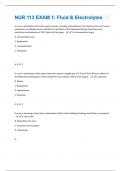
NUR 113 EXAM 1: Fluid & Electrolytes Questions With Correct Answers.
A nurse is admitting a client who reports nausea, vomiting, and weakness. The client has dry oral mucous membranes and blood pressure 102/64 mm Hg. Which of the following findings should the nurse identify as manifestations of FVD? Select all that apply. - A. Decreased skin turgor B. Concentrated urine C. Bradycardia D. Low-grade fever E. Tachypnea A, B, D, E A nurse is admitting an older adult client who reports a weight gain of 2.3 kg (5 lb) in 48 hours. Which of the following manifestations of FVE should the nurse expect? Select all that apply. - A. Dyspnea B. Edema C. Bradycardia D. Hypertension E. Weakness A, B, D, E A nurse is assessing a client who is dehydrated. Which of the following findings should the nurse expect? - A. Moist skin B. Distended neck veins C. Increased urinary output D. Tachycardia D.A nurse is caring for a client in a long-term care facility who has become weak, confused, and experienced dizziness when standing. The client's temperature is 38.3 c (100.9 f), pulse 92/min, respirations 20/min, and blood pressure 108/60 mm/Hg. Which of the following actions should the nurse take? - A. Initiate fluid restrictions to limit intake B. Check for peripheral edema C. Encourage the client to ambulate to promote oxygenation. D. Monitor for orthostatic hypotension D. A nurse is caring for a client who has a blood sodium level 133 mEq/L and blood potassium level 3.4 mEq/L. The nurse should recognize that which of the following treatments can result in these laboratory findings? - A. Three tap water enemas B. 0.9% sodium chloride solution IV at 50 mL/hr C. 5% Dextrose with 0.45% sodium chloride solution with 20 mEq of K+ IV at 80 Ml/hr D. Antibiotic therapy A. A nurse is caring for a client who has a blood potassium 5.4 mEq/L. The nurse should assess for which of the following manifestations? - A. ECG changes B. Constipation C. Polyuria D. Parasthesia A. A nurse is caring for a client who has a nasogastric tube attached to low intermittent suctioning. The nurse should monitor for which of the following electrolyte imbalances? - A. Hypercalcemia B. Hyponatremia C. HyperphosphatemiaD. Hyperkalemia B. A nurse is assessing a client who has hyperkalemia. The nurse should identify which of the following conditions as being associated with this electrolyte imbalances? - A. Diabetic ketoacidosis B. Heart failure C. Cushing's syndrome D. Thyroidectomy A. A nurse is assessing a client for Chvostek's sign. Which of the following techniques should the nurse use to perform this test? - A. Apply a blood pressure cuff to the clients arm B. Place the stethoscope bell over the client's carotid artery C. Tap lightly on the client's cheek D. Ask the client to lower their chin to their chest C. On morning assessment of your patient in room 2502 who has severe burns. You notice that fluid is starting to accumulate in his abdominal tissue. You note that his weight has not changed and his intake and output is equal. What do you suspect? - A. Third spacing B. This is normal and expected after a burn and it is benign C. Document this finding as non-pitting abdominal edema. D. Intravascular compartment syndromeA. Which patient is more at risk for an electrolyte imbalance? - A. An 8 month old with a fever of 102.3 'F and diarrhea B. A 55 year old diabetic with nausea and vomiting C. A 5 year old with RSV D. A healthy 87 year old with intermittent episodes of gout A. A patient is admitted to the ER with the following findings: heart rate of 110 (thready upon palpation), 80/62 blood pressure, 25 ml/hr urinary output, and Sodium level of 160. What interventions do you expect the medical doctor to order for this patient? - A. Restrict fluid intake and monitor daily weights B. Administer hypertonic solution of 5% Dextrose 0.45% Sodium Chloride and monitor urinary output C. Administer hypotonic IV fluid and administer sodium tablets. D. No interventions are expected B. After obtaining an EKG on a patient you notice that ST depression is present along with an inverted T wave and prominent U wave. What lab value would be the cause of this finding? - A. Magnesium level of 2.2 B. Potassium level of 5.6 C. Potassium level of 2.2 D. Phosphorus leve
Document information
- Uploaded on
- May 28, 2024
- Number of pages
- 14
- Written in
- 2023/2024
- Type
- Exam (elaborations)
- Contains
- Questions & answers


