
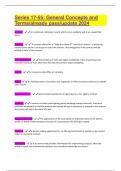
Series 17-55: General Concepts and Terms/already pass/update 2024
Accident - An unplanned, unforeseen event which occurs suddenly and at an unspecified place. Adhesion - "A contract offered on a ""take-it-or-leave-it"" basis by an insurer, in which the insured's only option is to accept or reject the contract. Any ambiguities in the contract will be settled in favor of the insured." Adverse Selection - The tendency of risks with higher probability of loss to purchase and maintain insurance more often than the risks who present lower probability. Agency - An insurance sales office or company. Agent - An individual who is licensed to sell, negotiate, or effect insurance contracts on behalf of an insurer. Agent's Authority - Special powers granted to an agent by his or her agency contract. Aleatory - A contract in which participating parties exchange unequal amounts. Insurance contracts are aleatory in that the amount the insured will pay in premiums is unequal to the amount the insurer will pay in the event of a loss. Apparent Authority - The appearance or the assumption of authority based on the actions, words, or deeds of the principal or because of circumstances the principal created. Applicant - A person making application for, or offering him/herself or another to be insured under an insurance contract. Application - A document that provides information for underwriting purposes. After the policy is issued, any unanswered questions are considered waived by the insurer. Avoidance - A method of dealing with risk by deliberately keeping away from it (e.g. if a person wanted to avoid the risk of being killed in an airplane crash, he/she might choose never to fly in a plane). Certificate of Authority - A document that authorizes a company to start conducting business and specifies the kind(s) of insurance a company can transact. It is illegal for an insurance company to transact insurance without this certificate. Conditional Contract - A type of an agreement in which both parties must perform certain duties and follow rules of conduct to make the contract enforceable. Consideration - The binding force in a contract that requires something of value to be exchanged for the transfer of risk. The consideration on the part of the insured is the representations made in the application and the payment of premium; the consideration on the part of the insurer is the promise to pay in the event of loss. Contract - An agreement between two or more parties enforceable by law. Estoppel - A legal impediment to denying a fact or restoring a right that has been previously waived. Express Authority - The authority granted to an agent by means of the agent's written contract. Fraternal Benefit Societies - Life or health insurance companies formed to provide insurance for members of an affiliated lodge, religious organization, or fraternal organization with a representative form of governmen
Document information
- Uploaded on
- May 27, 2024
- Number of pages
- 13
- Written in
- 2023/2024
- Type
- Exam (elaborations)
- Contains
- Questions & answers


