
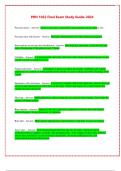
PRN 1032 Final Exam Study Guide -2024 Pressure ulcers - Answer - Often occurs due to immobility and shearing can also play a role Pressure ulcer risk factors - Answer - Moisture, Malnutrition and Alter sensory perception Interventions to prevent skin breakdown - Answer - Skin kept dry and clean, Avoid friction and shear, Positioning of the patient every 2 hours Cellulitis - Answer - Is a skin disorder caused by infection of the dermis and subcutaneous tissue, usually caused by Staphylococcus. Fungal infections - Answer - Candidiasis is known to affect the mouth, esophagus and vagina, appearance is a yellow or white patches in the mouth. It causes itching and white discharge from vagina Squamous cell carcinoma - Answer - Is caused by sunlight, affects the epidermis, and can become invasive and metastasize to other areas of the body. Tumor that begins as a small nodule that rapidly becomes ulcerated. Sheering - Answer - Rubbing/friction, skin moving one way and the bone staying . Don't slide the patient, lift them instead Burn injuries - Answer - injuries to the skin caused by exposure to extreme heat, hot liquids, electrical agents, strong chemicals, or radiation Burn diet - Answer - High calorie, high protein, and vitamins C an d Zinc to assist in healing Acne types - Answer - Acne rosacea begins between age 30 - 50 years; characterized by erythema(redness), papules, pustules, and telangiectasias. Acne vulgaris begins early puberty; factors that contribute to it are hereditary dis position, increased androgen levels, and premenstrual hormonal fluctuations Acne diet - Answer - Important to eat healthy -well balanced diet. May be caused by fatty/greasy foods Types of inmmunity - Answer - Active artificially acquired immunity occurs via immunization. E.g: Flu vaccinations Passive natural immunity occurs transmission of mother to baby. E.g: Mother to baby, Utero, Breast milk First line of defense - Answer - is intact skin against harmful environmental agents. Skin functions as a protecti ve barrier for the underlying tissues, helping maintain integrity. Sebaceous glands excrete sweat, lactic acid, and fatty acids to limit microbial growth Second line of defense - Answer - is fever (slows the growth of pathogens), leukocytosis, phagocytosis, inflammation, and the action of interferon (biologic response modifier that affects cellular growth). Third line of defense - Answer - the immune respons e of (WBCs) against pathogenic organisms. Microorganisms and other substances that do not belong in the body, such as pollen, are recognized as foreign invaders and trigger an immune response (the body's reaction to substances interpreted as nonself). Passive natural inmmunity - Answer - Transmission of mother to baby Hand washing - Answer - Perform before/after handling a patient. Switch gloves/wash hands in between tasks/before leaving patients room. At least 15 -30 seconds Intervention to prevent respira tory complications - Answer - Reposition every 2 hours Turn, cough and breathe deeply every 1 -2 hours Yawn every hour Use incentives spirometer Auscultate lungs
Preview 2 out of 6 pages
Exam (elaborations)
PRN 1032 Final Exam Study Guide-2024
Preview 2 out of 6 pages
Pressure ulcers - Answer- Often occurs due to immobility and shearing can also play a role Pressure ulcer risk factors - Answer- Moisture, Malnutrition and Alter sensory perception Interventions to prevent skin breakdown - Answer- Skin kept dry and clean, Avoid friction and shear, Positioning of the patient every 2 hours Cellulitis - Answer- Is a skin disorder caused by infection of the dermis and subcutaneous tissue, usually caused by Staphylococcus.
Content preview
Document information
- Uploaded on
- May 25, 2024
- Number of pages
- 6
- Written in
- 2023/2024
- Type
- Exam (elaborations)
- Contains
- Questions & answers
$15.69
Wrong document? Swap it for free
Within 14 days of purchase and before downloading, you can choose a different document. You can simply spend the amount again.
Written by students who passed
Immediately available after payment
Read online or as PDF

Reputation scores are based on the amount of documents a seller has sold for a fee and the reviews they have received for those documents. There are three levels: Bronze, Silver and Gold. The better the reputation, the more your can rely on the quality of the sellers work.

